.gif)


Most HR teams are comfortable completing Form I-9 on an employee’s first day. But Form I-9 is more than a one-time onboarding form; it is a living, compliance-sensitive record that can span years of employment, breaks in service, changing visa categories, and renewed work authorization. Federal law requires employers to complete and retain Form I-9 to verify each hire’s identity and work authorization, and that obligation does not stop after day one.
The real complexity begins when employees return, or their work authorization nears expiry. Rehires, seasonal staff, temp-to-perm hires, and employees on time-limited status all create moments where HR must decide whether an i 9 rehire can be handled on the existing record, whether i 9 reverification is required, or whether a brand-new I-9 is the safest choice. Getting these decisions wrong, or missing the reverification of i9 documents altogether, can surface during an ICE audit, lead to penalties, or create disruption when employees are pulled off the schedule.
This article breaks down the essentials: how the current Form I-9 is structured, what i-9 supplement b (Reverification and Rehire) does, when to use it for i 9 rehire events and reverification, and what steps HR should take to stay audit-ready without overburdening the team.
Form I-9 Sections and Supplements: A Quick Guide
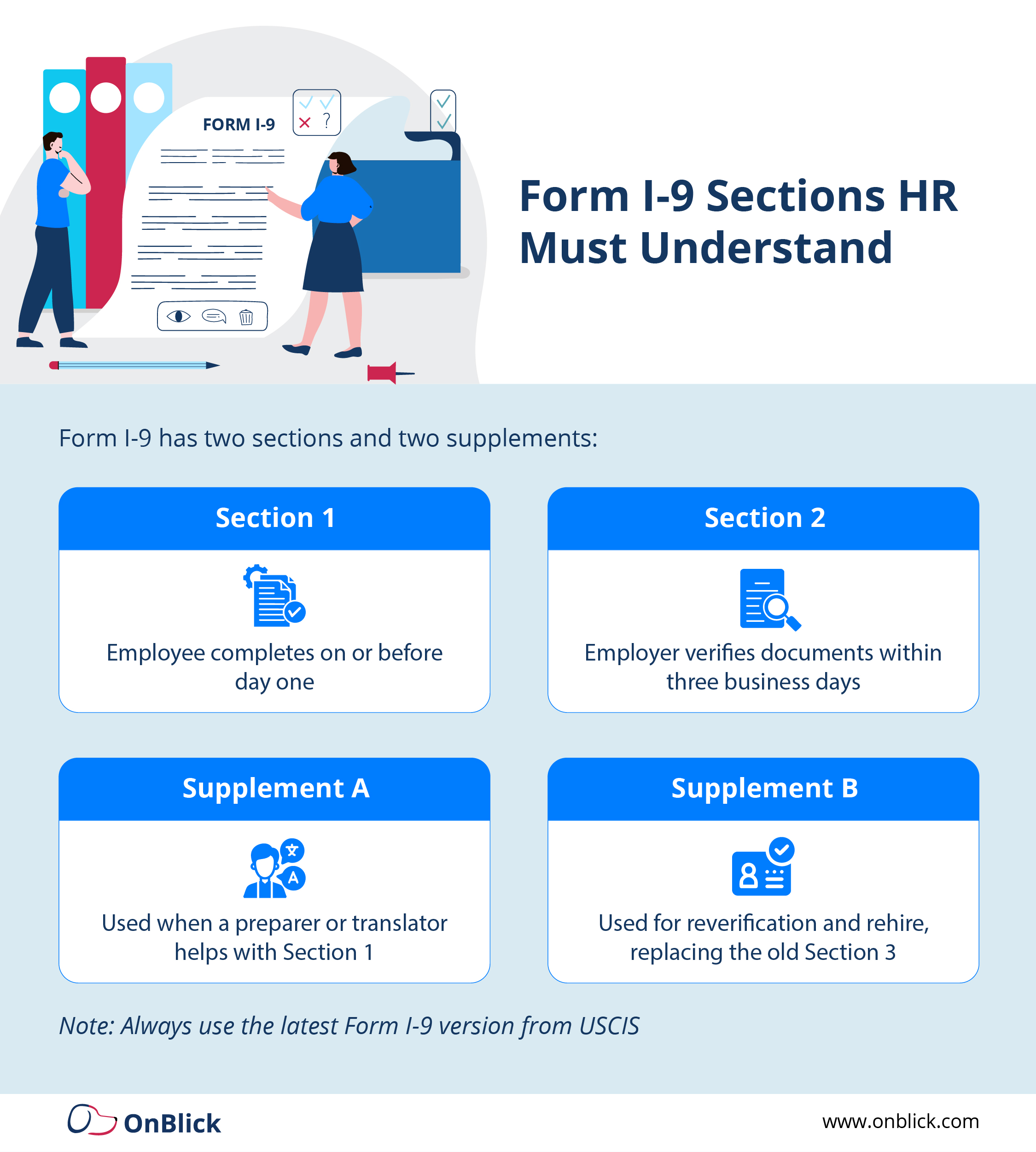
Before we dive into rehire and reverification, it helps to ground everything in how the current Form I-9 is structured. USCIS now describes the form as having two main sections and two supplements: Section 1 (employee), Section 2 (employer), Supplement A (Preparer/Translator), and Supplement B (Reverification and Rehire, formerly Section 3).
- Section 1 – Employee Information and Attestation
Completed by the employee on or before their first day of work, this captures personal details and the employee’s attestation of their immigration status and work authorization. - Section 2 – Employer Review and Verification
Completed by the employer within three business days of the employee’s start date, this is where HR examines original documents from the Lists of Acceptable Documents and records them to verify identity and work authorization. - Supplement A – Preparer and/or Translator Certification
Used only if someone helps the employee complete Section 1. Each preparer or translator must be recorded here. - Supplement B – Reverification and Rehire (formerly Section 3)
This is the piece HR relies on for rehire and reverification. Employers complete i-9 supplement b on the current version of Form I-9 to record rehires within the allowed timeframe and to reverify continued employment authorization when required, then attach it to the original I-9. Many practitioners still refer to this as “i 9 section 3,” and you may also see it called i9 supplement b in internal guidance and tracking systems.
For HR, the key takeaway is that rehire and reverification are not separate forms or side processes; they live inside i-9 supplement b of the latest I-9.
Form I-9 Rehire vs. Reverification: Key Differences for HR
When managing Form I-9 rehire and reverification, the first thing HR needs is a clear mental split between the two.
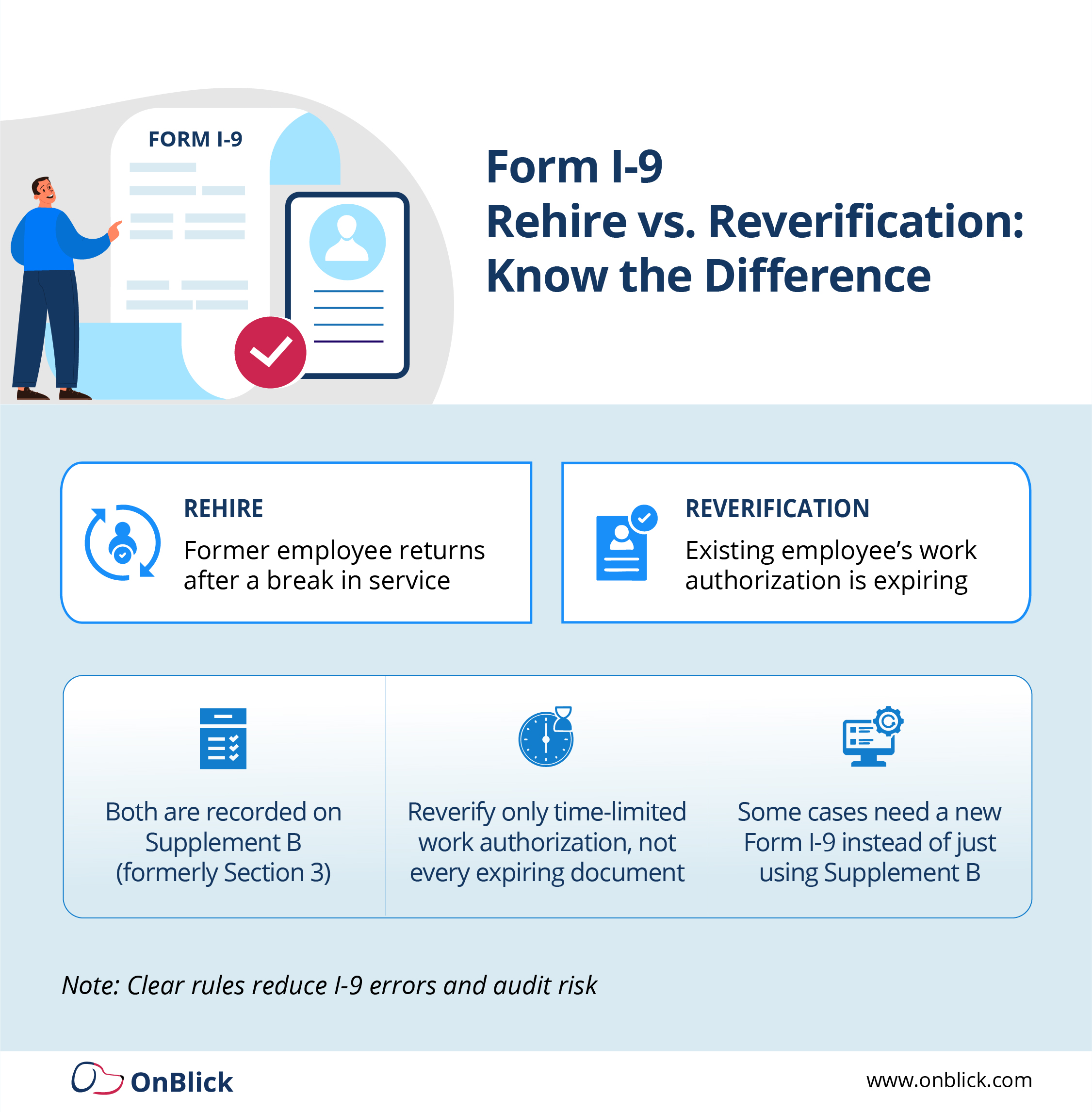
- A rehire happens when a former employee comes back after a break in service.
- A reverification happens when an existing employee’s employment authorization is about to expire and you must confirm that they are still authorized to work.
Both actions are documented on i-9 supplement b (Reverification and Rehire, formerly Section 3) of the current Form I-9, but the triggers and rules are different. For an i 9 rehire, HR generally has two choices: either record the rehire on Supplement B (if the employee is rehired within the allowed timeline and the original I-9 is still valid), or complete a new Form I-9. For i 9 reverification, the focus is on employees with time-limited work authorization (for example, certain nonimmigrant categories or EAD holders), and on following current dhs ead reverification guidance.
You only reverify when employment authorization is expiring; you do not reverify U.S. citizens or permanent residents simply because an identity-only document expires. From a compliance standpoint, this distinction is critical. Treating every return as a rehire without checking the underlying I-9, or reverifying people you should not be reverifying, can both create issues during an audit. The goal is to apply a consistent, documented decision path:
“Is this a rehire event, a reverification event, both, or neither, and does it belong on i-9 supplement b or a new I-9?”
Why Form I-9 Rehire and Reverification Decisions Matter for HR
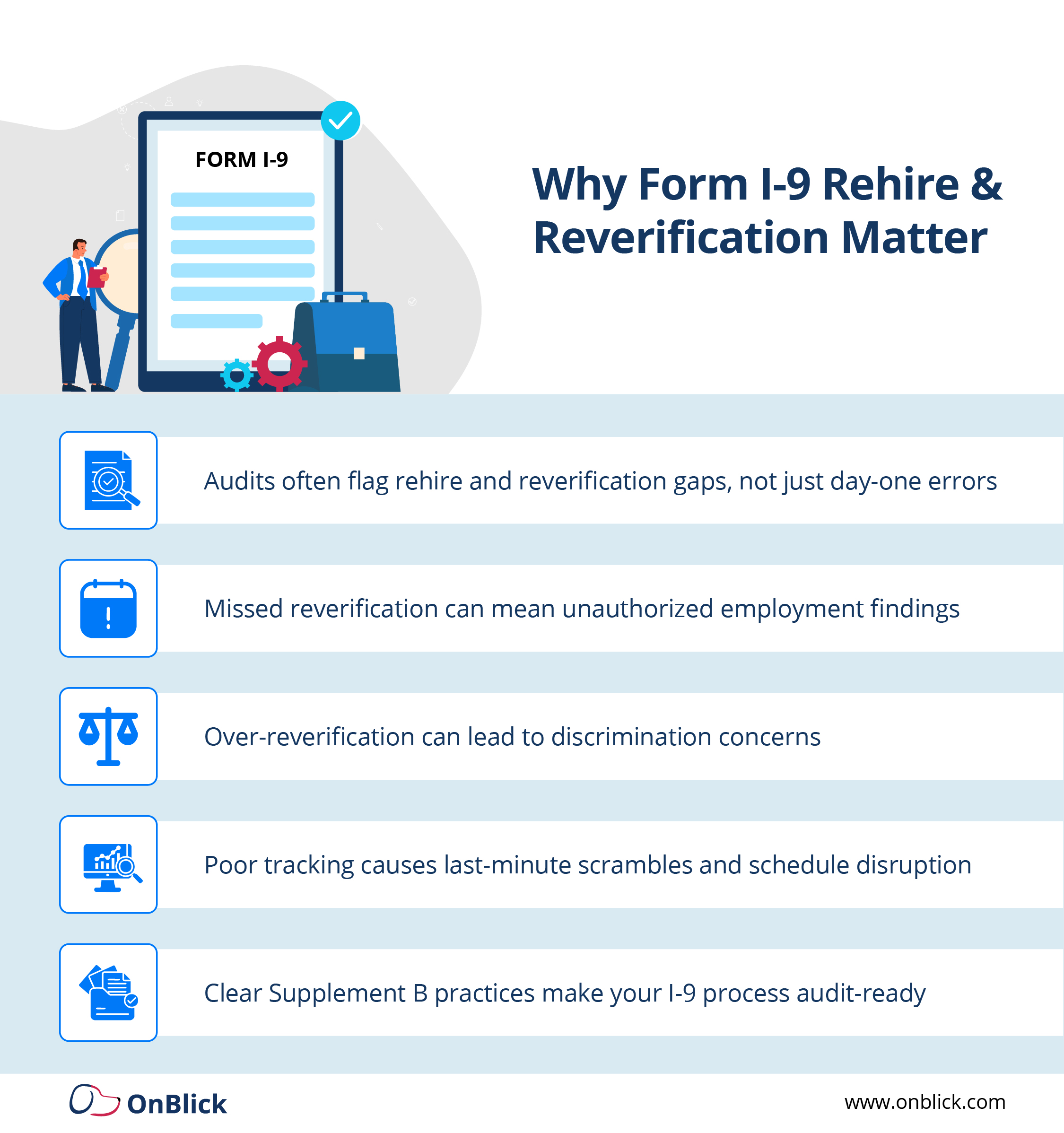
Form I-9 errors do not just come from missing signatures or wrong document codes. A large share of issues uncovered in audits relate to how organizations handle i 9 rehire events and i 9 reverification, especially when employees return after long breaks or when work authorization quietly expires in the background. These are exactly the touchpoints regulators look at to see whether your I-9 process is consistent, timely, and non-discriminatory.
For HR, weak Form I-9 rehire and reverification of i9 documents practices can translate into civil penalties, findings of unauthorized employment, and significant time spent fixing old records under pressure. Operationally, poor tracking can lead to last-minute document chases, employees being removed from the schedule, and confusion for managers. Getting these decisions right, documenting them properly on i9 supplement b, and tracking them systematically turns a major risk area into a repeatable, defensible HR process.
Form I-9 Rehire & Reverification Rules: When to Use Supplement B vs. a New I-9
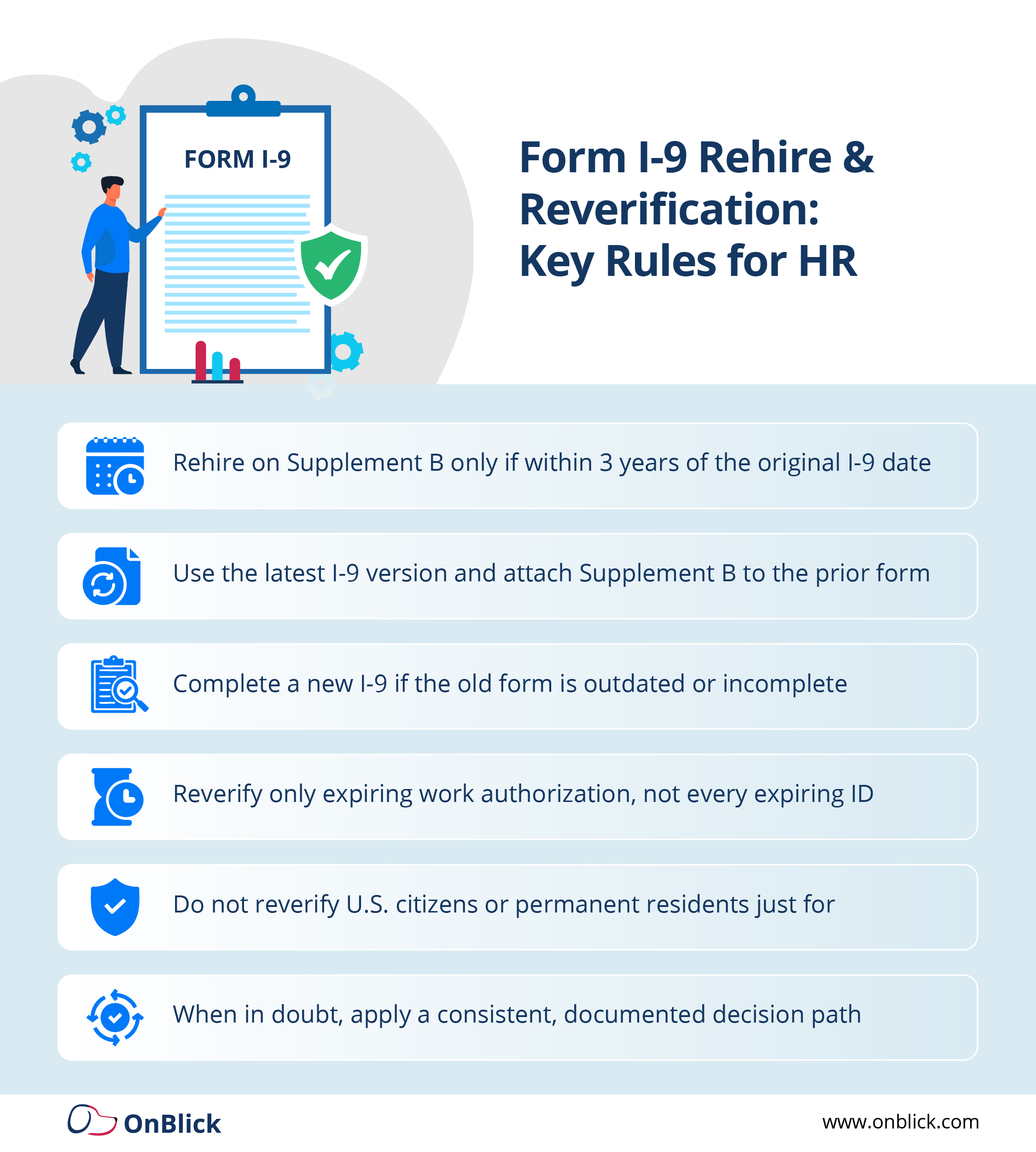
When an employee returns, HR has to decide whether to record the Form I-9 rehire on i-9 supplement b or complete a new I-9. As a general rule, if the employee is rehired within three years of the date the original Form I-9 was completed and that I-9 is still valid and legible, you may document the i 9 rehire on Supplement B of the current I-9 version and attach it to the original. If the old form is outdated, incomplete, or hard to read, it is safer to complete a brand-new Form I-9 instead of relying on that earlier record.
For i 9 reverification, the trigger is different: you act when an employee’s employment authorization is expiring, not when an identity-only document (like a driver’s license) expires. Reverification also belongs on i9 supplement b of the current I-9. You should not reverify U.S. citizens or permanent residents simply because a document expires, and you should avoid asking for specific documents instead of allowing the employee to choose from the Lists of Acceptable Documents. In practice, the rule of thumb is:
Use i-9 supplement b when a timely rehire or reverification fits USCIS and dhs ead reverification guidance; otherwise, treat the event as a new hire and complete a fresh Form I-9.
Remember that although USCIS now uses the term “Supplement B,” it is the functional successor to i 9 section 3 on prior versions of the form.
Common Form I-9 Rehire and Reverification Scenarios HR Must Get Right
Once you know the rules, the real test is applying them to everyday situations. Most Form I-9 rehire and reverification of i9 documents mistakes come from recurring scenarios: seasonal workers returning, interns converting to full-time, employees changing status, or staff moving across entities. These feel routine, but each one can require a different I-9 action.
A simple way to reduce risk is to treat these as “standard scenarios” with predefined responses. For each scenario, decide in advance whether you will use i9 supplement b (Reverification and Rehire) on the latest I-9, or complete a brand-new form. The goal is consistency, so different HR team members are not making different decisions for the same type of event. For example:
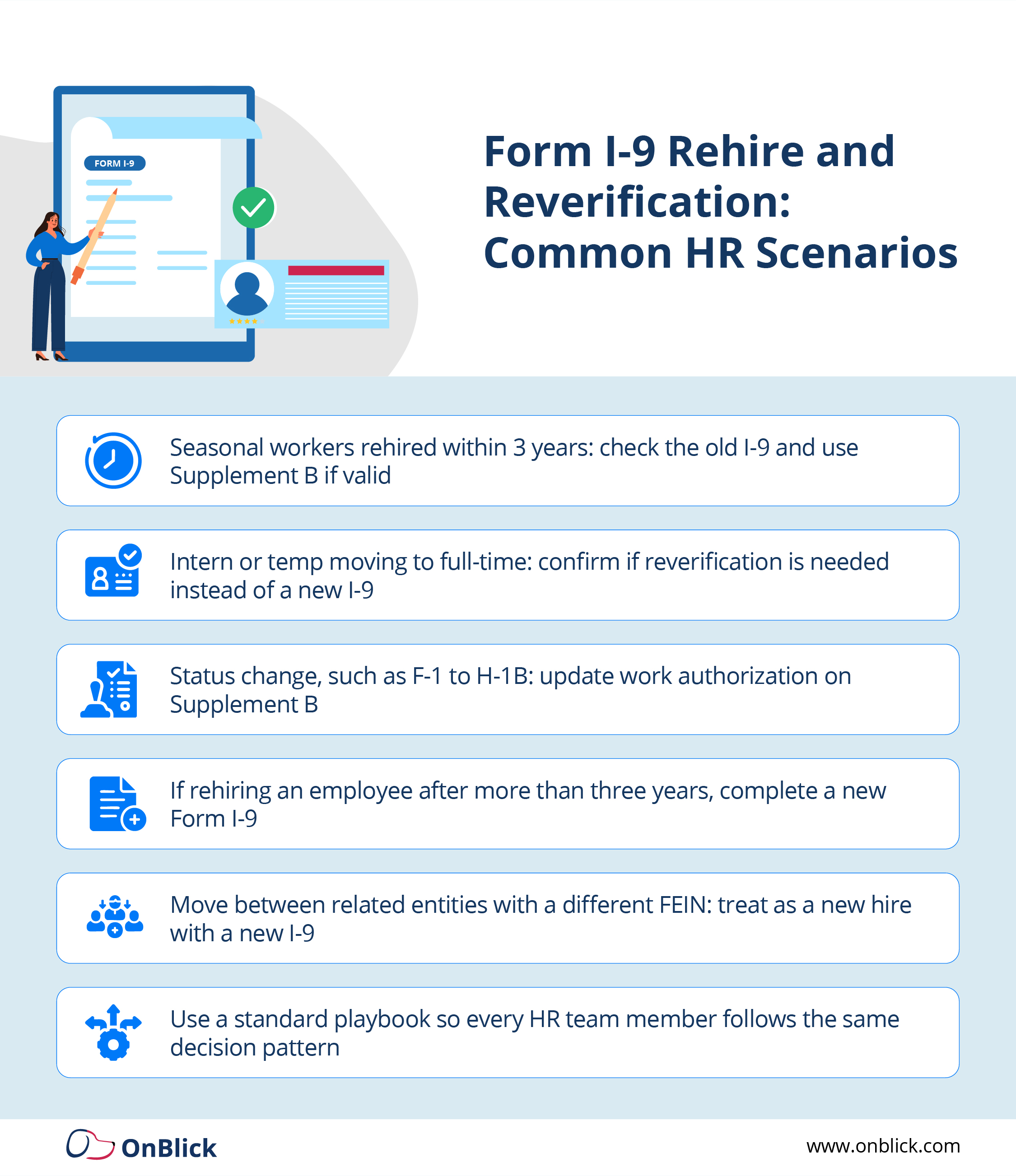
- Seasonal rehire: Employee returns each year within three years of the original I-9 date. Review the prior I-9 and use i-9 supplement b if it is still valid and complete.
- Temp or intern to full-time: Same employer, no break in service. Usually, a new I-9 is not required if one is already completed correctly, but confirm whether i 9 reverification is needed.
- Status change (for example, F-1 to H-1B): Same employee with new work authorization. Complete reverification of i9 documents on Supplement B with updated documents, following dhs ead reverification guidance when an EAD is involved.
- Rehire after a long break: Employee returns after more than three years from the original I-9 date. Complete a new Form I-9.
- Transfer between related entities: If the new entity is a different employer with a different FEIN and the move counts as a new hire, complete a new Form I-9.
Having these scenarios mapped out in a simple playbook makes responses faster, more accurate, and easier to defend in an audit.
What HR Should Track for Form I-9 Rehire and Reverification
Strong Form I-9 rehire and i 9 reverification practices depend on what you track behind the scenes. If key dates and status fields are buried in spreadsheets or scattered across systems, HR will always be reacting late. A good I-9 process treats rehires and reverifications as data-driven workflows, not one-off tasks.
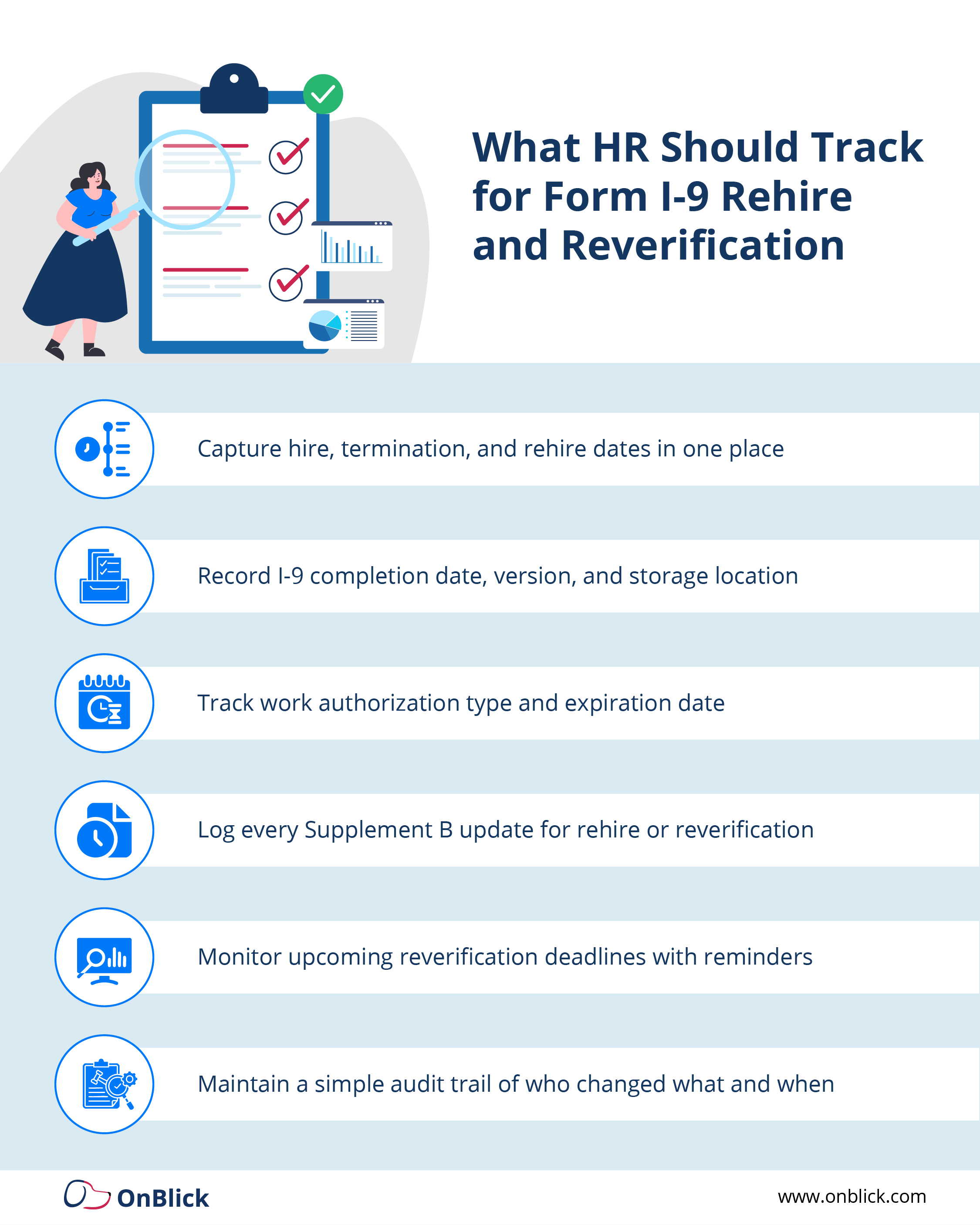
At minimum, your HRIS or I-9 system should make it easy to see who was hired when, who left, who returned, and whose work authorization has an upcoming end date. It should also show which I-9 form version you used, whether i-9 supplement b has been completed, and who made each update. That level of visibility turns audits, internal checks, and everyday decisions into straightforward reviews rather than painful investigations.
Form I-9 Rehire and Reverification Tracking Checklist
HR should be able to quickly view or report on:
- Original hire date, termination date, and rehire date for each employee
- I-9 completion date, form version, storage location, and any i 9 section 3 / Supplement B updates
- Work authorization type and expiration date for time-limited statuses
- All completed i9 supplement b entries for rehire and i 9 reverification
- Upcoming reverification deadlines across the workforce
- E-Verify case numbers and status, if the employer uses E-Verify
- A basic audit trail showing who updated I-9 or Supplement B and when
Form I-9 Rehire and Reverification: Common HR Mistakes to Avoid
Even when HR understands the rules, Form I-9 rehire and reverification errors often creep in through day-to-day shortcuts. The most frequent problems are not exotic; they are small inconsistencies that repeat across many records and become patterns an auditor can quickly spot.
Some mistakes come from doing too little, like missing reverification of i9 documents when work authorization expires. Others come from doing too much, such as reverifying people whose authorization does not need to be rechecked or asking for specific documents. Both sides of the spectrum can create risk: unauthorized employment on one side, discrimination concerns on the other.
To reduce exposure, HR teams should actively watch for these pitfalls and build them into training, checklists, and internal audits. A short “do not do this” list, kept handy when using i-9 supplement b and completing new I-9s, can prevent many repeat issues.
Key Form I-9 Rehire and Reverification Pitfalls
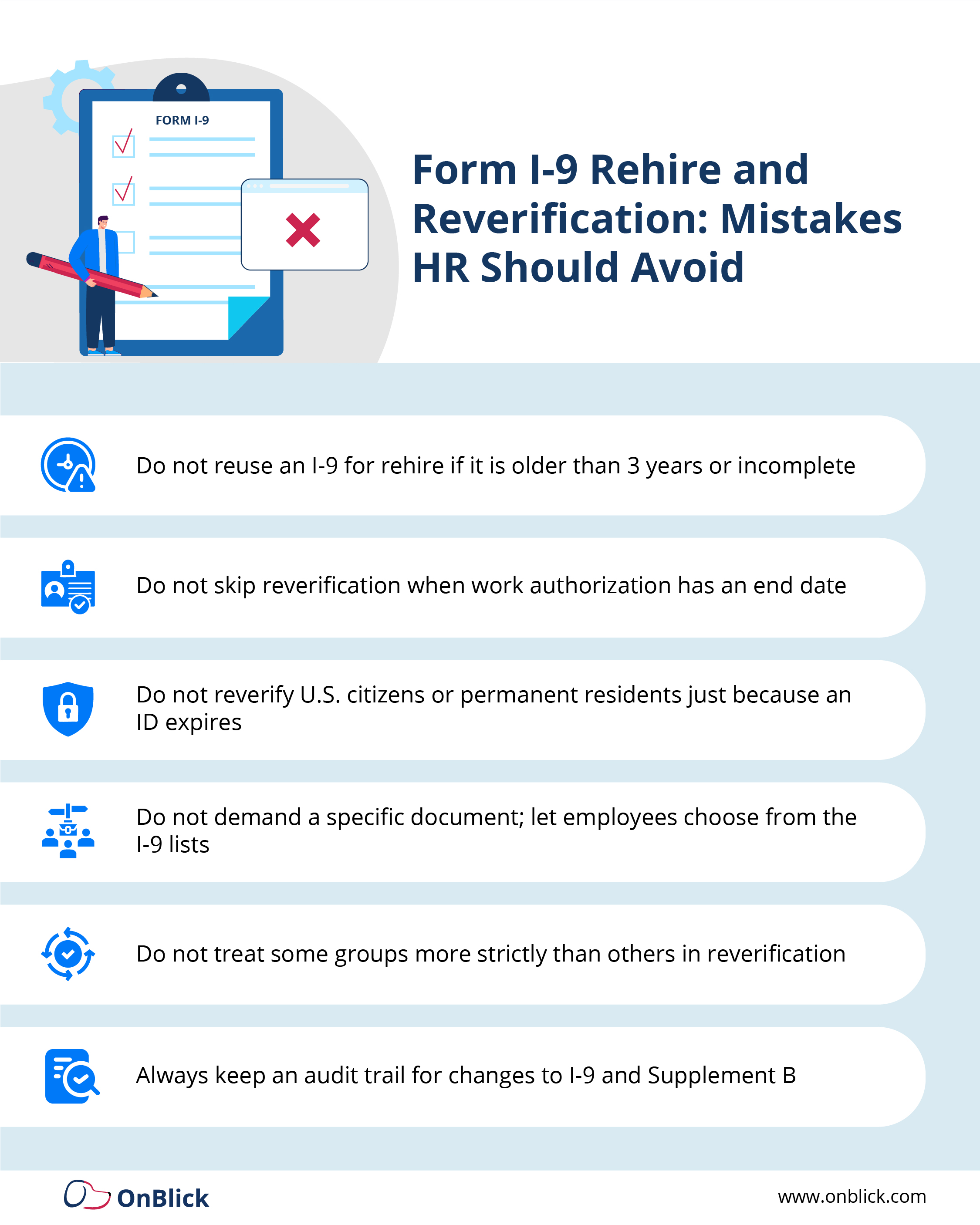
- Rehiring employees without checking whether the prior I-9 is still valid and complete
- Using i 9 section 3 / Supplement B for a rehire even though the original I-9 is more than three years old
- Missing i 9 reverification when work authorization is clearly time-limited
- Rechecking documents for U.S. citizens or permanent residents when reverification is not required
- Asking employees for a specific document instead of allowing them to choose from the Lists of Acceptable Documents
- Treating employees differently in reverification based on nationality, appearance, or accent
- Updating I-9 or i9 supplement b without recording who made the change and when
Building a Strong Form I-9 Rehire and Reverification Process
Once you know the rules and common mistakes, the next step is turning Form I-9 rehire and reverification of i9 documents into a clear, repeatable process. The goal is for any HR team member to handle a rehire or expiring work authorization the same way, using the same decision points and documentation steps. That consistency is what stands up in an audit and reduces day-to-day confusion.
A good process starts with a simple decision guide for i 9 rehire and i 9 reverification, built around i-9 supplement b and when to use a new I-9. It continues with automation where possible, especially for tracking expiration dates and sending reminders. Regular training, internal spot checks, and documented exceptions round out the system so that new hires, rehires, and reverifications all follow one standard playbook.
Practical Strategies for Form I-9 Rehire and Reverification
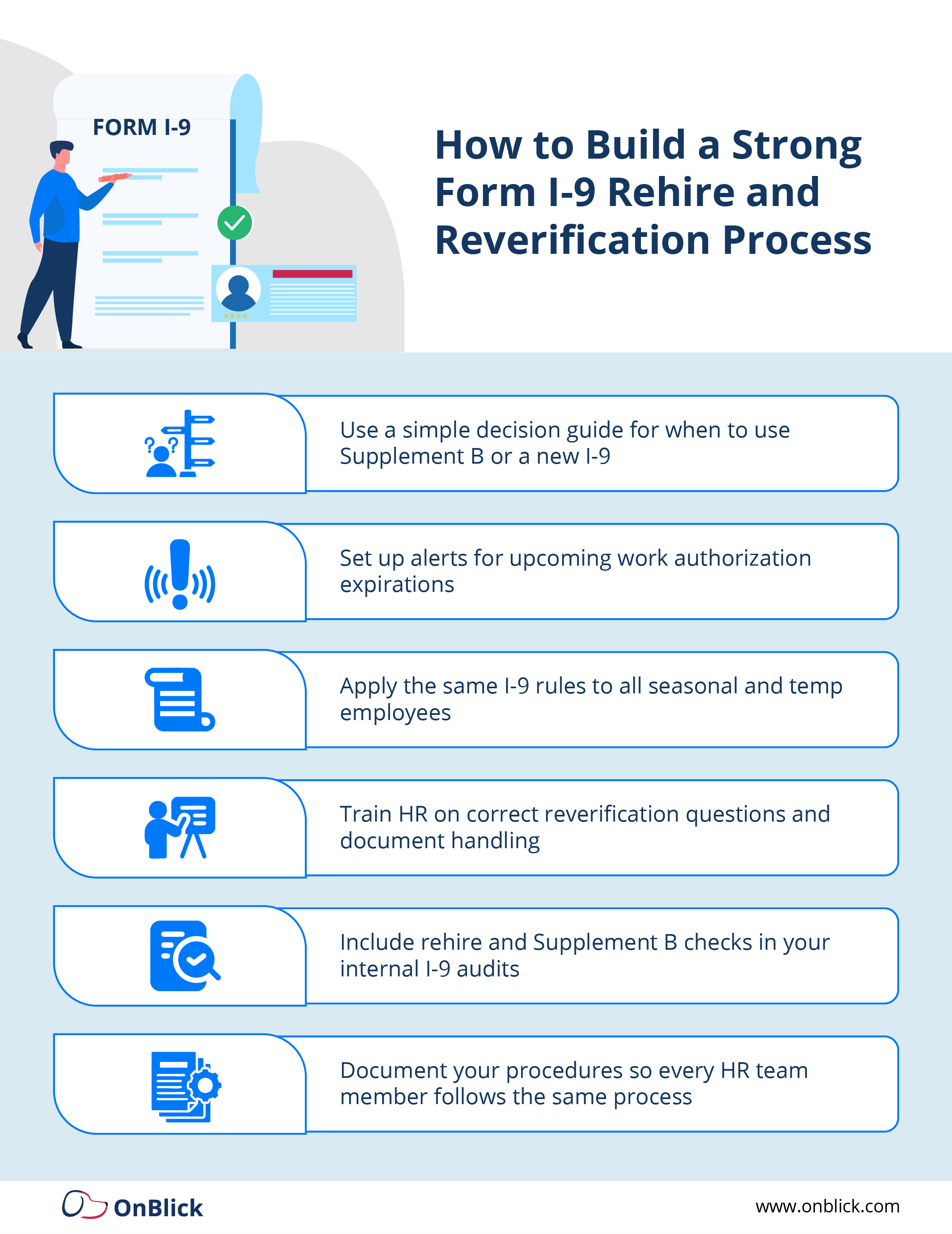
- Create a short decision guide that explains when to use i-9 supplement b and when to complete a new I-9
- Configure your HRIS or I-9 system to send alerts before work authorization expires
- Standardize how you handle seasonal, temp, and project-based roles from an I-9 perspective
- Train HR and managers on what can and cannot be asked during i 9 reverification, aligning with current dhs ead reverification guidance
- Schedule periodic internal I-9 audits that include a review of rehire and i9 supplement b entries
- Keep written procedures so new HR staff can follow the same steps from day one
Making Form I-9 Rehire and Reverification a Strategic Control
For leaders, Form I-9 rehire and reverification of i9 documents should be seen as more than an HR admin task. It is a control point that protects the organization against regulatory penalties, operational disruption, and reputational damage. When rehires and expiring work authorization are handled consistently through i-9 supplement b and well-documented procedures, executives gain confidence that the workforce is authorized, records are defensible, and audits will not derail the business.
From a strategic standpoint, leadership should be able to see simple metrics: how many employees have upcoming reverification dates, how many i 9 rehire events are being recorded each quarter, how many I-9 errors are found in internal audits, and how much time HR saves by using digital workflows instead of paper files. This is where a platform like OnBlick adds value, by centralizing I-9s, tracking rehire and reverification events, generating alerts for expiring authorization, and creating audit-ready reports that tie HR actions back to clear data.
Frequently Asked Questions: Form I-9 Rehire & Reverification
(These FAQs are for general informational purposes only and are not legal advice. Employers should consult counsel for organization-specific guidance.)
Can a company demand existing employees to recomplete I-9 forms?
In general, employers should not routinely require existing employees to recomplete I-9s without a valid reason. USCIS allows employers to complete a new I-9 in certain situations, such as when the original form is missing, incomplete, or clearly incorrect, but blanket “re-do all i9 paperwork” campaigns for existing staff can raise discrimination concerns. Instead, employers should follow a targeted, good-faith correction process, use i 9 reverification only when work authorization is expiring, and document why a new I-9 or i 9 section 3 update was needed in each case.
When to Update an I-9 Form for New Hires or Rehires?
You update an I-9 when there is a qualifying i 9 rehire or reverification event that fits USCIS rules. For rehires, if the employee returns within three years of the date the original I-9 was completed and that form is still valid and legible, you may record the rehire on i-9 supplement b and attach it to the original. For i 9 reverification, you update the I-9 on i9 supplement b when an employee’s work authorization is expiring and they present new, valid documentation. If the prior form is outdated, incomplete, or unreliable, it is safer to complete a new I-9 instead of updating the old record.
Employer never asked me for I-9 reverification. Can I as an employee be in trouble?
In most situations, the responsibility to track reverification deadlines lies with the employer, not the employee. If your work authorization expired and your employer did not complete reverification of i9 documents, that may be a compliance issue for the company. However, working without valid authorization can still create immigration consequences for you personally. If you are unsure about your status, it is wise to speak with qualified immigration counsel. From the employer’s side, consistent i 9 reverification practices, aligned with dhs ead reverification guidance, reduce these risks for everyone.
What are i 9 rehire rules?
“I 9 rehire rules” generally refer to when you may reuse a prior I-9 versus when you must complete a new one. If a former employee is rehired within three years of the date the original I-9 was completed, and that form is still accurate, complete, and legible, you may document the i 9 rehire on i-9 supplement b of the current form and attach it to the original. If more than three years have passed, or the old form is not reliable, you should treat the person as a new hire and complete a fresh I-9 instead of relying on an old i 9 section 3 update.
What do you mean by i9 paperwork?
“I9 paperwork” includes the Form I-9 itself, any related i9 supplement b or i-9 supplement b entries, and supporting records such as E-Verify case details (if used) and internal notes on corrections. Employers must retain this paperwork for the required retention period and be able to present it during an audit. Good I-9 paperwork management means tracking hire and rehire dates, reverification deadlines, and who made each update, so your files tell a clear, defensible story.
What happens if i-9 not completed within 3 days?
If an I-9 is not completed within three business days of the employee’s start date, it is a violation of the timing rules. The best practice is to complete the form as soon as the error is discovered, document why it was late, and ensure your process prevents repeat issues. Late forms, repeated across many hires, can be cited in audits and may lead to penalties. A structured workflow for new hires, i 9 rehire events, and reverification of i9 documents helps keep everything within the required timelines.
How long to keep i 9 forms?
Employers must keep I-9 forms for the longer of: three years after the employee’s date of hire, or one year after the date employment ends. After that, you may securely destroy the form and any attached i-9 supplement b / i9 supplement b pages. Applying this “how long to keep i 9 forms” rule consistently helps you avoid retaining outdated records while still being ready for audits covering the proper time frame.
What are i 9 form document requirements?
“I 9 form document requirements” refers to the Lists of Acceptable Documents and the rules for which combinations employees may present. For a new hire, the employee must present either one List A document (proving both identity and work authorization) or a combination of one List B and one List C document. For i 9 reverification, employees must present documentation that shows continued work authorization, and employers must allow them to choose from the applicable list- never specifying which exact document to bring. Recording these correctly on the I-9 and on i 9 section 3 / Supplement B is central to compliant reverification of i9 documents.
Summary
Form I-9 is not just an onboarding form; it is a long-term employment record that must keep pace with rehires and changing work authorization. When HR understands how Section 1, Section 2, and i 9 section 3 / Supplement B work together, it becomes much easier to decide whether to update an existing I-9 or complete a new one.
The real value comes from having clear rules, standard responses to common scenarios, and systems that track the right data. With defined processes, regular training, and the right tools, HR can handle i 9 rehire events and i 9 reverification confidently, support managers, and give leadership a strong, defensible compliance posture.
Here are the key takeaways for HR
- Treat Form I-9 as a lifecycle record, not a one-time form
- Use i-9 supplement b / i9 supplement b for eligible rehires and required reverifications on the latest form version
- Only reverify time-limited work authorization, not every expiring document
- Standardize responses to common scenarios such as seasonal rehires and status changes
- Track dates, expirations, and Supplement B entries in a centralized system
- Use internal audits and training to catch and correct patterns of error early
How OnBlick Helps with Form I-9 Rehire and Reverification
OnBlick helps HR teams manage Form I-9 as a complete lifecycle record instead of a one-time form. The platform centralizes I-9s, gives clear visibility into hire, i 9 rehire, and i 9 reverification history, and supports i-9 supplement b entries for rehire and reverification on the current form version.
OnBlick's I-9 Assist tracks employment authorization expirations, sends reminders ahead of key dates, and supports compliance with dhs ead reverification guidance for EAD holders. Dashboards and reports help you monitor I-9 errors, internal audit findings, and patterns in reverification of i9 documents. A built-in audit trail shows who completed or updated I-9 and i9 supplement b and when, helping HR teams standardize processes so executives can trust the compliance posture. With I-9 Assist's Live Video Verification feature, you can now ensure secure identity and employment authorization verification smoothly.
OnBlick's internal I-9 audit services guide organizations, right from resolving the Form I-9 errors to assisting in creating an I-9 policy.
If you'd like to know more about us, book a free OnBlick demo today.