.gif)


Most HR teams know that Form I-9 is mandatory, but its importance often sinks in only when a Notice of Inspection lands in the inbox. An unexpected i 9 audit can turn an ordinary week into a scramble, with teams pulling files from different locations, hunting for missing forms and discovering errors that should have been caught years ago.
For HR and compliance leaders, this is not just about paperwork. A form i 9 audit can affect fines, leadership confidence, employee trust and even your company’s reputation as a responsible employer. The difference between a stressful i9 audit and a manageable one usually comes down to how consistently you have built and maintained audit-ready I-9 records long before any agency reaches out.
This article explains what happens during a form i 9 audit, the risks that hide in everyday I-9 processes and how you can design systems that keep your records audit-ready by default.
What is a Form I-9 Audit?
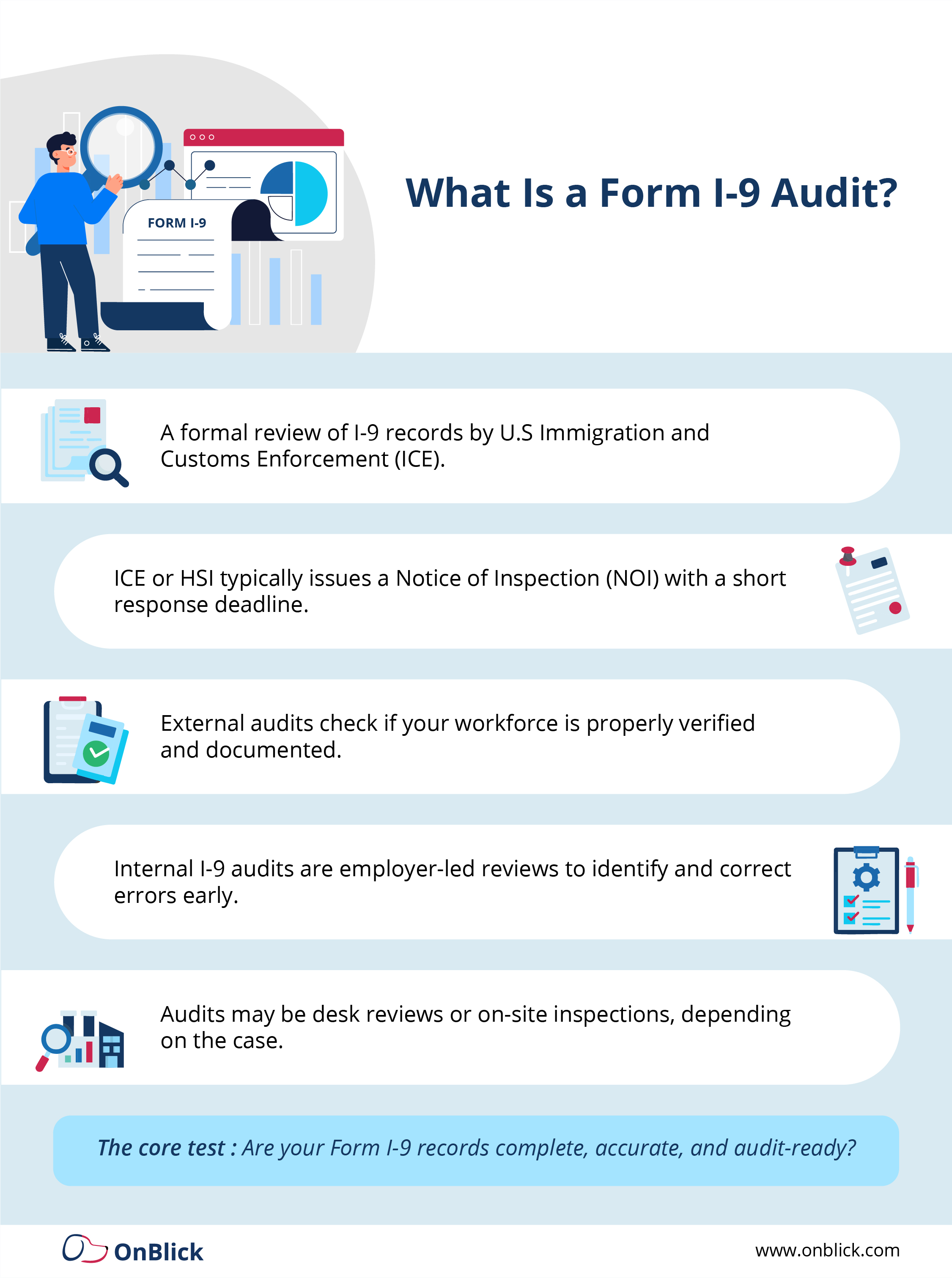
A form i 9 audit is a formal review of your employment eligibility verification records to confirm that your organization is completing and maintaining Form I-9 correctly for every employee. In most cases, these external reviews are conducted by Immigration and Customs Enforcement through its investigative arm Homeland Security Investigations. Many HR teams simply refer to this as an ICE audit or ICE i 9 audit. In some situations the Department of Justice or other agencies may also review I-9 practices.
The purpose is straightforward. Regulators want to verify that you are only employing individuals who are authorized to work in the United States and that your I-9 documentation supports this.
It is helpful to distinguish between:
- External audits or inspections that begin with a Notice of Inspection and a deadline to produce I-9 records. These are often called an ICE audit or ICE i 9 audit.
- Internal i 9 audits that are initiated by the employer to identify and correct errors before any regulator gets involved.
Both focus on the same records, but the stakes and timelines are very different.
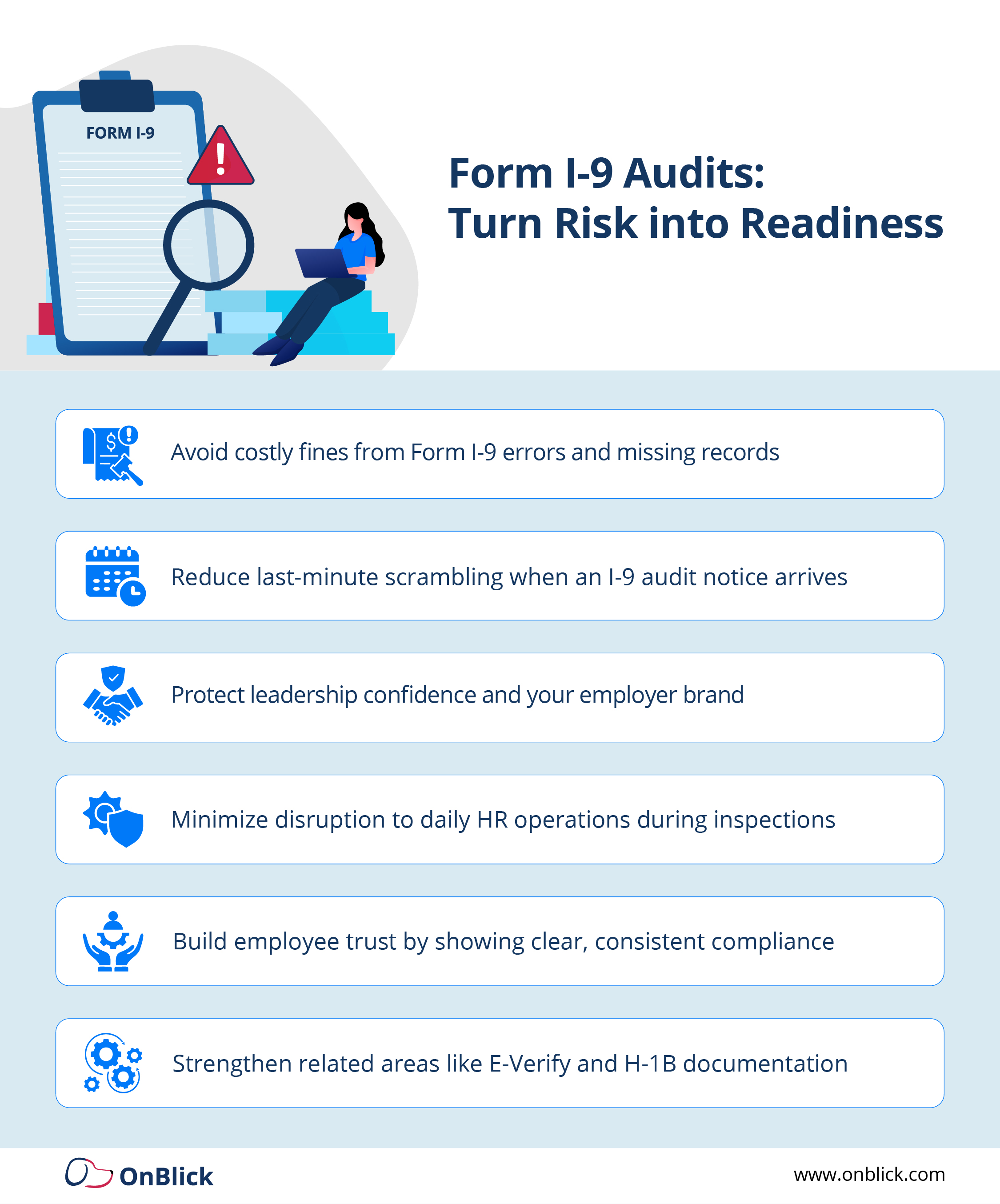
Why Form I-9 Audit Readiness Matters for HR and Compliance
Form I-9 is often treated as a simple onboarding step. During an i 9 audit, every missed signature, wrong date or missing form becomes a potential violation. For HR and compliance leaders, being audit-ready means your records can withstand scrutiny at any time without last-minute chaos or guesswork.
The risk is not limited to paperwork. A form i 9 audit can lead to civil fines for substantive errors and uncorrected technical mistakes and, in serious cases, allegations that the employer knowingly hired or continued to employ unauthorized workers. Even when there is no intent to violate the law, systemic issues across many forms can quickly add up to significant financial exposure.
Operationally, unprepared teams lose hours or days to searching, sorting and correcting records under tight deadlines. This disrupts everyday HR tasks and puts pressure on everyone involved. There is also a people and brand dimension. Employees become anxious when they hear “ICE audit,” and leadership may question whether HR has adequate controls in place.
Form I-9 audit readiness also connects with your broader compliance ecosystem, including E-Verify participation, remote hiring workflows and documentation for foreign national employees such as H-1B workers. When HR builds strong I-9 processes, it strengthens the foundation for employment and immigration compliance across the organization.
Form I-9 Audits, Fines and Penalties in 2025
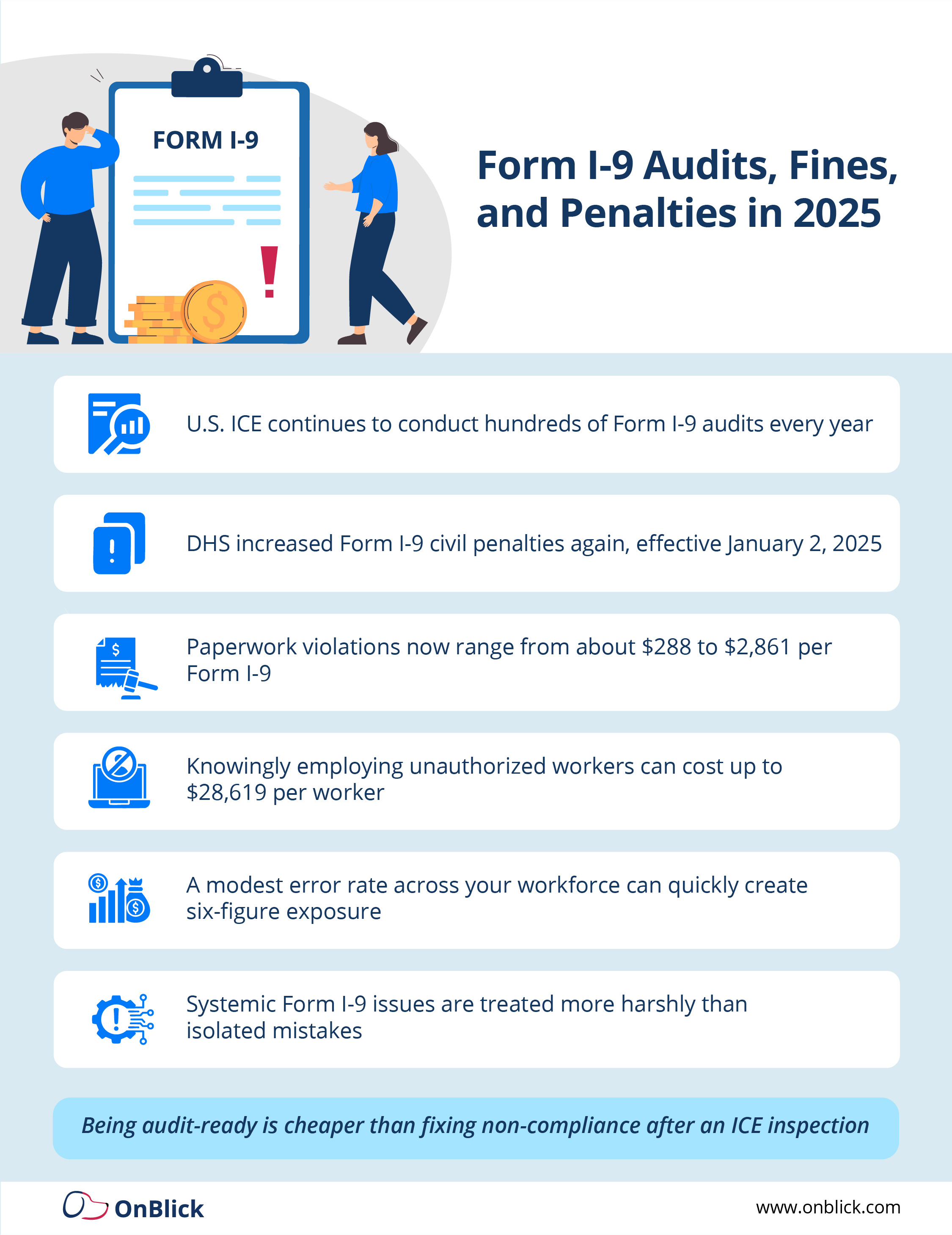
Although the volume of Form I-9 audits has fluctuated over the past decade, enforcement has not gone away. ICE and DHS have shifted from large, headline-grabbing raids to more targeted Form I-9 inspections and higher monetary penalties. Between 2018 and 2019, I-9 inspections peaked at nearly 6,000 per year, then fell during the pandemic and its aftermath. By 2024, ICE still conducted 264 I-9 inspections: far below the Trump-era peak, but enough to remind employers that worksite enforcement is very much active.
The real story in 2025 is the cost of non-compliance. On January 2, 2025, DHS published a new I-9 Fine Matrix, increasing civil monetary penalties across the board. For substantive Form I-9 violations and uncorrected technical errors, fines now range from about $288 to $2,861 per form.
For employers who knowingly hire or continue to employ unauthorized workers, the penalties are far steeper: in 2025, they range from $716 to $5,724 per worker for a first offense, up to $28,619 per worker for repeat offenses.
These amounts add up quickly. A company with 500 employees and a 20 percent error rate could have 100 deficient forms. Even at the lower end of the 2025 paperwork range, that is tens of thousands of dollars in exposure; at the higher end, it can cross into six-figure territory. And because ICE typically assesses penalties based on the percentage of violations across your sample or population of I-9s, systemic process issues are much more expensive than isolated mistakes.
It is also important to remember that I-9 violations are not limited to paperwork. USCIS and DOJ guidance makes clear that employers can face civil and even criminal consequences for patterns of hiring unauthorized workers, document fraud, or discriminatory verification practices, in addition to Form I-9 compliance errors.
For HR and compliance leaders, this means I-9 audit readiness is not just about avoiding “small” technical fines. It is about reducing the risk of major financial penalties, enforcement actions, and reputational damage that come with being flagged as a non-compliant employer.
What Makes an I-9 Record Audit-Ready?
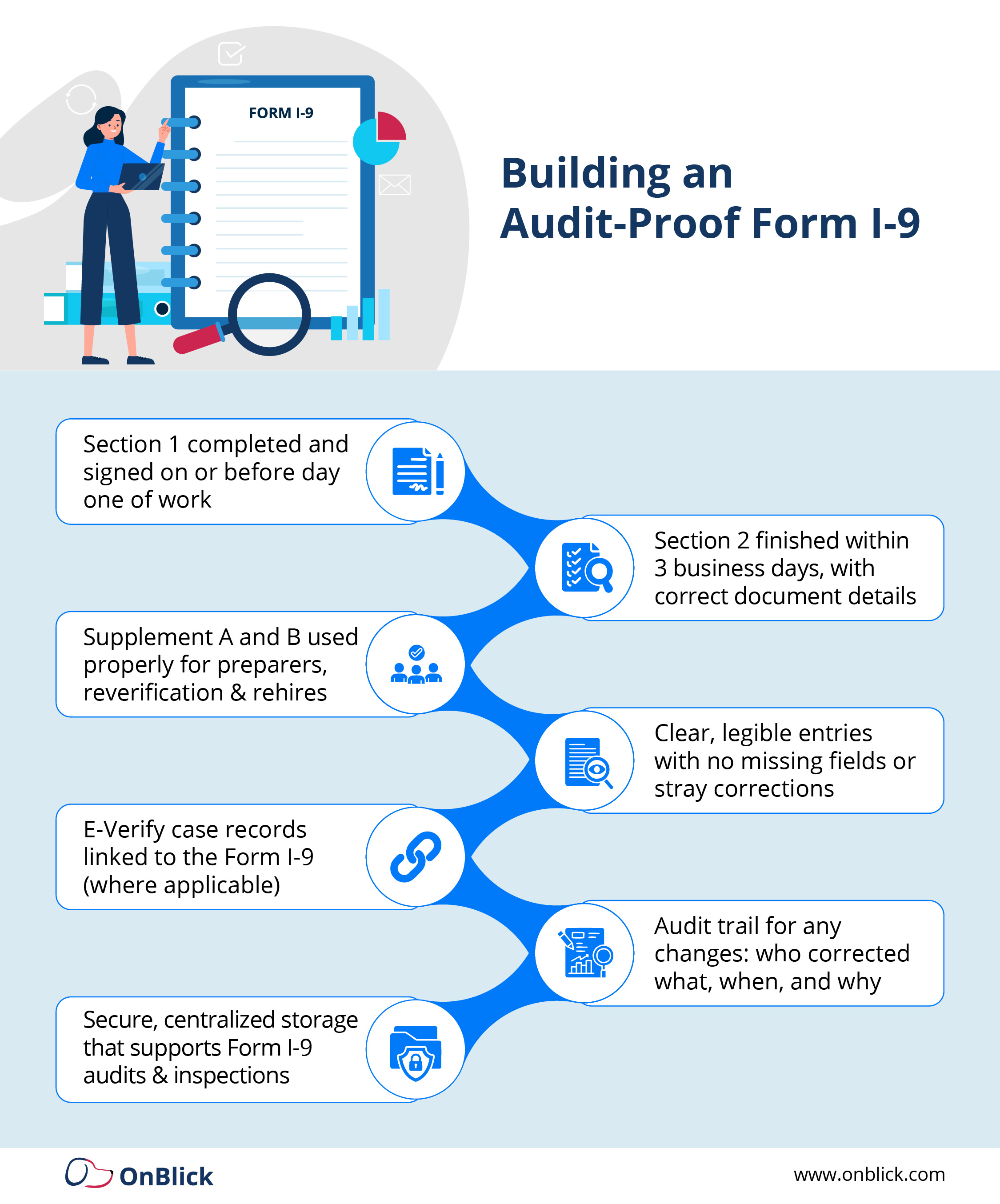
An audit-ready I-9 record is more than a completed form in a folder. It is a combination of accurate data, timely completion, proper documentation and a clear trail of how the record has been handled over time. When an agency conducts a form i 9 audit, it looks not only at what is on each page but also at whether your process consistently follows the rules.
At the form level, an audit-ready I-9:
- Has all required fields completed legibly and accurately
- Shows Section 1 filled out and signed on or before the employee’s first day of work for pay
- Shows Section 2 completed by the employer within three business days of the start date
- Uses Supplement A when a preparer or translator assists
- Uses Supplement B for reverification and rehire with dates and signatures that match the employment timeline
Beyond the form itself, strong audit-ready records include supporting elements that make an ICE i 9 audit smoother, such as E-Verify case details (if used), logs of reverification reminders and completions and a record of corrections made after internal i 9 audits. For electronic systems, regulators expect secure storage, role-based access controls and an audit trail that shows who created, viewed or modified each record and when.
Organizations that invest in these details can respond to an i9 audit with far more confidence. Instead of scrambling to explain gaps or reconstruct timelines, HR can quickly produce clean, consistent and well-documented records that demonstrate good-faith compliance.
Form I-9 Red Flags: Gaps That Put You at Risk
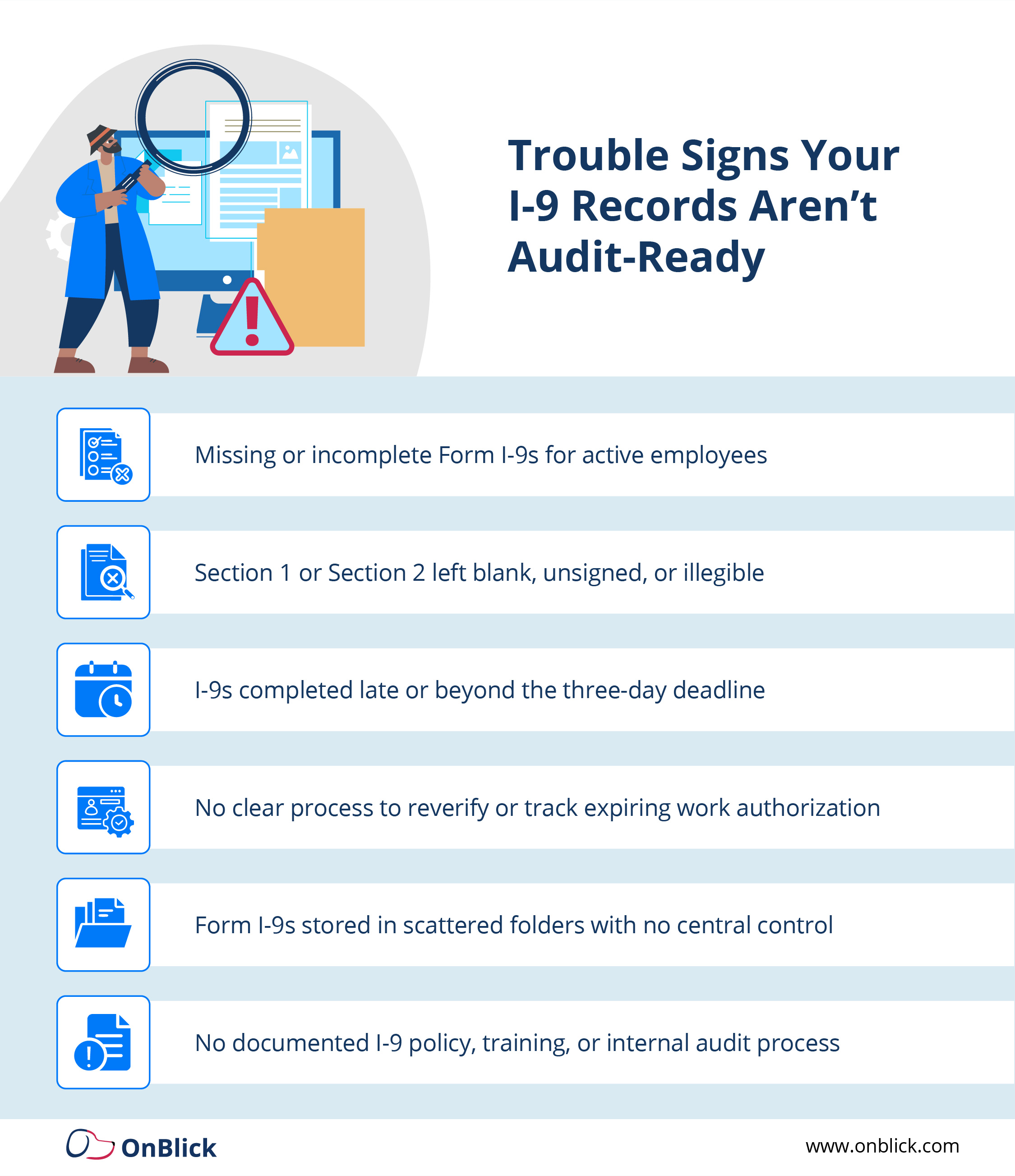
Even if your Form I-9 files look “mostly fine,” certain patterns can signal trouble in an i 9 audit. These red flags usually point to process gaps rather than one-off mistakes, and that is exactly what ICE and other agencies look for during a Form I-9 inspection or ICE i 9 audit. When the same types of errors repeat across your workforce, they can quickly escalate into higher penalty ranges in any form i 9 audit.
One clear warning sign is missing or incomplete paperwork. If you cannot quickly produce a Form I-9 for every active employee in scope, or if large numbers of forms have blank fields, missing signatures, or illegible information, your records are not audit-ready. Another common issue is timing: Forms I-9 completed late, Section 2 signed more than three business days after the hire date, or reverification done after work authorization expires. These errors are easy for auditors to detect in an i9 audit and difficult to defend.
Storage and retention problems are another major red flag. When I-9s are scattered across multiple locations, kept in individual manager files, or mixed with other HR documents, it becomes hard to prove consistency and control during an ICE audit. If your team does not follow a clear retention rule (three years after hire or one year after termination, whichever is later) or has no documented process for securely destroying outdated forms, auditors may conclude that your I-9 program is not well managed.
Finally, the absence of internal oversight is itself a red flag. If you have never done an internal i 9 audit, do not have a written policy, or rely solely on one person’s memory to apply the rules, it suggests that errors are going unnoticed. An audit-ready organization can show that it reviews records, corrects mistakes properly, and continually improves its Form I-9 process, instead of waiting for an ICE inspection or formal form i 9 audit to expose the gaps.
How to Build Audit-Ready Form I-9 Records
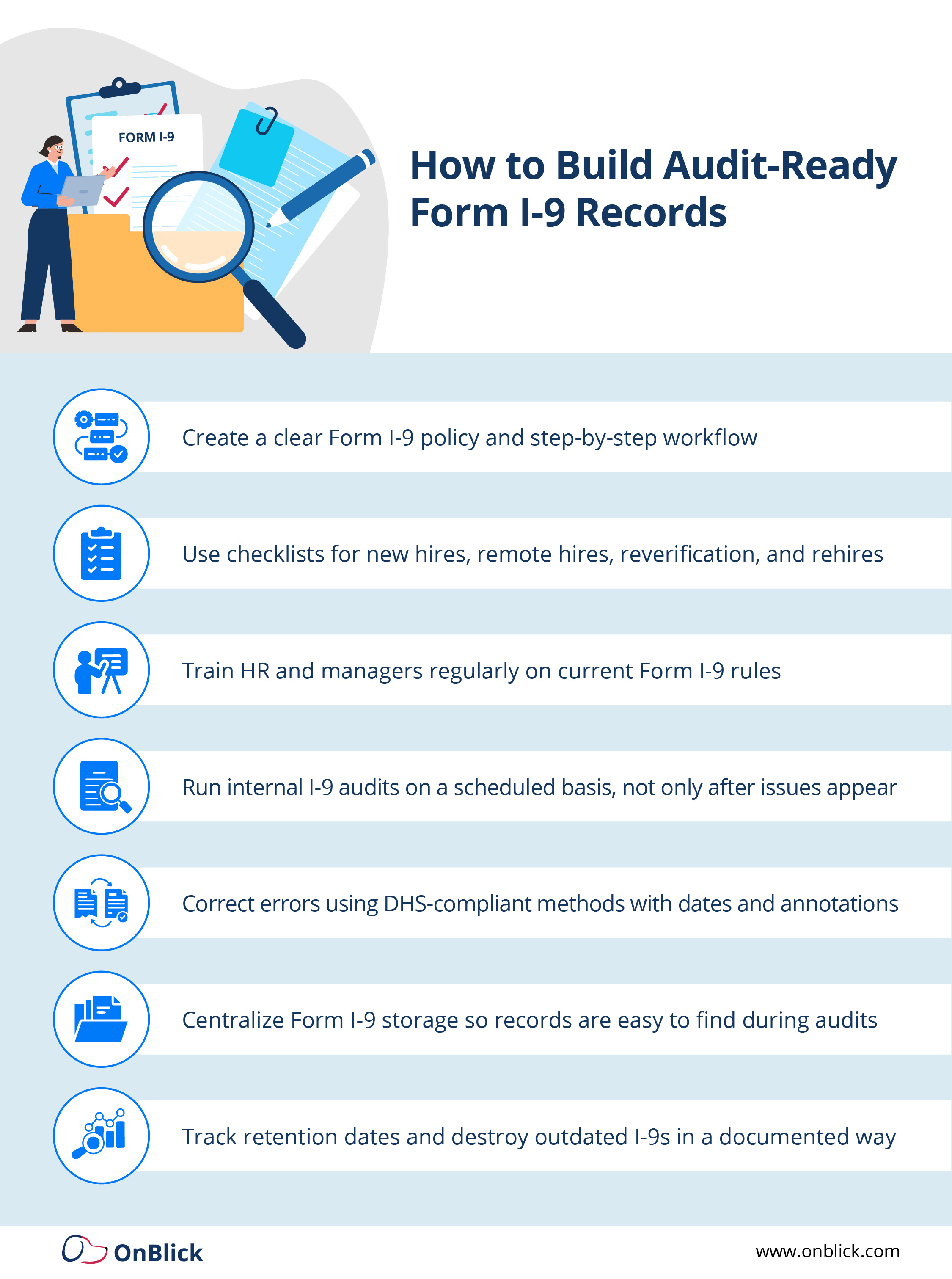
Building audit-ready Form I-9 records is a process, not a one-time clean-up project. HR teams that handle an i 9 audit well usually have clear ownership, simple procedures, and the right tools supporting them. The goal is to make compliant I-9 completion the default outcome, not something that depends on one expert remembering every rule when a form i 9 audit or ICE audit appears on the horizon.
Start by standardizing your Form I-9 policy and workflow. Define who is responsible for each step in Section 1, Section 2, and Supplement B. Document the process in simple checklists that cover key scenarios such as new hires, remote hires, reverification, and rehires. This helps new HR team members and hiring managers follow the same steps every time, which reduces variation and errors that an i9 audit would quickly surface.
Training is the next layer. Anyone who handles Form I-9 completion, reverification, or storage should receive regular training on the latest form version, acceptable documents, and common mistakes that lead to penalties in audits. Short refreshers at least once a year can keep people familiar with the rules, especially if you have high manager turnover or multiple hiring locations that could otherwise create inconsistent practices ahead of a possible ICE i 9 audit.
Internal I-9 audits turn this into a continuous improvement cycle. Schedule periodic reviews of a sample or full set of I-9s so that you can identify trends, identify risk areas, and correct errors before an agency inspection. Use a documented correction process that follows DHS guidance: do not backdate, make clean line-through corrections, add initials and dates, and include simple annotations that explain what was fixed. These internal i 9 audits show good-faith efforts if a future form i 9 audit occurs.
Last but not least, organize your records so they support an audit instead of fighting against it. Centralize storage, whether physical or electronic, and use a simple indexing system based on status or date so you can quickly pull forms by hire date or employee name. Implement a retention and purge schedule that tracks when each Form I-9 can be destroyed and document how destruction is carried out. When these steps are in place, your Form I-9 program is ready to respond quickly and confidently to any i 9 audit request, whether it comes from ICE or another agency.
Reducing Form I-9 Audit Anxiety with Better Processes and Technology
Form I-9 audits often create a unique kind of anxiety for HR teams. It is not just the fear of fines, but the worry that long-forgotten onboarding decisions will now be reviewed line by line in a form i 9 audit. When records are scattered, processes are informal, or only one person “knows how I-9 is done here,” even a routine i 9 audit or ICE audit can feel overwhelming.
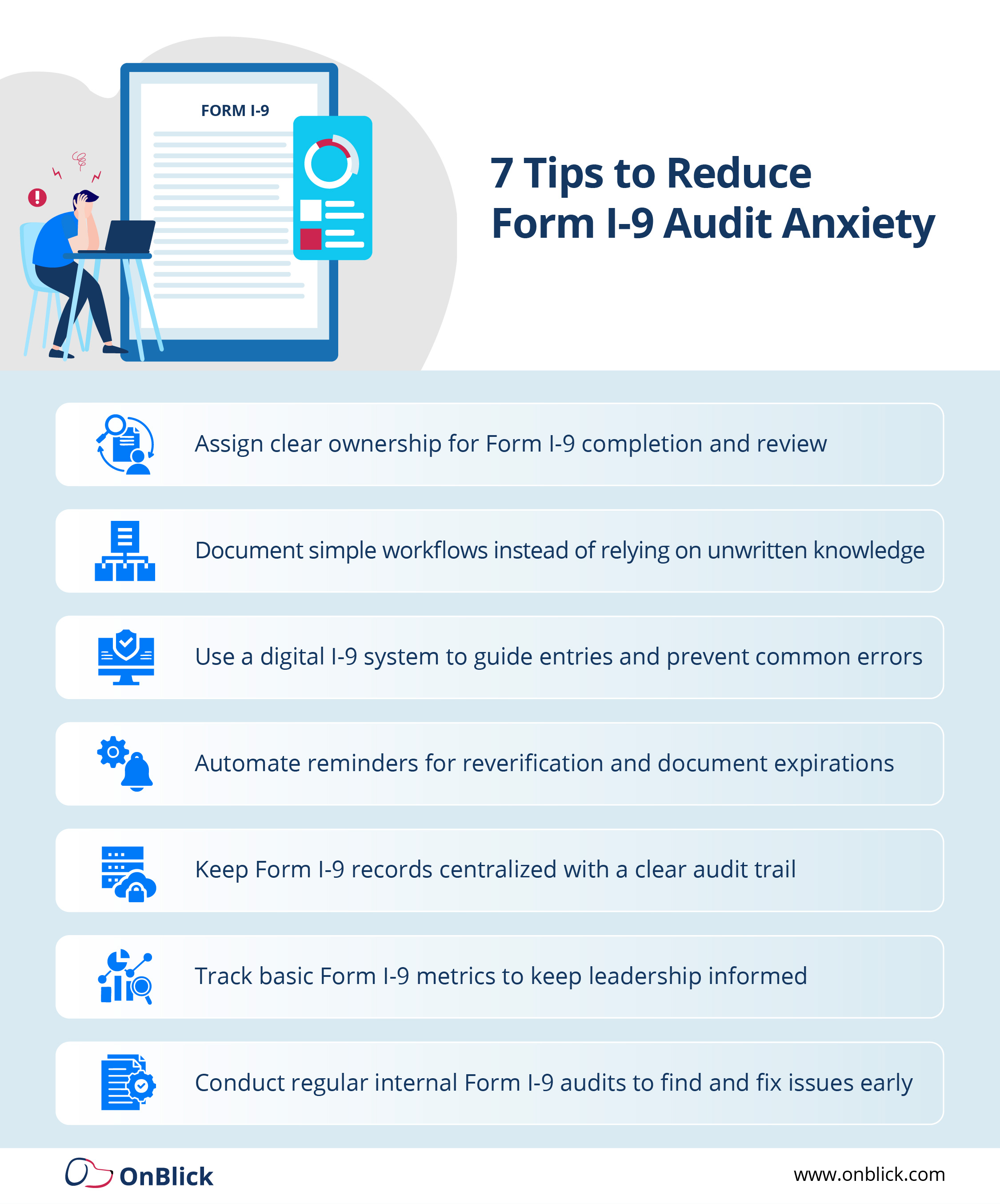
The fastest way to reduce this stress is to design your people and processes around predictability. That means clearly assigning ownership for Form I-9 completion, reverification, and recordkeeping, and documenting these responsibilities so they do not live only in someone’s memory. When everyone knows what to do, when to do it, and where to store the records, the panic of an audit notice is replaced by a checklist you can follow, whether the review is an internal i 9 audit or an external ICE i 9 audit.
Internal Form I-9 audits are a powerful way to turn anxiety into control. By reviewing a sample or full set of I-9s on a regular schedule, HR can spot patterns, fix errors using DHS-compliant correction methods, and document the improvements made over time. When an external form i 9 audit arrives, you are not seeing your issues for the first time; you already know your risk areas and what has been done to address them.
Technology can reinforce these habits and remove guesswork. A good Form I-9 or I-9 plus E-Verify platform can guide users through each field, prevent common errors in Sections 1 and 2, send automatic reverification reminders, maintain a detailed audit trail of every change, and even support structured internal audit reviews. Instead of manually tracking expiration dates and retention timelines in spreadsheets, HR can rely on system alerts and workflows that keep records audit-ready in the background for any future i9 audit.
Finally, transparency with leadership is part of reducing audit anxiety. Simple I-9 compliance metrics, such as the percentage of records reviewed internally, the number of corrections completed, or upcoming reverifications, reassure executives that there is an active program in place. When HR can show that people, internal audits, and tools work together, a Form I-9 audit becomes a test of a known system rather than a jump into the unknown.
Turning Form I-9 Audits into a Strategic Safeguard
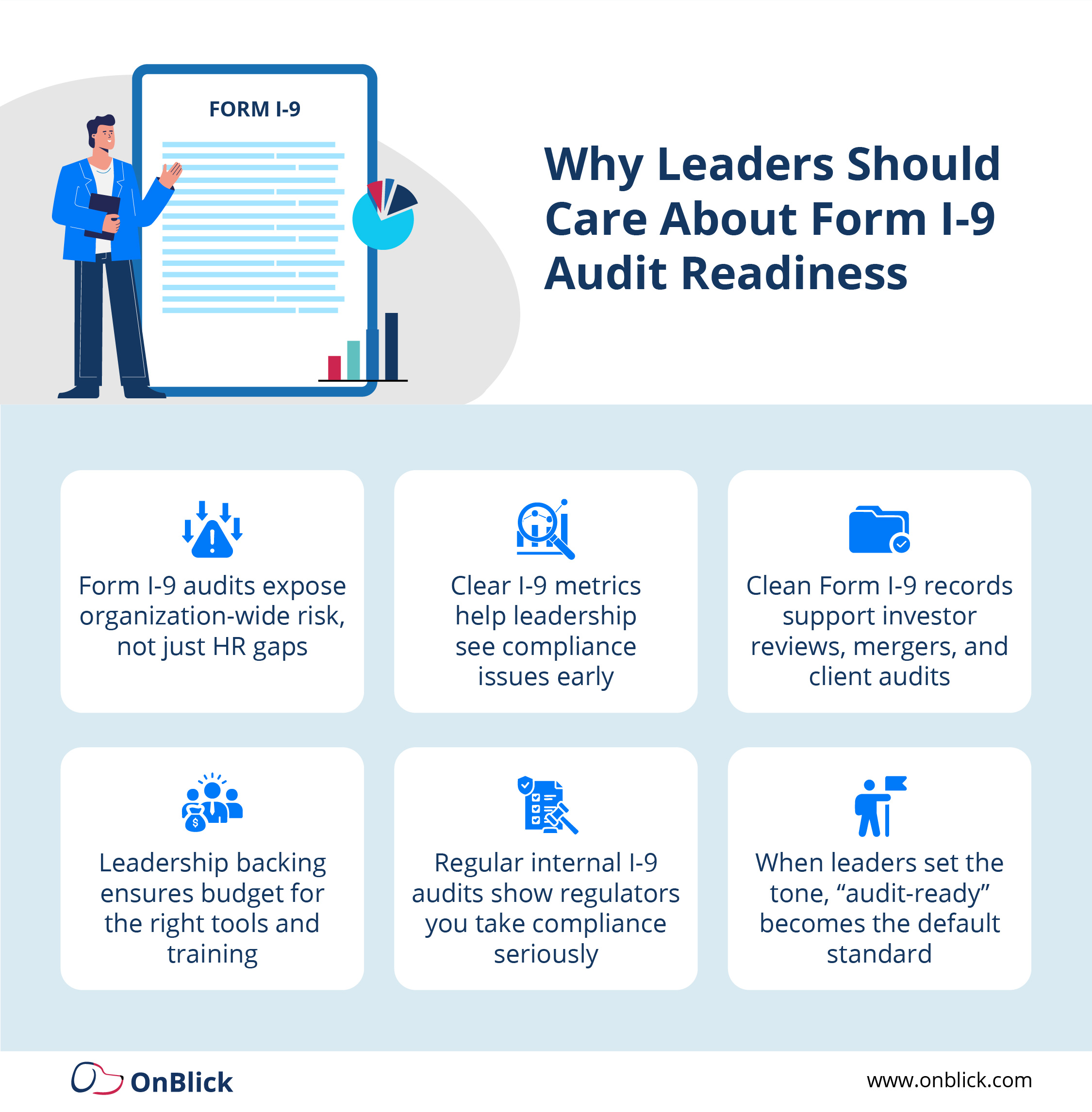
For senior leadership, Form I-9 audits can easily feel like a “back-office HR issue.” In reality, they sit squarely in the middle of organizational risk management. When ICE or another agency reviews your Form I-9 records in an ICE audit or ICE i 9 audit, they are evaluating not just HR’s diligence, but the company’s overall approach to regulatory compliance, internal controls, and governance.
Executives need a clear line of sight into Form I-9 risk, just as they would for financial, cybersecurity, or data privacy risks. This starts with simple, digestible metrics: the percentage of Form I-9s reviewed in internal i 9 audits, current error rates, upcoming reverification events, and how many I-9s are due for retention-based destruction. These indicators tell leaders whether the organization is trending towards “audit-ready” or accumulating hidden exposure that could be exposed in a future form i 9 audit.
Proactive organizations also connect Form I-9 compliance to broader business events. Clean, well-managed I-9 records reduce friction in mergers and acquisitions, due diligence reviews, and large client audits. They demonstrate that the company has its workforce documentation under control, which can be a deciding factor for investors, regulators, and enterprise customers who care about vendor compliance and how you would fare in an i9 audit.
Leadership’s role is not to micromanage the process, but to set expectations and resource it properly. That means supporting HR with the right technology, approving time for internal audits and training, and making it clear that Form I-9 accuracy and audit-readiness are non-negotiable. When executives frame Form I-9 audits and i 9 audit readiness as part of a larger compliance and risk strategy, HR is empowered to build systems that protect the entire organization, not just avoid fines.
Summing Up
Form I-9 audits often feel intimidating because they bring together legal risk, operational pressure, and years of HR decisions in one moment of review. The good news is that most of what determines the outcome of a Form I-9 audit does not happen on audit day. It happens in the everyday choices your team makes about how to complete, store, and monitor I-9 records.
Audit-ready Form I-9 records are the result of clear policies, trained people, consistent internal audits, and the right technology support. When Section 1 and Section 2 are completed on time, reverification is tracked properly, files are centralized, and errors are corrected using DHS-compliant methods, your I-9 program can hold up to external scrutiny with far less stress.
For HR and compliance leaders, the way forward is to treat Form I-9 as an ongoing compliance program rather than a one-time onboarding task. That means setting expectations with managers, reporting simple I-9 metrics to leadership, and making internal I-9 audits a routine part of your year. With this mindset, a Notice of Inspection becomes a test of a system you already know, not a surprise exam.
OnBlick’s I-9 platform and audit services are designed to support this shift. They help you close process gaps, identify risks early, and keep your records organized and audit-ready across locations and team members. Whether or not an audit is on the horizon, building a strong Form I-9 program now is one of the most effective ways to protect your organization and your people.
Key Takeaways for HR and Compliance
- Treat Form I-9 audits as a recurring compliance risk, not a rare event
- Standardize your I-9 policy, workflow, and ownership across locations
- Train everyone who touches Form I-9 on current rules and common errors
- Run internal I-9 audits regularly and correct issues in a documented way
- Centralize records, track retention, and use tools that support clean audit trails
- Give leadership simple I-9 metrics so they understand risk and progress
- Use platforms like OnBlick to make audit readiness part of everyday HR work
Frequently Asked Questions About Form I-9 Audits
(These FAQs are for general information only and are not legal advice. Employers should consult qualified counsel for organization-specific guidance)
What is an ICE audit?
An ICE audit is a review conducted by Immigration and Customs Enforcement, usually through Homeland Security Investigations, to check whether an employer is complying with employment eligibility verification rules. In a workforce context, an ICE audit often starts as an ICE i 9 audit when the agency serves a Notice of Inspection and requests your Form I-9 records and related documents.
What triggers an i 9 audit?
An i 9 audit can be triggered in several ways. Some employers are selected as part of targeted enforcement in certain industries or regions. Others are reviewed after tips, complaints or information that suggests possible non-compliance. I-9 issues may also surface during other investigations or large regulatory reviews. Because you cannot always predict what triggers a form i 9 audit, it is safer to keep records audit-ready at all times.
How to audit i 9 forms?
To audit i 9 forms internally, start by defining the scope. You can review all active employees or a representative sample. Check each I-9 for complete and accurate fields, correct timing for Section 1 and Section 2, proper use of documents, reverification where required and appropriate retention. Use DHS-compliant correction methods, avoid backdating and keep notes on what was reviewed and fixed. Regular internal i 9 audits help you identify patterns and reduce risk before an external review.
Who performs audits on form i-9?
External audits on form i-9 are most commonly performed by ICE, but other agencies, such as the Department of Justice’s Immigrant and Employee Rights Section, can review I-9 practices in certain cases. Internally, HR or compliance teams perform i 9 audits as part of routine risk management. Some employers also work with experienced counsel or third-party providers to conduct deeper internal reviews.
Can a 3rd party audit my i-9 forms?
Yes. Employers can engage a third party to help with an internal i 9 audit. Law firms and specialized compliance providers often review form i 9 audit readiness, identify common errors, provide guidance on corrections and help design better processes. Even when a third party supports the review, the employer remains ultimately responsible for complying with I-9 rules and for responding to any ICE audit.
What is an i 9 audit checklist?
An i 9 audit checklist is a simple tool that outlines what to review on each form and across your overall process. It typically covers timing of completion, completeness of Sections 1 and 2, document recording, use of Supplements A and B, reverification, retention rules and correction methods. Using a consistent checklist helps HR teams run i 9 audits in a structured way and makes it easier to compare findings over time.
What is an i 9 audit letter to employees?
An i 9 audit letter to employees is a communication used during an internal review or in response to an external audit when employees need to present documents or correct information. The letter should be clear and neutral, explain why updated I-9 information is needed and outline what employees must do and by when. It should avoid specifying which exact documents employees must bring so that you remain compliant with anti-discrimination rules while preparing for a form i 9 audit or ICE audit.
How long does an i 9 audit take?
The length of an i 9 audit depends on scope and complexity. An internal review of a small sample may take only a few days, while a full review of many locations can take weeks. For an external ICE i 9 audit, the initial deadline to produce records is often three business days after receiving the Notice of Inspection, but follow-up questions and penalty discussions can extend the process. Having organized, centralized records significantly shortens response time.
What is the difference between an internal i 9 audit and an ICE i 9 audit?
An internal i 9 audit is initiated by the employer to find and fix issues proactively. It allows you to correct errors, improve processes and document good-faith efforts before any regulator is involved. An ICE i 9 audit is conducted by the government and carries the risk of penalties. Both look at the same forms, but an internal audit is preventive, while an external i 9 audit is evaluative and can have legal consequences.
How often should employers run an internal i 9 audit?
Frequency depends on your size, turnover and risk profile, but many organizations aim to review at least a sample of I-9s once a year and conduct a fuller internal i 9 audit every one to three years. Employers with multiple locations or a history of errors may benefit from more frequent reviews. Regular scheduling demonstrates that you are not waiting for an ICE audit to find problems and that you treat I-9 compliance as an ongoing program.
What are the steps in the I-9 audit process?
The basic steps in an i 9 audit process are:
- Notice and scope: For an external ICE audit, it usually starts with a Notice of Inspection that tells you which records and time period are in scope. For an internal review, HR defines scope and objectives.
- Collecting records: Gather all Form I-9s (and any related documents like E-Verify reports) for the employees in scope.
- Review and findings: Check each form against an i 9 audit checklist for timing, completeness, document recording and reverification. Identify technical and substantive errors and any missing forms.
- Corrections and remediation: Correct errors where allowed by DHS guidance and document what was fixed. For an ICE audit, you may be given a chance to correct certain technical violations.
- Follow-up and process improvement: Summarize trends, update policies and training and, if needed, improve systems so the same issues do not recur before the next form i 9 audit.
How to prepare I-9 audit documentation?
To prepare i 9 audit documentation, start by making sure you can quickly pull all I-9 forms and related records for the employees in scope. That usually includes:
- Completed I-9 forms and any Supplements A or B
- Lists or reports of active and terminated employees during the audit period
- E-Verify reports or logs (if you use E-Verify)
- Written I-9 policies, training materials and internal i 9 audit procedures
- Notes on prior corrections and how you followed DHS guidance
Organize these in a way that matches the request from the agency or your internal plan. Label files clearly by employee and date so an external reviewer can follow your logic. Good documentation makes a form i 9 audit or ICE audit much easier to manage.
How to prepare for an I-9 audit?
To prepare for an i 9 audit before it happens, treat I-9s as a standing compliance program, not a one-time project. Practical steps include:
- Writing a clear policy that covers completion, reverification, retention and internal reviews
- Training everyone who handles I-9s and refreshing that training regularly
- Running internal i 9 audits on a schedule using a standard checklist
- Correcting errors in line with DHS guidance and keeping brief notes on what you corrected
- Centralizing storage so you can respond quickly to any ICE i 9 audit or other agency request
If you receive a Notice of Inspection, use the time before the response deadline to verify that all requested records are complete, organized and consistent with your written procedures.
How OnBlick Helps You Stay Form I-9 Audit-Ready
Staying Form I-9 audit-ready every day is hard to manage with paper forms, shared folders, or spreadsheets. OnBlick's I-9 Assist helps HR and compliance teams simplify this by turning Form I-9 completion, reverification, and recordkeeping into a guided, trackable workflow. Instead of relying on memory or manual checks, your team has a system that walks them through each step and keeps a clean trail for future audits.
OnBlick’s Form I-9 module validates key fields, prompts users if information is missing, and reflects the latest form requirements so your team is less likely to make the errors that lead to fines. Automated reminders for reverification and rehires help you stay ahead of expiring work authorization and Supplement B updates. For E-Verify participants, OnBlick connects your I-9 process with E-Verify case creation and recordkeeping, so you are not juggling multiple systems during a Form I-9 audit.
Beyond day-to-day completion, OnBlick also supports internal Form I-9 audits. Our I-9 audit services help you review existing files, identify patterns of errors, and prioritize which records need correction. HR teams receive clear reports on missing forms, late completions, and high-risk issues, along with guidance on DHS-compliant correction methods. This turns internal audits from an ad-hoc exercise into a structured program that continually reduces risk.
From a recordkeeping standpoint, OnBlick centralizes your Form I-9 files in a secure, searchable repository with audit trails and retention controls built in. HR can quickly filter I-9s by hire date, location, status, or retention deadline, and generate the documentation neede