.gif)



For many employers, the i9 form has lived in the background of hiring: a routine document HR completes, files, and rarely revisits. When people search online for what is an i-9 form, they are usually just trying to understand a basic requirement that quietly sits inside onboarding workflows. But as we move into 2026, that “paperwork” mindset has become risky. With rising enforcement, shifting DHS guidance, and more remote and hybrid hires, the margin for I-9 error is shrinking fast.
What used to be a quiet onboarding form is now a frontline compliance obligation. Late completions, incorrect documents, missing signatures, or poor retention practices can trigger audits, fines, or follow-up investigations. For HR, each form i9 is no longer just a form to finish. It is a record that may need to stand up to scrutiny months or years from now, especially when us citizenship and immigration services uscis form i 9 rules and penalty ranges continue to evolve.
In this article, we break down what Form I-9 compliance means in 2026, explain the most common mistakes that trip up HR teams, and outline steps to build an audit-ready process that protects both your organization and your workforce.
Ensuring Form I-9 Compliance in 2026
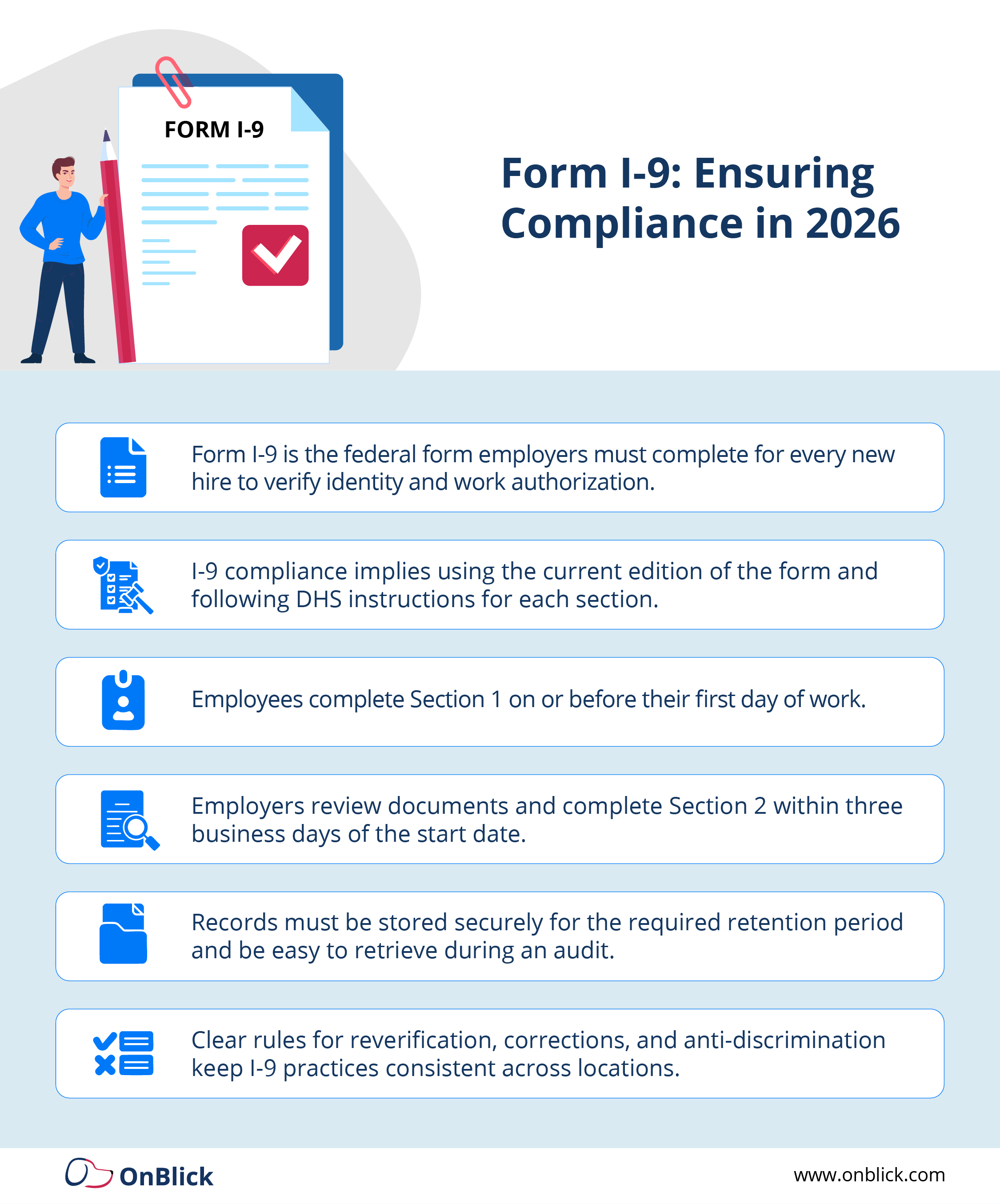
Form I-9, Employment Eligibility Verification, is the federal form that U.S. employers must complete for every new hire to confirm their identity and authorization to work. Many HR professionals know it simply as “the i9 form” or “form i-9,” but its full title is i-9 employment eligibility verification, and it is one of the most regulated pieces of new-hire paperwork. It has three parts: employee information and attestation (Section 1), employer review of documents (Section 2), and reverification or rehire (Supplement B, formerly Section 3).
When people ask what is an i-9 form, a simple answer is that it is the us citizenship and immigration services uscis form i 9 that every U.S. employer must complete and keep on file. But Form I-9 compliance means more than having a signed form in the file. It is the end-to-end process of verifying identity and work authorization, completing each section on time, examining documents correctly, storing records securely, and applying the rules consistently across locations and worker types.
By 2026, the context around I-9 has shifted. Employers must use the current version of form i9, follow the latest instructions, and decide when to use in-person document inspection and when any DHS-approved alternative procedure (such as certain remote document examination options) is allowed.
Form I-9 compliance also includes anti-discrimination obligations. HR must avoid over-documentation, document bias, or different treatment based on national origin or citizenship status, even when trying to “be safe.” In practice, this means training staff to focus on what us citizenship and immigration services uscis form i 9 rules actually require, not on internal habits or assumptions.
A compliant I-9 program in 2026 answers four questions clearly for every hire:
- Was the right form used and completed fully and on time?
- Were acceptable documents reviewed correctly, using the permitted method?
- Are reverification and retention handled according to the rules?
- Can the employer show its decisions and timelines during an audit?
When these answers are consistently “yes,” Form I-9 turns from a paperwork risk into a structured control that protects both the organization and its workforce.
Why Form I-9 Errors Matter for HR and Employers
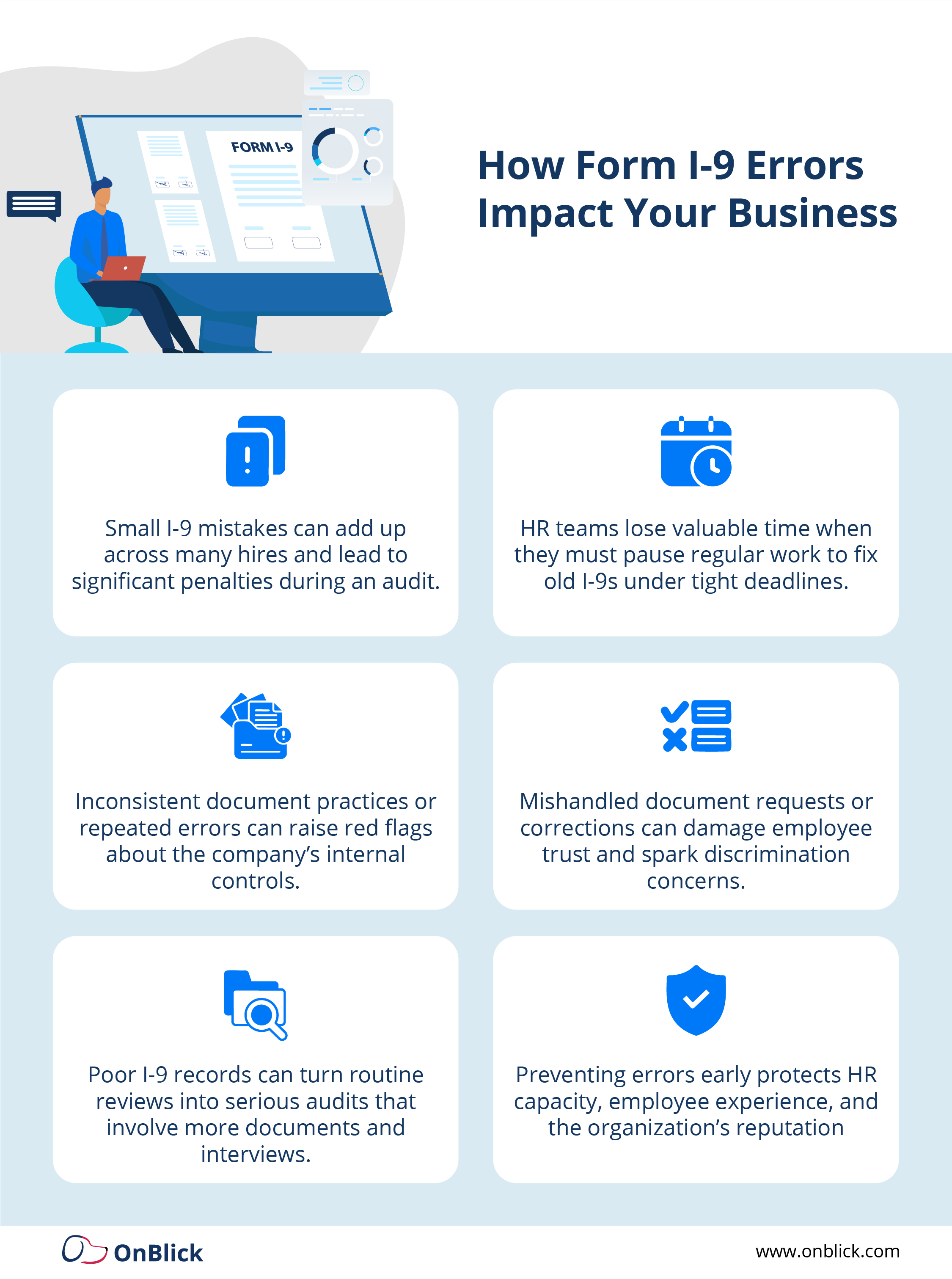
For HR teams, Form I-9 errors rarely show up as one big crisis at first. They start as small issues in daily work: a section left incomplete, a missing signature, a document copied for some hires but not others, or a reverification date that slips through the cracks. When hiring is fast, remote, or handled by different locations, these gaps can multiply without anyone noticing.
The problem is that audits do not look at good intentions. They look at patterns. A stack of late I-9s, inconsistent document practices, or incorrect corrections can quickly translate into penalties, follow-up requests, and intense time pressure on HR. Even when fines are avoidable, pulling staff into emergency clean up work disrupts onboarding, payroll, and other priorities.
I-9 issues also affect employees and the wider business. Mishandled document requests or inconsistent treatment can damage trust, trigger complaints, or raise discrimination concerns. For leaders, repeated I-9 findings signal weak internal controls, which can affect future inspections, customer confidence, and even deals or partnerships that involve compliance reviews.
Treating the i9 form as a strategic compliance risk rather than a routine form helps HR move from reacting to problems to preventing them altogether. Teams that still think of it only as paperwork often underestimate how much risk is attached to i-9 employment eligibility verification and how quickly small gaps can escalate during an audit.
Form I-9 Audits, Fines, and Penalties in 2026
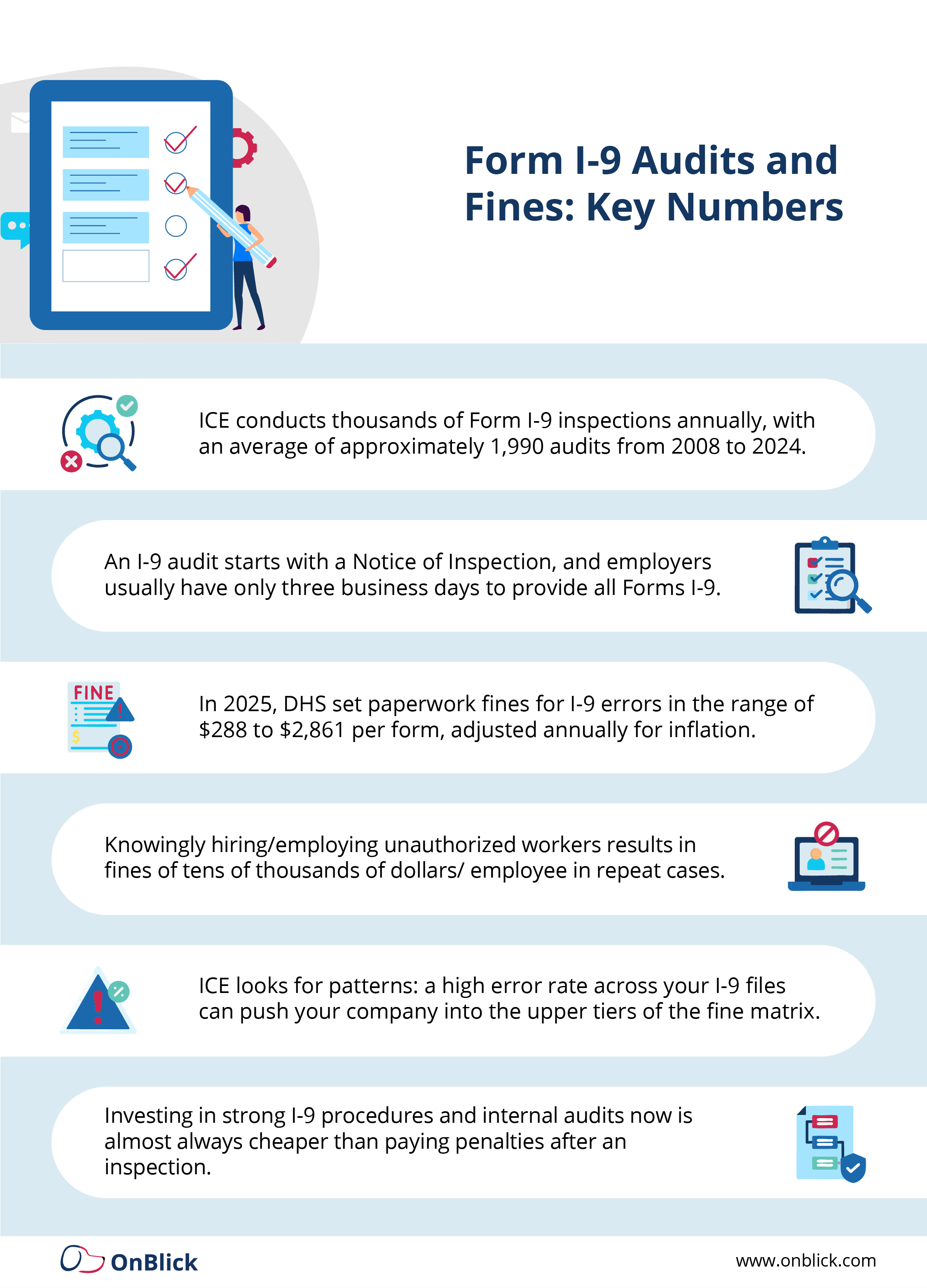
I-9 enforcement can fluctuate from year to year, but the long-term picture shows that audits are a regular part of how the government checks employer compliance. ICE worksite data compiled from fiscal years 2008–2024 shows I-9 inspections ranging from a low of about 203 audits in FY 2021 to a peak of 6,456 inspections in 2019, with an average of around 1,990 inspections per year over that period.
An I-9 audit typically starts when ICE serves a Notice of Inspection (NOI). Employers usually have three business days to produce their Forms I-9 and may also be asked for payroll records, employee lists, and other documents.
USCIS and ICE both stress that failing to complete or retain I-9s properly can lead to civil money penalties under section 274A of the Immigration and Nationality Act.
For 2025, DHS updated the official I-9 penalty ranges for inflation. Under the Federal Register’s 2025 adjustment, paperwork violations under 8 CFR 274a.10(b)(2) now carry fines from $288 to $2,861 per form, depending on the error rate and other factors.
Law firm summaries that apply this schedule note that knowingly hiring or continuing to employ unauthorized workers can result in fines up to $28,619 per violation for repeat offenses.
For most employers, the biggest risk is not one bad form, but patterns. When ICE finds that a large percentage of I-9s contain substantive or uncorrected technical errors, it can use the upper tiers of the fine matrix, multiplying penalties across hundreds or thousands of employees. A single enforcement action can quickly become far more expensive than years of proactive training, internal audits, and technology investment.
Key I-9 numbers HR leaders should keep in mind for 2025–2026:
- Average of ~1,990 I-9 inspections per year (2008–2024), with peaks above 6,000
- Three business days is the typical window to produce I-9s after a Notice of Inspection
- $288–$2,861 per form for paperwork violations under the latest DHS penalty schedule
- Fines for knowingly hiring or continuing to employ unauthorized workers can reach tens of thousands of dollars per worker in repeat cases
Common Causes of Form I-9 Errors
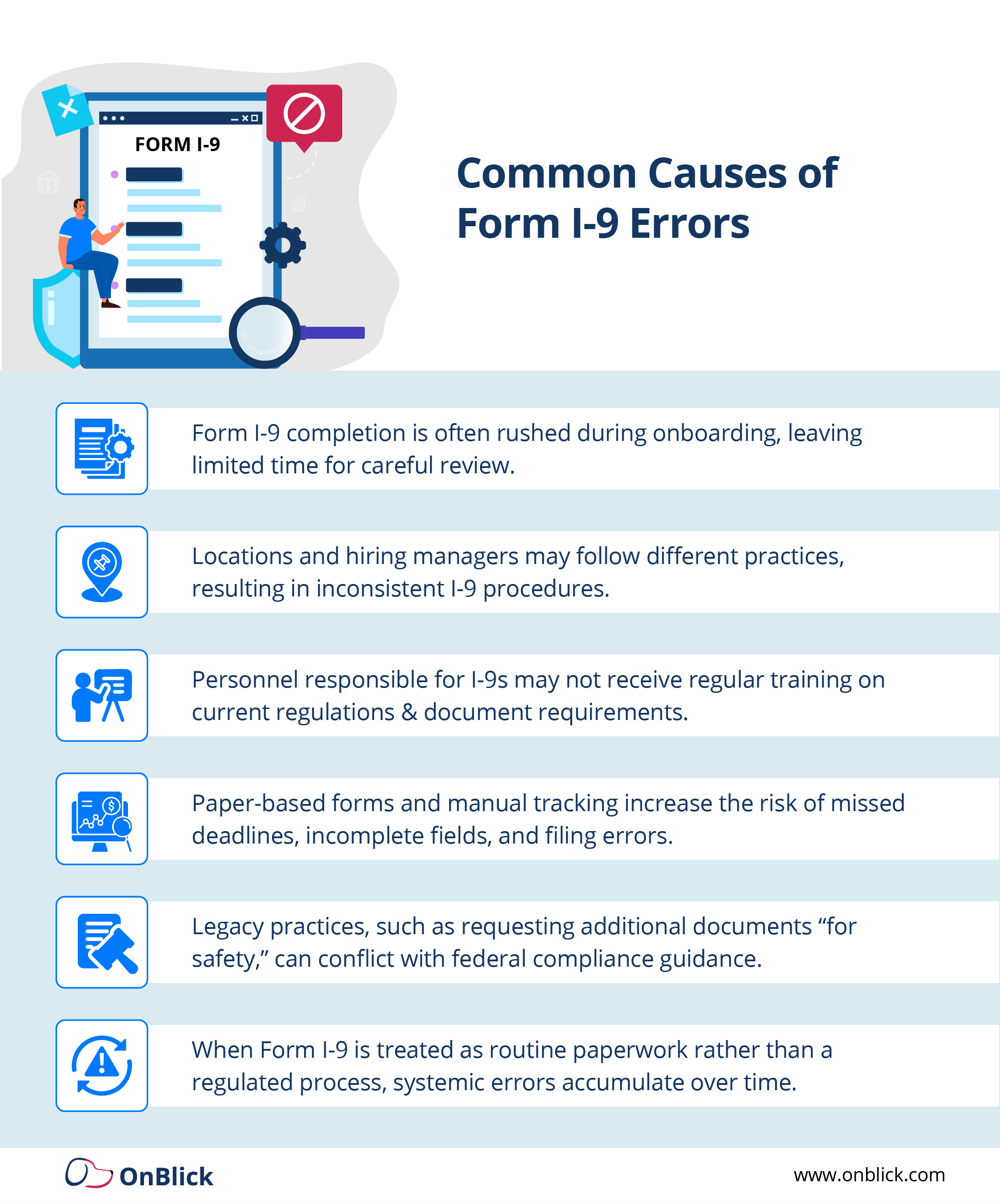
- Most Form I-9 errors are not made on purpose. They usually come from rushed onboarding, unclear instructions, or a lack of time. When HR is juggling many tasks at once, I-9 completion and review can slip into the background. This is when small issues like missing dates, unchecked boxes, or incorrect documents start to appear more often.
- Another common reason is inconsistent processes. Different locations or hiring managers may follow their own habits instead of a standard workflow. Some copy documents for every employee; others do not. Some use one set of acceptable documents; others ask for more than required. These differences create confusion for staff and can look like patterns of non-compliance during an audit.
- Training gaps also play a large role. Many people who handle I-9s have never had formal training on the latest uscis form i 9 instructions, remote document inspection options, or how to avoid discrimination. Without clear guidance, they rely on guesswork or old practices that no longer match current rules.
- Technology and tools can either help or hurt. Paper forms, spreadsheets, and email reminders are easy to lose or forget. Manual data entry and filing errors are common when there is no system to flag missing fields, track deadlines, or store records consistently. Over time, these small weaknesses in the process build up into a larger compliance risk.
When employers treat form i-9 as a simple paperwork task instead of a regulated process, the system itself becomes error-prone. Fixing the system is more effective than asking individual staff to “be more careful.”
Common Form I-9 Mistakes Employers Still Make
Even with updated forms and guidance, the most frequent Form I-9 problems are basic. They are usually not about fraud but about timing, incomplete information, document choices, and how corrections are handled. Many of these show up as technical or substantive violations during an ICE inspection and can lead to fines for each affected form.
1. Missing or Late Sections 1 and 2
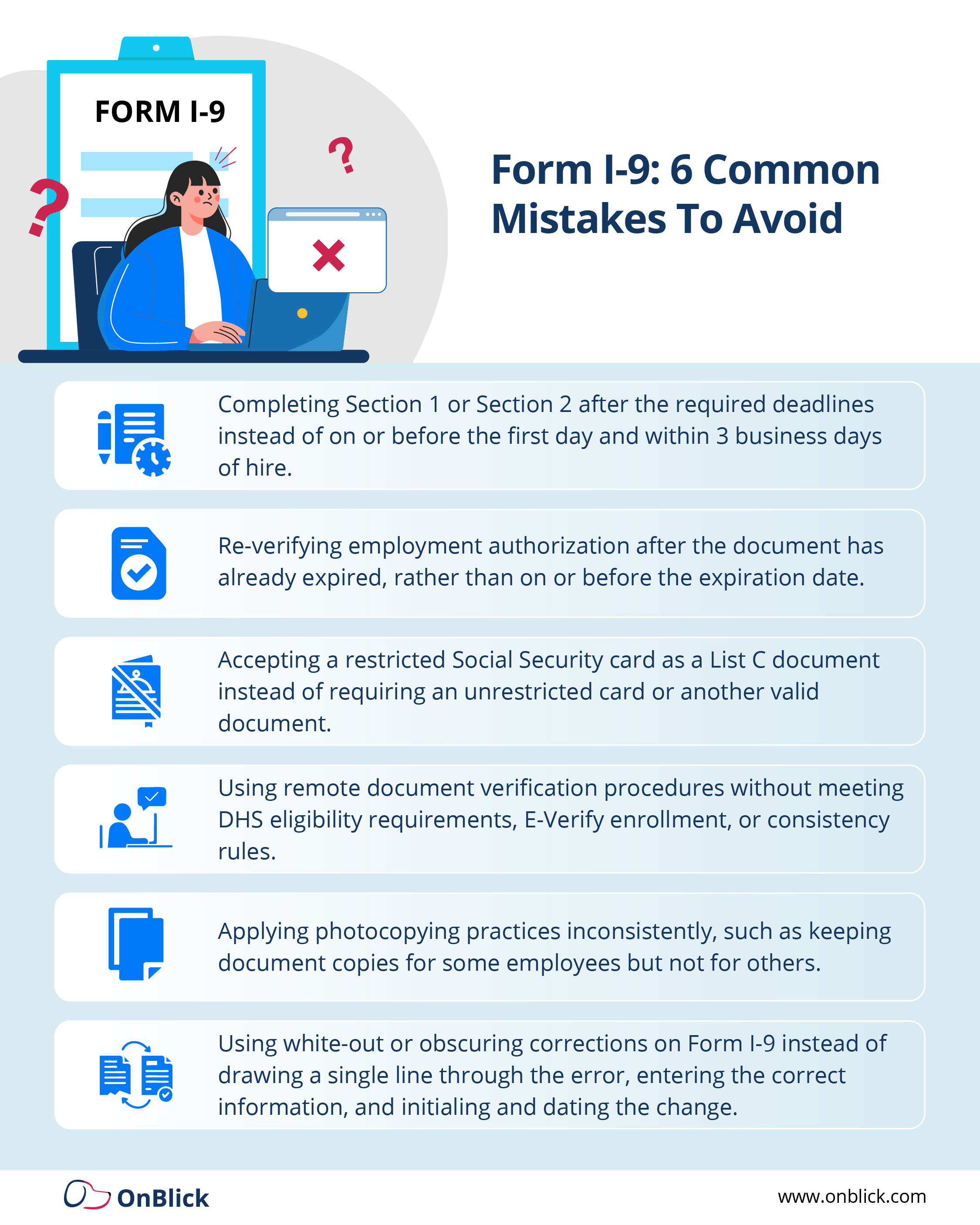
USCIS requires employees to complete Section 1 on or before their first day of employment, and employers to complete Section 2 within three business days of the start date.
Common mistakes include:
- Section 1 completed after the employee has already started work
- Section 2 completed more than three business days after the start date
- No Form I-9 at all for some employees, which is treated as a serious substantive violation
2. Incomplete or Incorrect Information
Another cluster of mistakes involves missing or inaccurate fields:
- No box checked for citizenship or immigration status
- Missing signatures or dates in Sections 1 or 2
- Missing document title, issuing authority, document number, or expiration date in Section 2
3. Accepting the Wrong Documents
Employers must accept either one List A document or a combination of one List B and one List C document. Frequent document-related mistakes include:
- Accepting a restricted Social Security card (for example, marked “NOT VALID FOR EMPLOYMENT” or “VALID FOR WORK ONLY WITH DHS AUTHORIZATION”) as a List C document, even though USCIS clearly states these are not acceptable
- Accepting the wrong combination of documents (e.g., only a List B document without List C, or extra documents that do not match the Lists of Acceptable Documents)
- Failing to recognize expired documents where no automatic extension applies
4. Over-Documentation and Discriminatory Practices
A different category of mistakes involves asking for too many or specific documents. USCIS and the Department of Justice explicitly warn employers not to:
- Request more or different documents than Form I-9 requires
- Tell employees which documents they must present
- Treat workers differently based on citizenship, immigration status, or national origin in the I-9 process
5. Misusing Remote Verification and Reverification
Since DHS introduced an optional alternative procedure for remote document examination, only employers that participate in E-Verify and remain in good standing can use it.
Common mistakes here include:
- Using remote examination even though the employer is not an eligible E-Verify participant
- Applying the alternative procedure inconsistently at the same site, which can create discrimination concerns
- Failing to keep required copies of documents when using the alternative procedure
Reverification errors are just as common:
- Not tracking expiration dates and failing to reverify on or before the document’s expiration
- Re-verifying when it is not required, such as for U.S. citizens or lawful permanent residents with no temporary work authorization limits
6. Improper Corrections and Recordkeeping
USCIS guidance is clear that errors must be corrected in a transparent way: use a single line to strike through the error, enter the correct information, and add initials and a date. For Section 1, the employee should make the correction; for Section 2 or reverification, the employer should do so.
Common problems include:
- Using white-out, markers, or erasing entries, so the original information is no longer visible
- Re-writing large sections without explanation or attaching a new form with no note about why
- Applying photocopying practices inconsistently: keeping copies of documents for some employees but not others, even though USCIS requires that if you choose to copy, you do so consistently for all employees
Warning Signs of Form I-9 Non-Compliance
Before an external audit ever happens, most organizations already have signals that Form I-9 risk is building in the background. The challenge is that these signals are spread across files, people, and systems, so they are easy to miss in day-to-day work. Taking time to review these indicators helps HR and compliance teams address issues early, instead of discovering them for the first time during a government inspection.
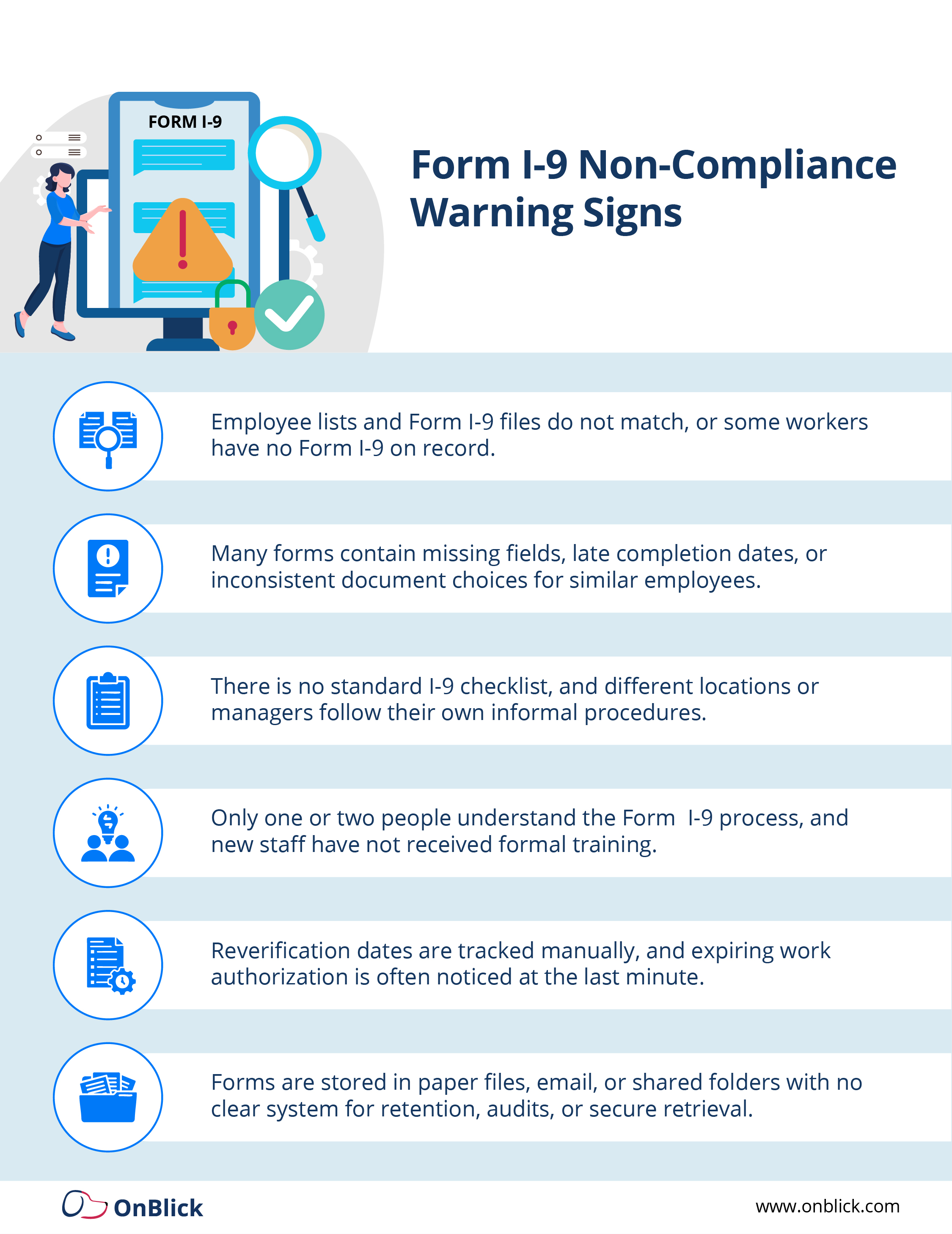
At the file level, warning signs include missing I-9s for certain employees, sections left blank, dates that do not match start dates, or forms completed after the required deadlines. Inconsistent use of documents, such as accepting different types of List C documents for similar hires, or keeping copies for some employees but not others, also suggests that procedures are not being applied uniformly.
At the process level, red flags appear when there is no standard I-9 checklist, when responsibilities between HR, recruiters, and hiring managers are unclear, or when reverification is handled reactively rather than planned in advance. If each location or business unit manages I-9s in its own way, it becomes difficult to show consistent compliance across the organization.
At the people and training level, risk grows when only one or two individuals understand the I-9 process, when there is no recent training on the latest form i9 version and guidance, or when new staff learn informally from peers instead of from documented procedures. If employees responsible for I-9s are unsure about what to do in complex situations, that uncertainty often shows up as inconsistent decisions in the files.
Finally, system and technology gaps are a warning sign on their own. Reliance on paper forms, shared drives, or ad hoc spreadsheets, with no automated reminders or validation, makes it more likely that deadlines will be missed, records will be misplaced, or corrections will not be documented properly. When these warning signs appear together, it is a signal to step back and strengthen the overall I-9 program before an external audit tests it.
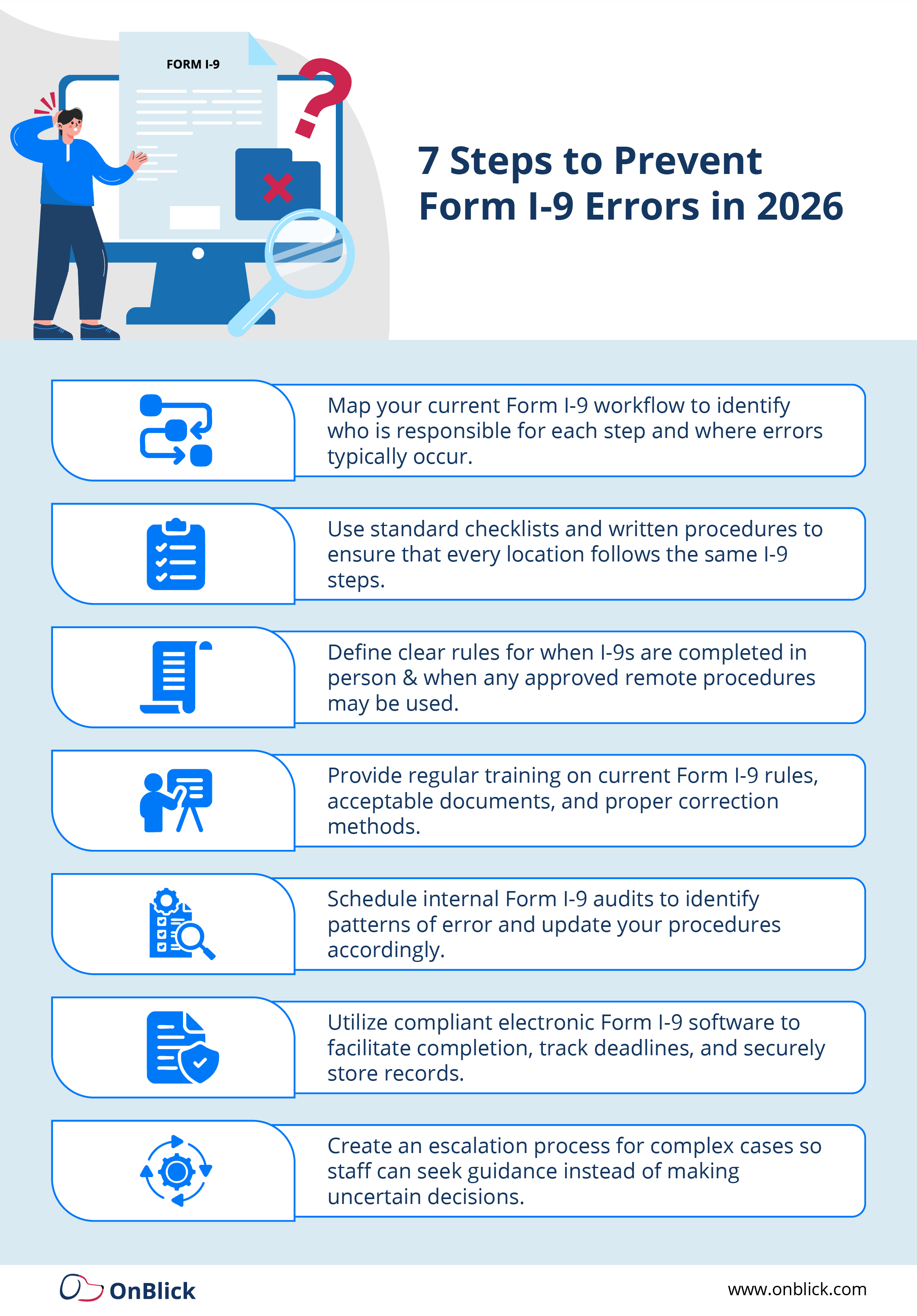
7 Tips to Prevent Form I-9 Errors in 2026
Preventing Form I-9 errors starts with seeing it as a structured compliance process instead of a single form. The goal is to build a workflow that is clear, repeatable, and documented, so that every new hire follows the same steps regardless of location or hiring manager.
1. Document your I-9 workflow
Begin by mapping how Form I-9 is handled today, from offer to retention. Identify who is responsible at each step, how deadlines are tracked, and where forms are stored. This makes gaps and inconsistencies visible and easier to correct.
2. Use standard checklists and templates
Create simple checklists for Section 1, Section 2, reverification, and retention. Share them with HR, recruiters, and hiring managers. Standard written procedures reduce variation between teams and help new staff follow the same process from day one.
3. Clarify rules for remote and in-person completion
If your organization uses any form of remote hiring, define when in-person document inspection is required and when a DHS-approved alternative procedure is allowed. Put these rules in writing so that all locations follow the same approach.
4. Provide regular training and refreshers
Schedule periodic training on the current version of Form I-9, acceptable documents, anti-discrimination rules, and correction practices. Include real examples from your own files. Training should reach everyone who completes, reviews, or stores I-9s.
5. Run internal I-9 reviews on a schedule
Plan internal audits at regular intervals. Review a sample of forms for each location, document the types of errors found, and address root causes. Use these reviews to improve procedures, not only to fix individual forms.
6. Use compliant technology where possible
Consider using electronic Form I-9 tools that guide completion, flag missing fields, prompt for signatures and dates, and store records in a central location. The goal is to reduce manual tracking and create a clear audit trail.
7. Establish an escalation path for complex cases
Define who reviews unusual situations, such as name mismatches, document questions, or repeat corrections. Give staff a clear contact point so they can ask for guidance instead of guessing. This helps keep complex decisions consistent and documented.
When these steps are applied together, the result is a predictable I-9 process that reduces errors, supports audits, and protects both employees and the organization.
Form I-9 Compliance: Employers’ Role
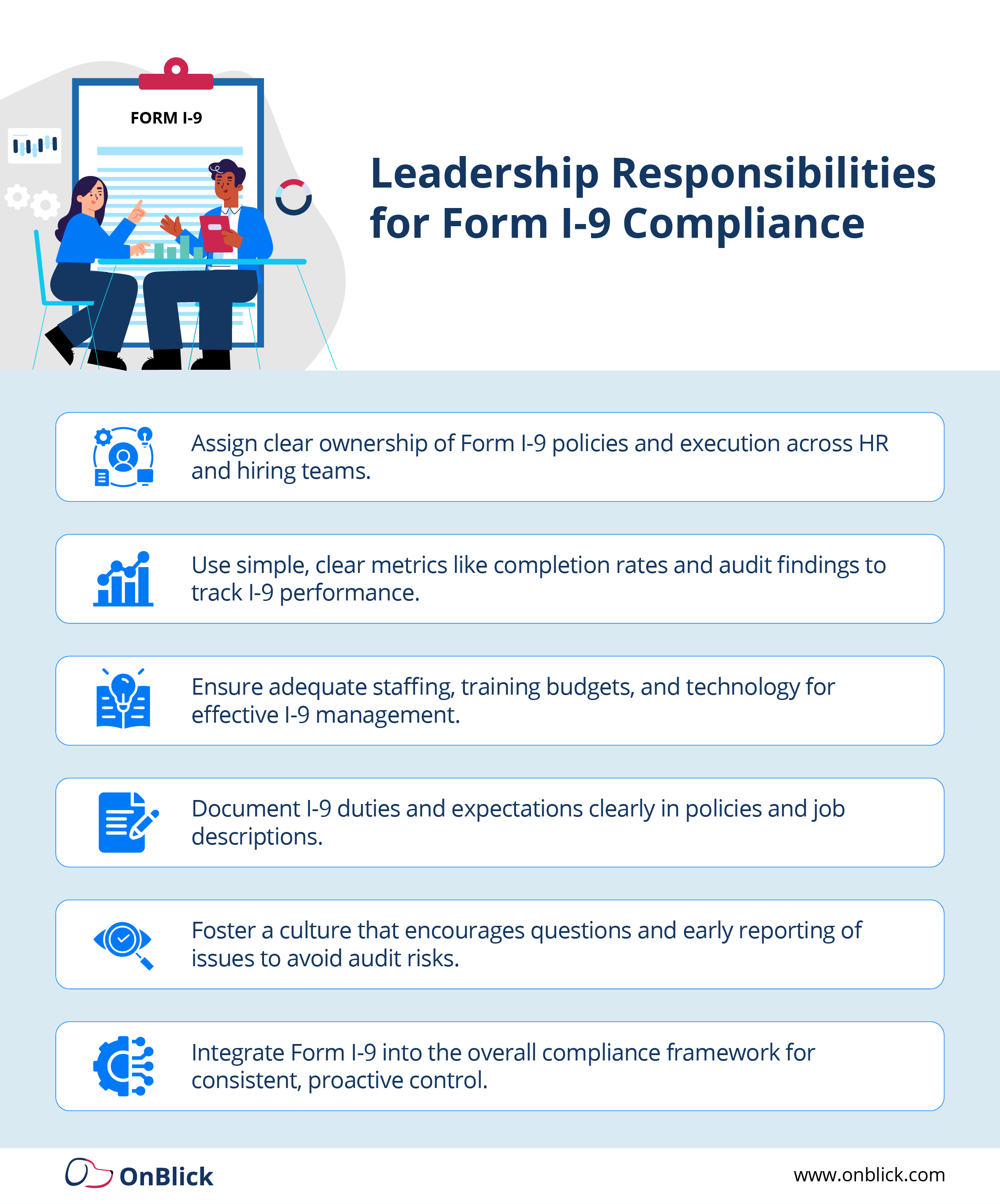
Strong Form I-9 compliance does not start at the HR desk. It starts with how leadership defines risk and sets expectations. When executives see I-9 as a core compliance requirement, not just an HR form, it becomes easier to secure the time, tools, and training needed to manage it properly.
- The first step is clear ownership. Senior leaders should confirm who is responsible for I-9 policy, who oversees implementation, and how responsibilities are shared between HR, recruiting, and local managers. This should be documented, communicated, and reflected in job descriptions and performance goals, not left to informal practice.
- Executives should also agree on a small set of I-9 performance metrics. Examples include the percentage of I-9s completed on time, the error rate found in internal audits, the percentage of expiring work authorization tracked before the due date, and the time taken to respond to document requests. Reviewing these metrics periodically, just like other compliance indicators, keeps I-9 visible at leadership level.
- Resourcing is another key area. Leadership decisions determine whether HR has adequate staff, training budget, and suitable technology to manage I-9 across locations and employment types. When teams are expected to handle complex verification rules with only paper forms and ad hoc instructions, errors are a predictable outcome.
- Form I-9 also interacts with broader risk and culture. Leaders set the tone for whether staff feel safe to report issues, ask questions, or request a review of existing forms. A culture that encourages early issue reporting leads to fewer surprises during government inspections. In contrast, a culture that pushes problems out of sight often results in larger findings later.
When executives integrate Form I-9 into the organization’s wider compliance and risk framework, they help shift I-9 from a reactive, form-by-form activity into a managed, measurable program. That shift reduces exposure, supports HR, and signals to employees and regulators that the organization takes its obligations seriously.
Frequently Asked Questions about Form I-9 Compliance
(The answers below are general information only and are not legal advice. Employers should consult counsel for organization-specific guidance.)
What happens if you mess up an I-9?
If you make errors on an I-9, the impact depends on the type and pattern of mistakes. Technical errors (like missing dates) can often be corrected if discovered and fixed properly. Substantive errors: such as failing to complete form i-9 at all, using the wrong documents, or not signing required sections can lead to civil penalties if identified during an audit. When many forms contain similar errors, that pattern can significantly increase fines and trigger closer scrutiny of your overall i9 form process.
Who is responsible for Form I-9 compliance?
Ultimately, the employer is responsible for Form I-9 compliance, even if HR, recruiters, or third parties help with completion. Senior leadership should assign clear ownership for policy, day-to-day administration, training, and internal reviews. Individual managers or HR staff may complete and review the forms, but the organization as a whole is accountable for following us citizenship and immigration services uscis form i 9 rules.
What triggers an I-9 audit?
I-9 audits may be triggered in several ways: random or targeted enforcement efforts, tips or complaints, patterns seen in E-Verify use, or information identified during other investigations. Sometimes employers are selected as part of broader industry sweeps. Because you cannot always predict what triggers an audit, building an audit-ready form i-9 process is safer than trying to “clean up” only when a Notice of Inspection arrives.
How to make a correction on an i-9 form?
To correct an I-9, do not erase or use white-out. Instead, draw a single line through the incorrect information, enter the correct data, and add initials and the date. The employee should correct Section 1; the employer should correct Section 2 or reverification. If the error is extensive, you can complete a new i9 form and attach it to the original with a brief note explaining why. Keeping a transparent correction trail is critical for i-9 employment eligibility verification compliance.
Why is I-9 compliance important?
I-9 compliance is important because it helps employers verify work authorization, avoid penalties, and demonstrate that they are following federal law. Improper or inconsistent handling of Form I-9 can lead to fines, disruption during audits, and reputational damage. It also intersects with anti-discrimination rules, so a well-managed form i9 process protects both the organization and employees by applying the same standards fairly.
What are i9 documents?
“i9 documents” refers to the identity and work authorization documents employees present for I-9 completion. These are listed as List A (identity and work authorization), List B (identity only), and List C (work authorization only). Employers must accept either one List A document, or a combination of one List B and one List C document, that meets us citizenship and immigration services uscis form i 9 requirements: without requesting extra or specific documents.
How to complete an i9?
To complete an I-9, the employee fills out and signs Section 1 on or before their first day of work for pay. Within three business days of the start date, the employer reviews original documents from the employee, completes Section 2, and signs it. For employees whose work authorization expires, reverification is done in Supplement B. Following the current form i-9 instructions from USCIS, and training staff regularly, helps ensure each i-9 employment eligibility verification is done correctly.
How long should you keep Form I-9 on file?
Employers must retain each Form I-9 for as long as the individual works for the organization, and for a specific period after they leave. The rule is: keep the form for three years after the date of hire or one year after the date employment ends, whichever is later. Once that retention period passes, you may securely destroy the i9 form as part of your document management policy.
Can Form I-9 be completed electronically?
Yes. Employers may use compliant electronic systems to complete and store form i9 records. An electronic system must follow USCIS standards for integrity, security, audit trails, and accessibility. When implemented correctly, electronic i-9 employment eligibility verification reduces data-entry errors, helps track deadlines, and makes it easier to respond to audits or internal reviews.
What is the penalty for Form I-9 violations?
Penalties vary based on the type and number of violations. Paperwork violations can result in per-form fines, while knowingly hiring or continuing to employ unauthorized workers carries higher penalties. Fine ranges are periodically adjusted for inflation, and patterns of errors across many i9 form records can push you into the higher tiers of the penalty matrix. Investing in training, internal audits, and strong processes usually costs far less than a single major enforcement action.
Summing Up: Building Strong Form I-9 Practices for 2026
Form I-9 (form i-9) is one of the simplest looking forms in the hiring process, but it carries significant compliance risk. In 2026, treating it as routine paperwork is no longer enough. HR teams need a consistent workflow, informed staff, and systems that support accurate, timely completion.
The most effective I-9 programs are built step by step. Map how you work today, standardize procedures, train the people who handle I-9s, and check your files regularly. Add technology that fits your scale and risk profile so that reminders, validations, and records do not depend on one person’s memory.
Leadership attention matters as much as process. When executives recognize I-9 as a regulated obligation, they are more likely to provide the time, tools, and support HR needs. That investment protects the organization from avoidable penalties and helps create a fair, transparent experience for employees.
If you are ready to strengthen your I-9 program, start with one action: review your current workflow against the warning signs and steps in this edition of HR Insights. From there, you can decide where process changes, training, or a platform like OnBlick can add the most value. Whether you call it Form I-9, form i9, or i-9 employment eligibility verification, the expectations behind the us citizenship and immigration services uscis form i 9 stay the same.
How OnBlick Supports Form I-9 Compliance
Form I-9 compliance depends on clear rules, consistent steps, and accurate records. OnBlick is designed to help employers put this structure in place. Instead of relying on paper forms and manual tracking, HR teams can guide every new hire through a standard, compliant workf