
An employee handbook gives your team a clear place to find answers about working hours, time off, workplace expectations, and where to raise concerns. For small and midsize businesses (SMBs), it also helps owners and managers handle everyday situations consistently.
When it is time to review your employment practices, you should be able to show which policies were in effect, how employees received them, and whether your team followed them. Keeping that information organized makes it easier to answer questions and identify gaps.
This guide explains how to build an audit-ready employee handbook, connect policies to supporting records, and keep everything current as your business grows.
What Makes an Employee Handbook Audit-Ready?
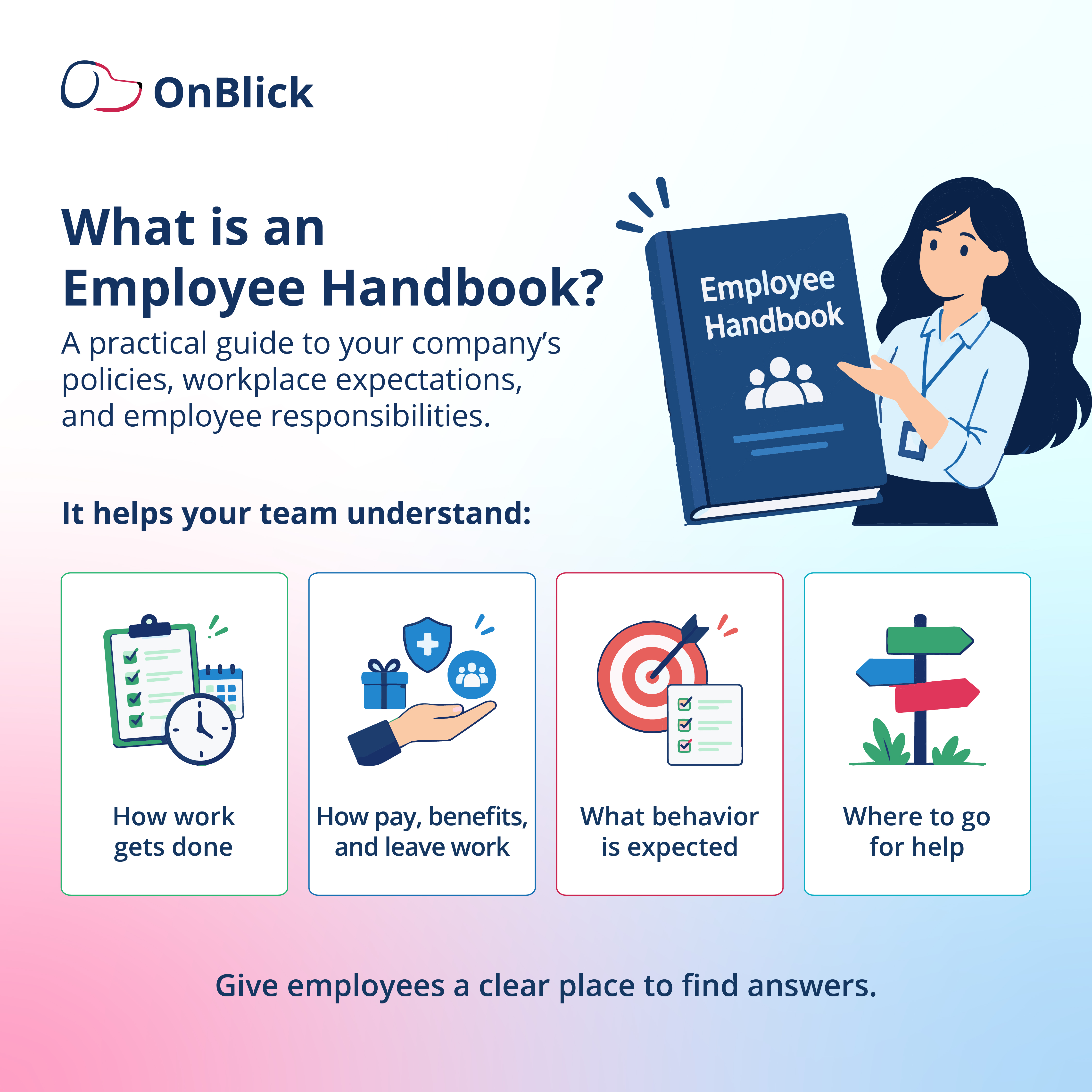
An audit-ready employee handbook contains clear, current policies backed by records of how they are shared and applied. It helps your business explain what employees were told and how workplace decisions were handled.
For example, imagine reviewing a leave request from six months ago. Could you find the policy that applied at the time, confirm that the employee received it, and retrieve the request and decision? Having those records available makes the review more straightforward.
Focus on five essentials
- Policies that fit your business. Reflect your employees’ work locations, work arrangements, and the requirements that apply to your organization.
- An identifiable version. Include an effective date and version number so you can distinguish the current handbook from earlier editions.
- A record of distribution. Track who received each version and follow up on missing acknowledgments.
- Consistent application. Help managers understand the policies, follow the relevant procedures, and document decisions.
- Records you can retrieve. Keep previous versions, acknowledgments, and supporting documents organized, with access limited where appropriate.
An acknowledgment helps document receipt; it does not establish that every policy is lawful or has been followed. Readiness depends on keeping the handbook, your records, and everyday practices aligned.
Start With Your Workforce, Locations, and Existing Practices
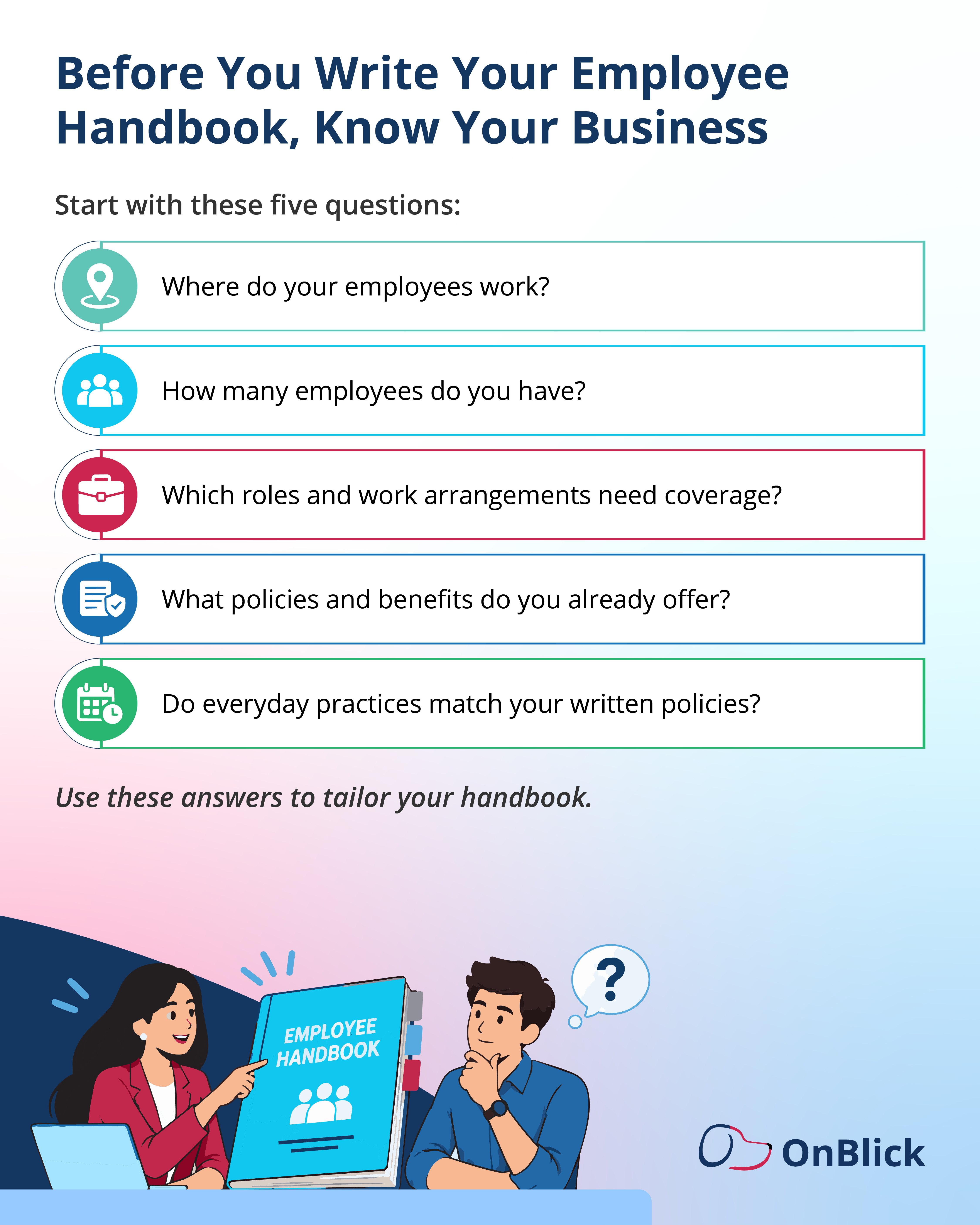
Before writing your handbook, gather the information that will shape its policies. A useful starting point is a simple list of:
- Where your employees work, including remote locations
- How many employees you have
- Their roles, schedules, and work arrangements
- The benefits and leave options you offer
- Your existing policies, forms, and employment documents
- Who handles employee questions, requests, and concerns
Next,compare your written policies with what actually happens. If the handbook directs employees to request leave by email, but managers now use an online system, that process needs updating. If departments follow different practices, resolve those differences before describing a company-wide policy.
For businesses operating across multiple locations, consider a core handbook supported by state or local addenda. An addendum explains the policies that apply to employees in a particular location. Make it clear which documents each employee should receive.
Assign one person to coordinate this work. In a small business, that might be the owner, an HR manager, or an operations lead working with employment counsel.
Which Policies Should an SMB Employee Handbook Include?
Your handbook should help employees understand what to expect and how to handle common workplace situations. Use the following areas as a starting point, then tailor the details to your business:
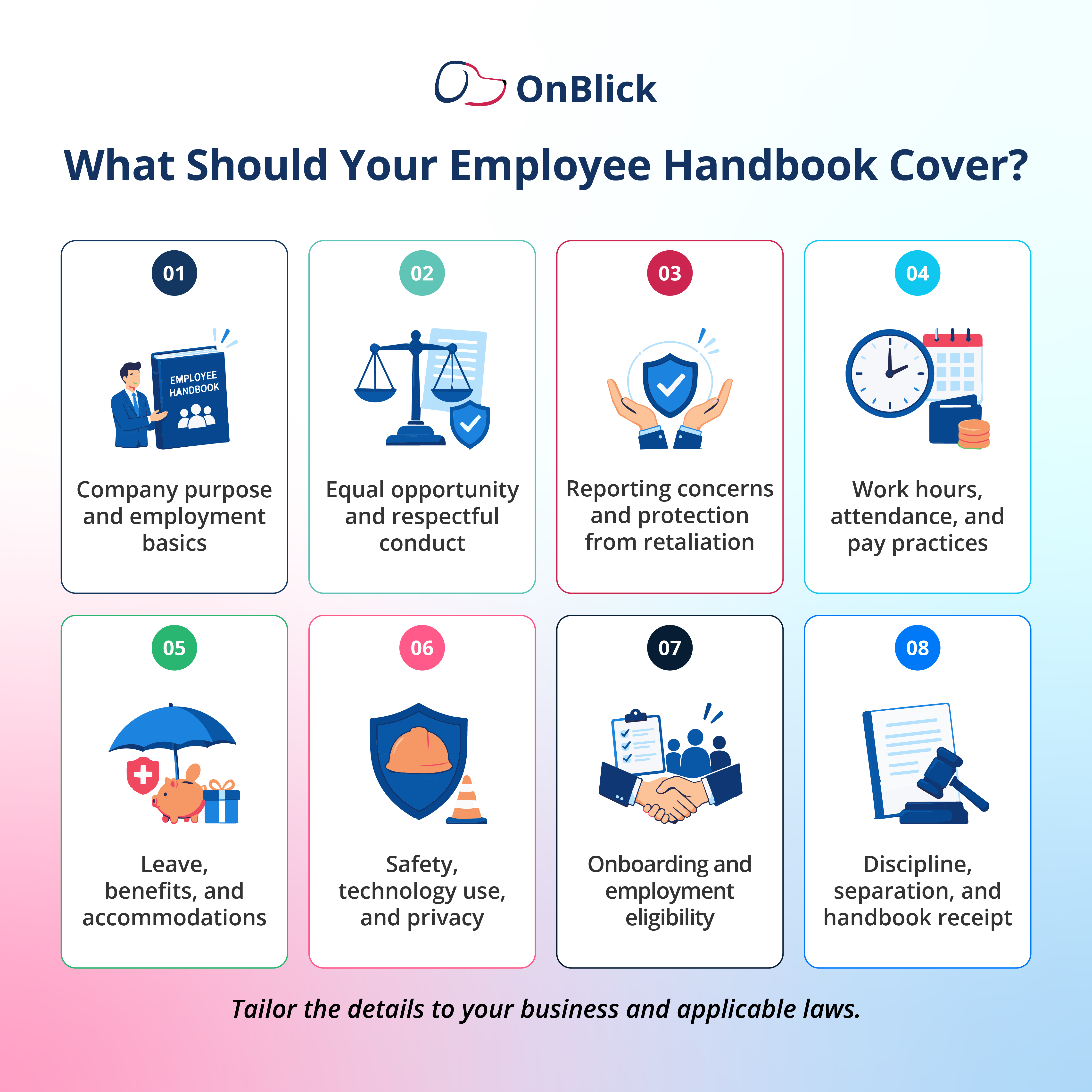
- Company basics and acknowledgment: Clarify who the handbook covers, key contacts, employment terms, and reviewed disclaimers, as well as how employees confirm receipt, ask questions, and access future updates.
- Onboarding and eligibility: Include the handbook and applicable addenda in your new hire onboarding packet, outlining required onboarding steps, employee responsibilities, and where to get help with employment documentation.
- Equal opportunity and respectful conduct: Set expectations for a workplace free from unlawful discrimination and harassment, ensuring employees are protected from retaliation. Make reporting instructions specific so employees know whom to contact, including an alternative when their immediate supervisor is involved. EEOC guidance recommends multiple reporting options, employee and manager training, and consistent follow-through.
- Leave, benefits, and accommodations: Distinguish company choices from legal requirements, as voluntary benefits need different wording from legally mandated leave (such as DOL notice requirements for FMLA). Clearly state available benefits, eligibility, request procedures, where to find detailed plan information, and whom to contact about workplace accommodations.
- Working hours and pay practices: Define schedules, attendance, timekeeping, paydays, breaks, overtime procedures, and how to report pay errors.
- Safety, technology, and privacy: Cover how to report hazards, emergency procedures, acceptable technology use, data handling, and remote-work expectations.
- Discipline and separation: Explain how workplace concerns are addressed, resignation procedures, and how to return company property.
Keep explanations straightforward. Employees should be able to find the relevant policy, understand what to do, and identify the right contact without interpreting complicated language.
Connect Handbook Policies to Supporting Records
Once your policies are written, identify the records that show how they work in practice. This is where handbook management connects with everyday HR administration. For each policy, ask: What action does it describe, who handles that action, and where is the record kept?
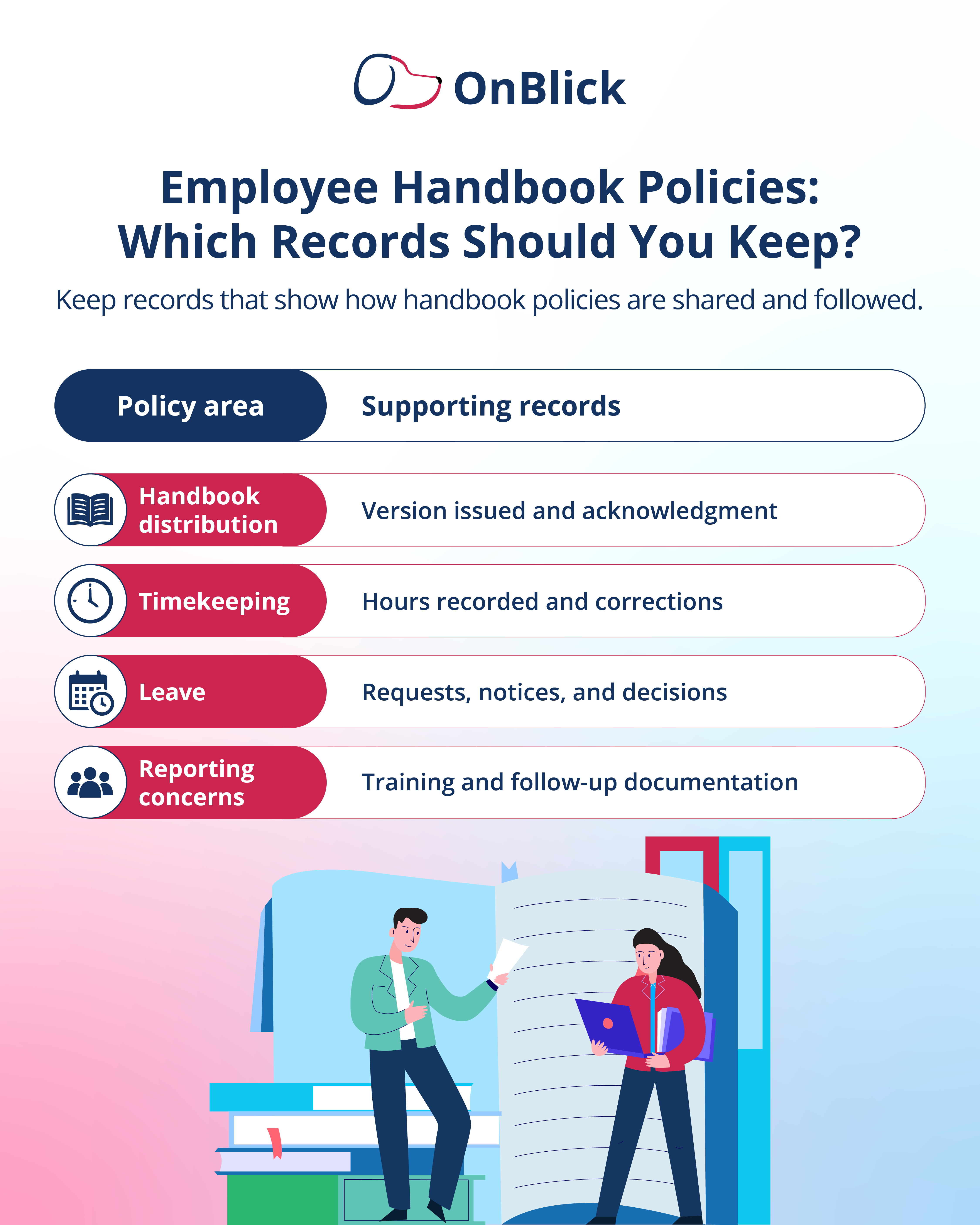
Track concrete supporting records across key areas:
- Handbook distribution: Record the version issued, distribution date, employee acknowledgment, and any follow-up on missing responses.
- Timekeeping: Maintain logs of recorded hours, submitted corrections (such as tracing a missed entry and who handled it), and relevant approvals.
- Leave: Keep records of requests, required notices, decisions, and the specific policy version that applied.
- Reporting concerns: Document policy training, reports received, and appropriately restricted follow-up documentation.
- Policy updates: Track approved changes, effective dates, employee communications, and updated acknowledgments where appropriate.
Give each type of record a clear owner and storage location. A small business might use a controlled document folder and tracking sheet; a growing business may use HR software to coordinate the process.
Keep sensitive information separate from broadly accessible documents. Medical information requires particular care: EEOC guidance explains that covered medical information must be kept confidential and separate from ordinary personnel files.
Set retention rules by record type and applicable requirements. Include a process for preserving relevant records when a complaint, investigation, or legal matter arises.
Review, Approve, and Roll Out the Handbook
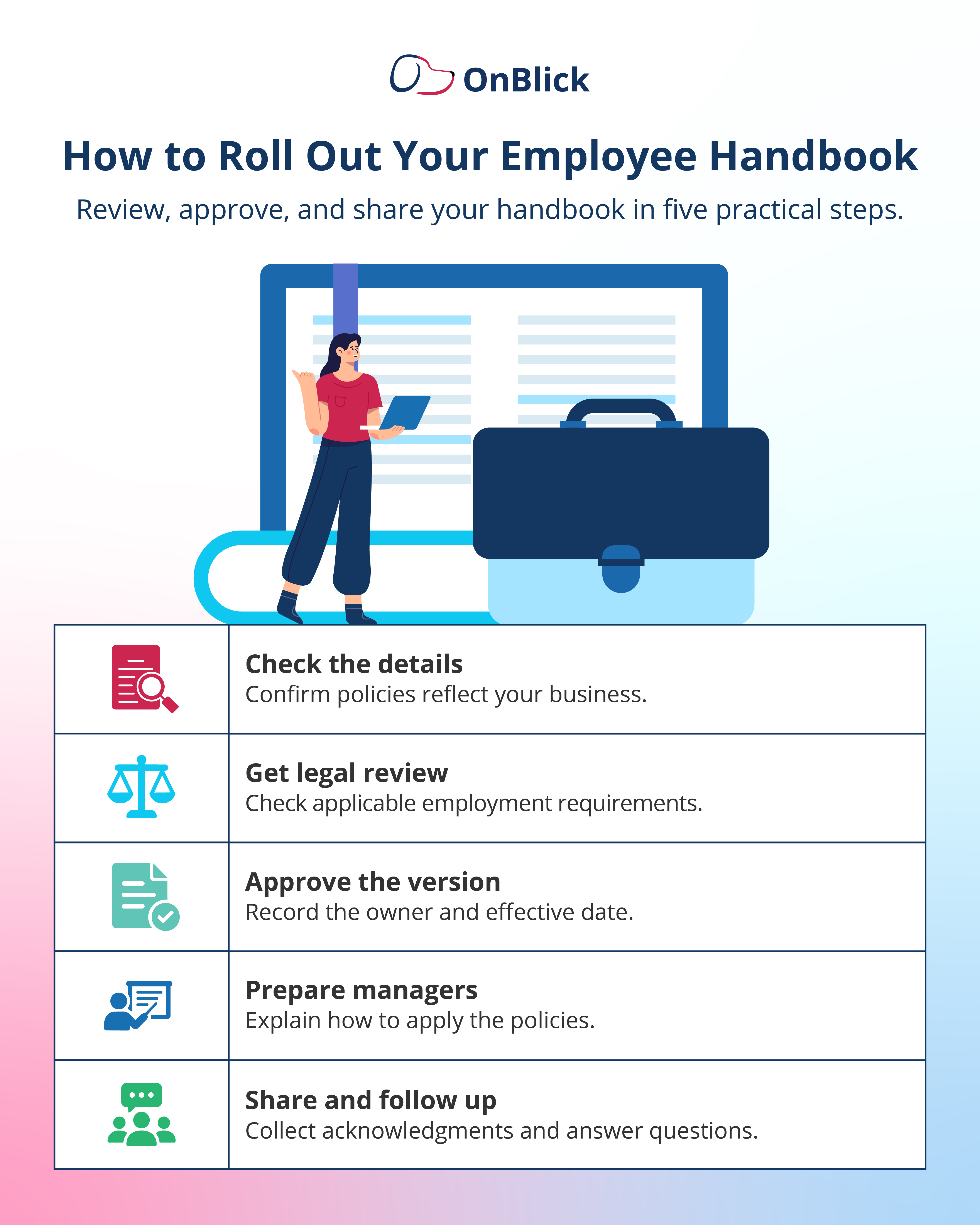
Before distribution, ask the people responsible for carrying out the policies to review them. Managers can identify instructions that are unclear or difficult to follow. HR or operations can check that contacts, systems, benefits, and procedures are accurate.
Then have employment counsel review the handbook for the laws and employment arrangements that apply to your business. This is particularly useful for provisions involving employment status, leave, discipline, confidentiality, and employee rights.
What to do once the handbook is ready
- Approve a specific version. Record its owner, version number, approval date, and effective date.
- Prepare managers. Explain their responsibilities, reporting procedures, and when to involve HR.
- Distribute the right documents. Provide the handbook and any applicable location-specific addenda in an accessible format.
- Explain what employees need to do. Give them time to read it, ask questions, and acknowledge receipt.
- Track and follow up. Record distribution and acknowledgments, then address missing responses.
Include the handbook in your new hire orientation process, and keep the current version available after orientation ends.
An employee who needs to check a policy months later should know exactly where to find it.
Keep the Handbook Current as Your Business Changes
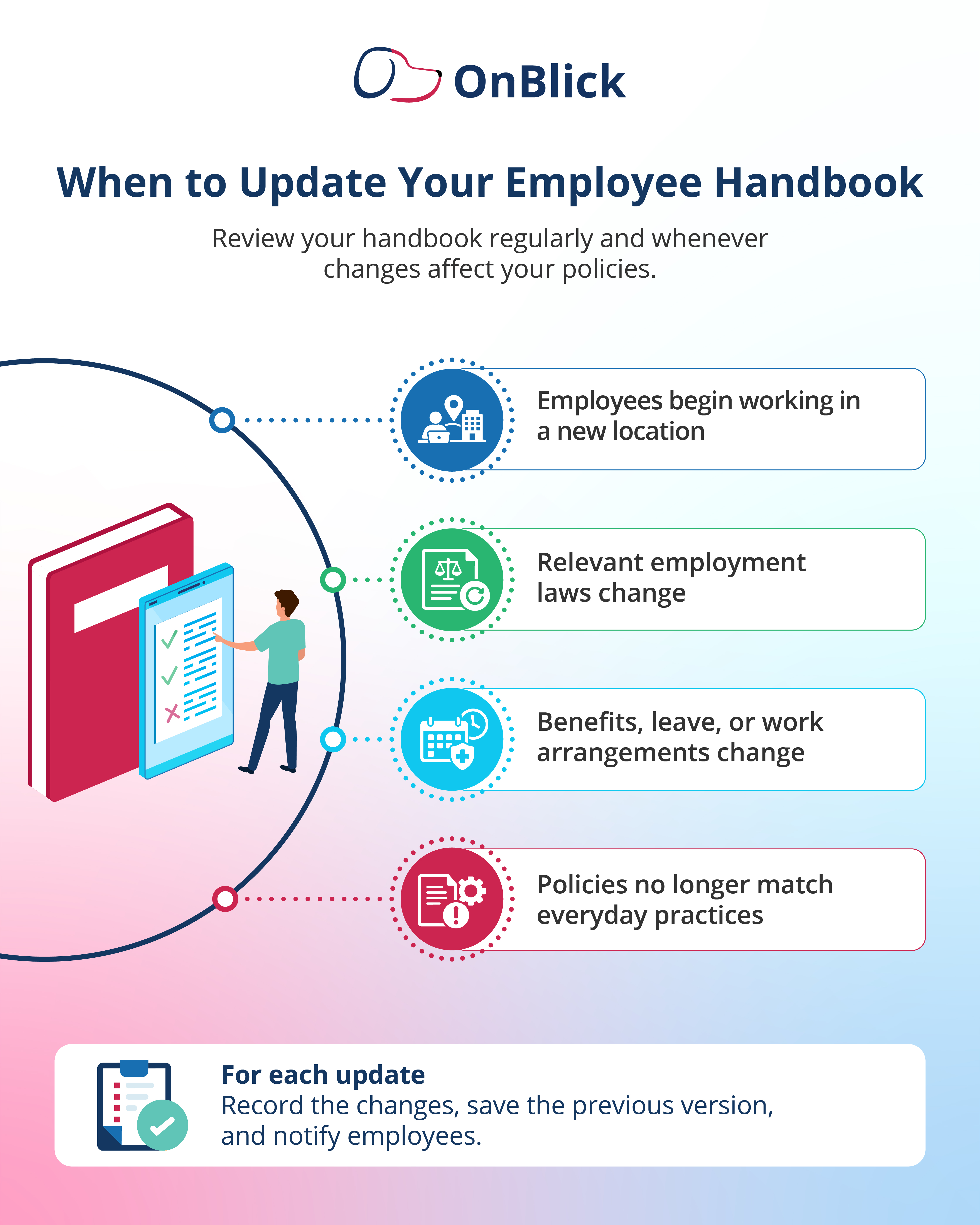
Put a recurring review on the calendar. An annual review can be a useful starting point, with earlier checks when changes affect your policies.
When to review the handbook
- Employees begin working in a new state or locality
- Relevant employment requirements change
- Workforce growth affects your obligations
- Benefits, leave, schedules, or remote-work arrangements change
- A process moves to a new system
- Employee questions reveal unclear or conflicting instructions
For every revision, keep a short change log showing what changed, why, who approved it, and when it takes effect.
Suppose your business introduces a new PTO policy effective January 1. Preserve the previous version with its applicable dates, save the approved replacement, and document how employees were informed. This helps HR determine which policy applied to a request made before or after the change.
Communicate changes clearly and follow any applicable notice requirements. Where acknowledgment of an update is appropriate, link the response to the specific version distributed.
Keep superseded copies in a controlled archive and clearly identify the current handbook. Employees should not have to compare several files to work out which one to use.
An Employee Handbook Audit-Readiness Checklist for SMBs
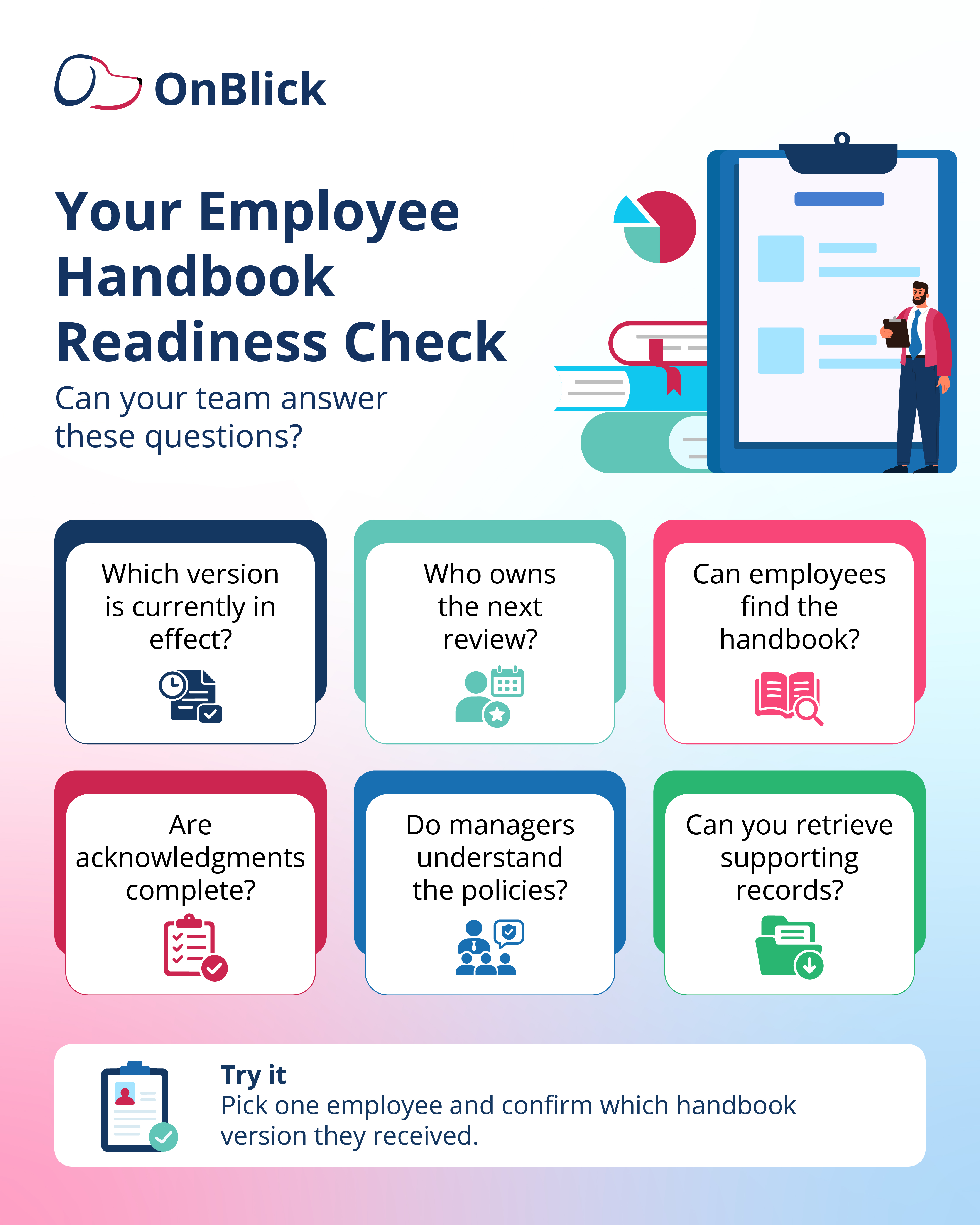
Use this checklist to review your handbook and the process behind it:
- The handbook reflects your workforce, locations, and current practices.
- Applicable state or local addenda are included.
- Employees have clear instructions for requests, questions, and concerns.
- The approved version has an owner and effective date.
- Employees can access the documents that apply to them.
- Distribution and acknowledgment records are available.
- Missing acknowledgments have documented follow-up.
- Managers understand their responsibilities.
- Previous versions and change records are preserved.
- Supporting documents are retrievable, with appropriate access controls.
Then try a small practical check. Select one employee and one policy. Can you identify the version that applied, confirm its distribution, and find the relevant supporting records?
If something is missing, record the gap, assign someone to address it, and set a follow-up date. Document corrections honestly, preserving the original history.
How OnBlick Can Support Organized Employee Documentation
Managing handbook-related documents becomes easier when employee information and onboarding records are organized.
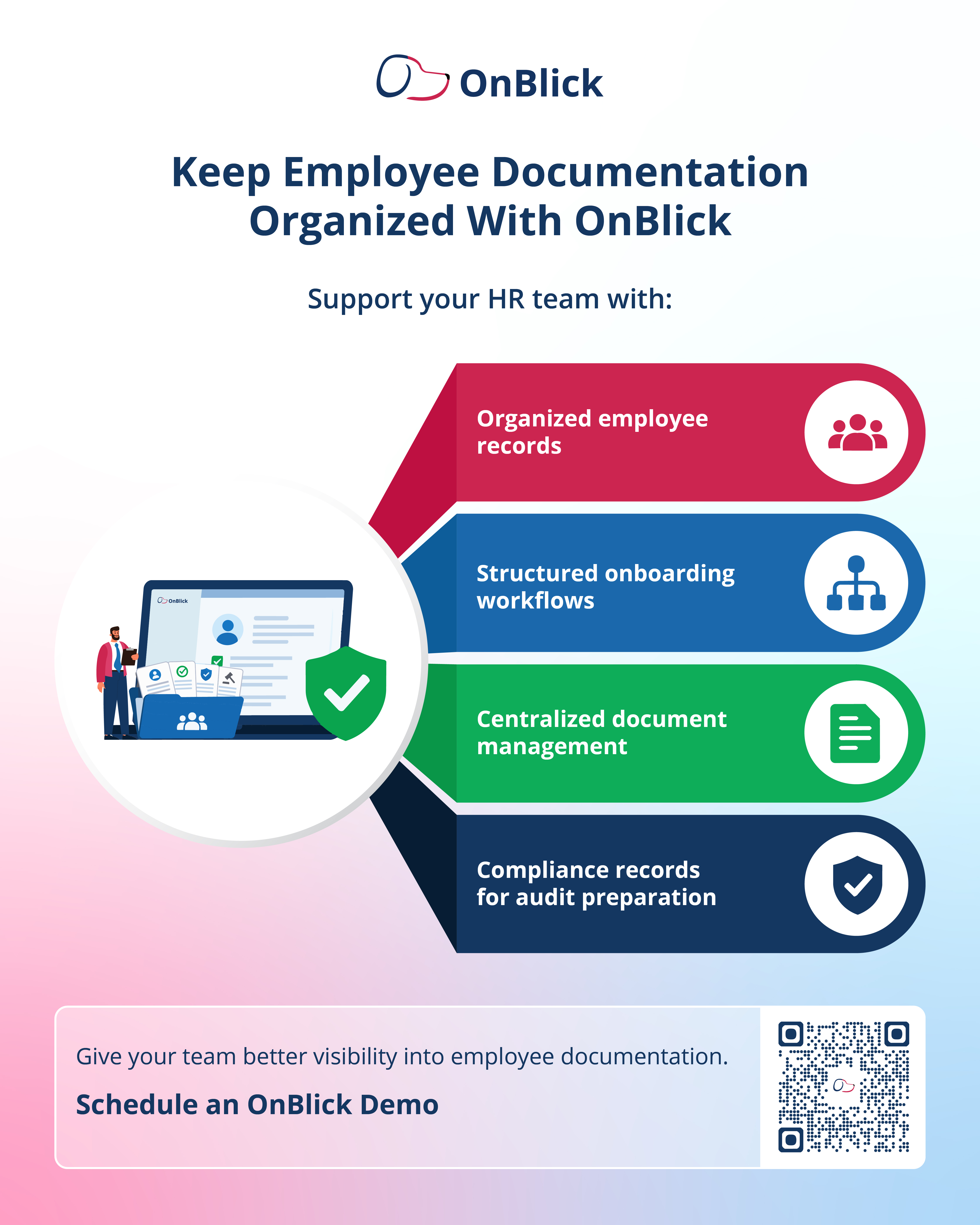
OnBlick supports employee records, onboarding workflows, organizational-document management, and compliance-document storage. These capabilities can help HR teams manage documentation alongside the employee lifecycle and reduce the need to search across disconnected files.
For an SMB, the practical starting point is to identify which documents employees need, who is responsible for them, and how completion will be tracked. OnBlick can support the administrative workflows around those responsibilities, while your team and employment counsel manage policy content and legal review.
Schedule an OnBlick demo to explore how your business can organize employee records, onboarding documents, and compliance workflows.
Frequently Asked Questions
Is an employee handbook legally required for a small business?
A handbook is not universally required, but employers may be required to maintain particular written policies or provide specific notices. Requirements depend on factors such as location, employer size, and legal coverage. Check which obligations apply before deciding what your handbook should contain.
Can an SMB use a free employee handbook template?
Yes, as a starting point. Check its publication date, intended location, and assumptions about the employer. Replace placeholders, remove provisions that do not apply, and review the content against current requirements and your actual practices.
How often should an employee handbook be reviewed?
A practical approach is to schedule an annual review and check sooner when relevant laws, employee locations, benefits, or business practices change. Assign an owner so updates do not depend on someone noticing a problem.
What should HR do when an employee has not acknowledged the handbook?
First, confirm that the employee received the correct version and can access it. Ask whether they have questions or need assistance, then document the follow-up. If they decline to acknowledge it, record that accurately and seek HR or legal guidance before deciding on further action. Do not mark the acknowledgment complete without a valid record.