.gif)


Not because they lack skill, but because onboarding feels messy: 12 different emails, missing links, unclear expectations, and “we’ll send that later” paperwork. For HR, it becomes a week of follow-ups. For the employee, it becomes a week of doubt.
A strong new hire onboarding packet fixes this. It is the most practical way to make onboarding repeatable, consistent, and audit-ready, especially when you are hiring across locations, teams, and time zones. The onboarding packet is considered a key early touchpoint that shapes how employees perceive the business and helps new hires feel comfortable and engaged quickly.
What Is a New Hire Onboarding Packet?
A new hire onboarding packet is a structured collection of the information and documentation a new employee needs to review, complete, and understand as they begin employment. It typically includes:
- Paperwork the employee must sign
- Tasks and assignments they must complete
- Company and role-specific information
- A few welcome items to help them feel included
It can be physical (a folder/packet) or digital (portal, e-sign tasks, shared links). The key point is that content matters more than format.

Onboarding packet vs. onboarding program
Let us separate the two concepts:
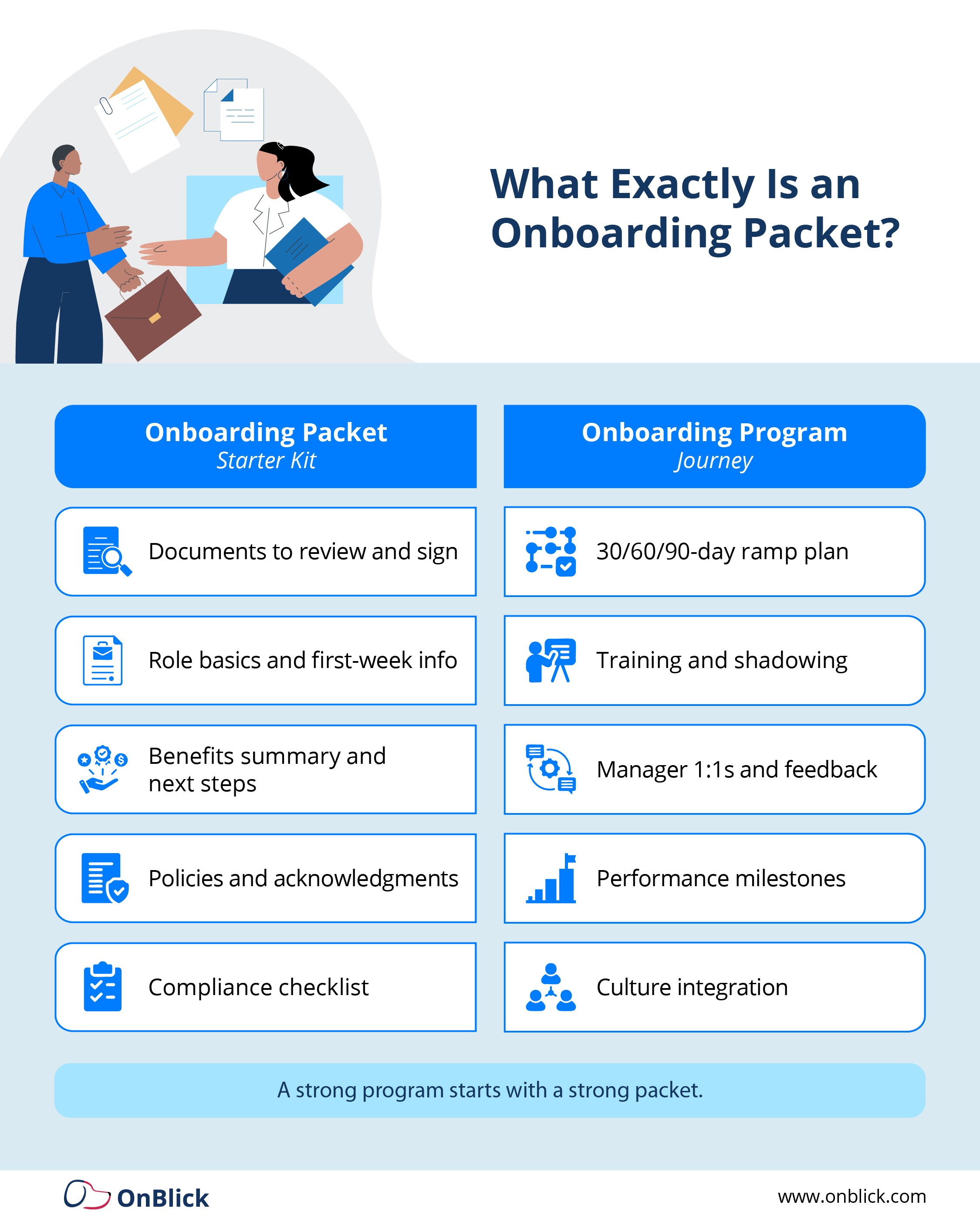
- Onboarding packet: the “starter kit” (documents + essentials)
- Onboarding program: the “journey” (30/60/90-day ramp plan, training, manager coaching, feedback loops)
A great onboarding program often starts with an excellent onboarding packet.
Why HR Teams Need a Standard Onboarding Packet for Consistency
HR teams are often asked to do two things at once: create a welcoming experience and ensure legal readiness. The onboarding packet is where those two priorities meet.
Why this matters for HR teams
A well-designed packet helps HR:
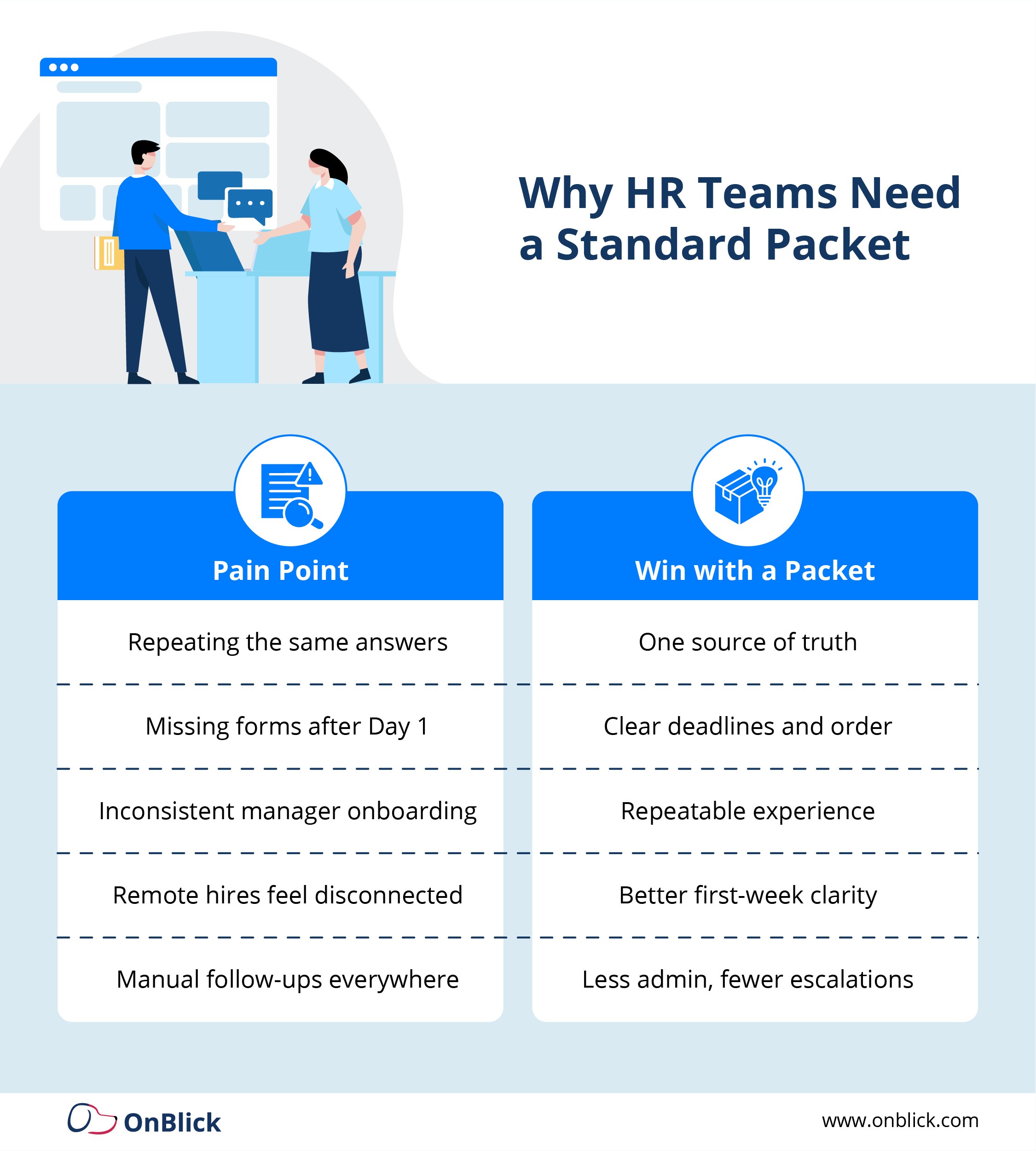
- Reduce repeat questions (“Where do I find X?” “What happens next?”)
- Standardize onboarding across departments and managers
- Prevent late or missing forms
- Improve employee confidence in week one
- Create a clear record trail for audits and internal reviews
Common patterns HR sees when packets are weak
- Employees start without tool access or clear first-week goals
- Managers improvise the onboarding experience
- Payroll and benefits enrollment steps happen late
- Compliance actions get rushed (and errors rise)
- Remote hires feel isolated because information is fragmented
New Hire Onboarding Statistics: Productivity, Retention, and Experience
Onboarding is measurable, and the gap is larger than most organizations think:
- Only 12% of employees strongly agree their organization does a great job onboarding new employees (Gallup).
- SHRM reports new hires can be 50% more productive when they go through standardized onboarding.
- SHRM also recommends tracking onboarding success using meaningful metrics like time-to-productivity, retention/turnover rates, retention threshold, and new hire surveys.
What these numbers suggest: even small improvements in consistency can create meaningful gains in early productivity and retention.

The Psychology of Onboarding: How Clarity Reduces New Hire Anxiety
A new job creates “hidden workload.” Even high performers spend mental energy on basic uncertainty:
- How do things work here?
- Who do I ask?
- What is expected in the first week?
- How will my work be evaluated?
.jpeg)
Gallup notes that onboarding is critical for forming an emotional bond between the new hire and the company. When onboarding feels disorganized, the employee may not say it directly, but they often interpret it as a signal: “This place is not prepared.”
What a great onboarding packet really does
It reduces cognitive load and builds early confidence by providing:
- Clear next steps
- Predictable schedules
- Trusted sources of truth
- “You belong here” signals (welcome note, culture overview, team context)
.jpeg)
Culture and welcome elements (like a welcome note and culture overview) need to be recognized not as fluff, but as an experience driver that helps employees feel involved and at ease quickly.
Spotting the Signs
If you are unsure whether your onboarding packet is working, the signals usually show up fast.
Early warning signs (operational)
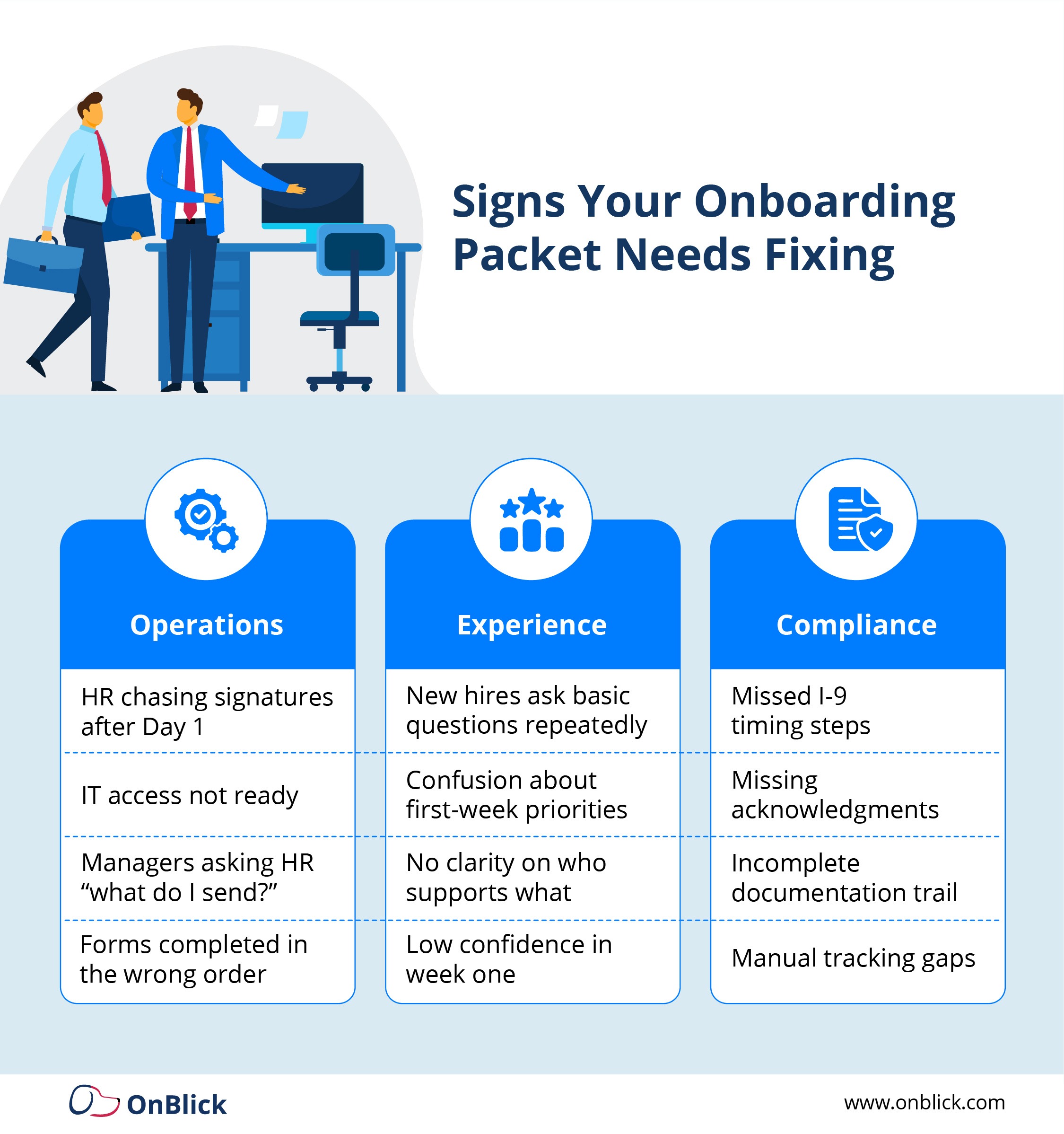
- HR is chasing signatures after Day 1
- IT provisioning is delayed or inconsistent
- Managers ask HR for “what do I send the new hire?” every time
- New hires complete forms in the wrong order
Early warning signs (employee experience)
- New hires repeatedly ask where to find basics
- They do not know the schedule for week one
- They struggle to name their key contacts
- They feel hesitant to reach out (because there is no clear process)
Early warning signs (compliance risk)
In the U.S., onboarding often includes time-sensitive compliance steps:
- Form I-9 Section 1 must be completed no later than the employee’s first day of employment (USCIS).
- Form I-9 Section 2 must be completed within three business days after the employee’s first day of employment (USCIS instructions).
- Employers must have employees complete Form W-4 so the employer can withhold correct federal income tax (IRS).
- Federal law requires employers to report basic information on new and rehired employees within 20 days of hire to the state where the employee works (ACF).
A packet that clearly guides employees through what to complete and when reduces last-minute scrambling.
New Hire Onboarding Packet Checklist: 7 Essentials to Include
Below is a practical, HR-friendly blueprint based on expert-recommended packet components, expanded into a repeatable structure you can implement across teams.
.jpeg)
Strategy 1: Build the packet in 7 sections (keep it predictable)
Key packet inclusions are goodies, a welcome note, culture overview, role details, perks/benefits, forms, and onboarding expectations. Use those as the backbone.
Suggested packet structure (simple and scalable):
- Welcome (note, message from leadership, day-one overview)
- Culture (values, how you work, where to get involved)
- Role & Team (team intro, goals, tools, mentor contact)
- Logistics (schedule, key contacts, IT access checklist)
- Benefits & Perks (plain language summaries, enrollment steps)
- Required Forms (what, why, when, where to submit)
- First Week Expectations (learning plan, meetings, success milestones)
Strategy 2: Add a one-page “Day 1 Map”
The Day 1 Map is a single page that answers the questions new hires ask most:
- Where do I start?
- What do I do first?
- Who do I contact?
- What meetings are already scheduled?
- What must be completed today vs later?
This reduces anxiety and cuts HR follow-ups.
Strategy 3: Make culture tangible (not generic)
Several HR experts recommend incorporating a company culture overview and values, plus ways to engage with company communities and initiatives.
To make this meaningful, include:
- 3–5 core values with a real example for each
- “How decisions are made here” (short and honest)
- Communication norms (response times, meeting expectations)
- Optional: a short “get to know you” questionnaire (learning style, work preferences)
Strategy 4: Create a role clarity sheet (manager-owned, HR-enabled)
It's suggested to include designation and team details, current objectives, mentor contacts, and tools used.
Turn that into a one-page role clarity sheet:
- Role purpose (1 paragraph)
- Top 5 responsibilities
- First 30-day goals (3 bullets)
- Key partners (names + what they support)
- Tools used (what each tool is for)
- “What success looks like” (1 paragraph)
This improves alignment between HR and managers, and makes performance expectations less ambiguous.
Strategy 5: Simplify benefits into decision-ready steps
Benefit summaries, cost share info, and forms for choosing benefits can also be included in the packet.
Employees often struggle because benefits information is long and time-sensitive. Make sure your packet has:
- A plain-language “what you must decide” list
- Dates: enrollment window and deadlines
- Who to contact for questions
- Links to plan documents (for detail), but keep the packet summary short
Strategy 6: Put compliance forms in a “what, why, when” format
The biggest onboarding mistakes happen when forms are treated like attachments rather than a guided process.
For example:
- Form I-9: required to verify identity and employment authorization for individuals hired to work in the U.S.
- Form W-4: used to withhold the correct federal income tax from pay; IRS states employers must have employees complete it when hired.
- New hire reporting: required within 20 days to the state where the employee works (federal requirement).
When you list these items in the packet, add:
- What it is (one line)
- Why it matters (one line)
- When it is due (one line, with the specific deadline)
- How to complete it (one line, including what documents to bring)
USCIS provides official lists of acceptable documents for Form I-9 verification; linking to those resources can help reduce confusion and errors.
Strategy 7: Set onboarding expectations that reduce fear
Outlining onboarding schedules and expectations can reduce nervousness and help new hires acclimate.
Practical expectation-setters to include:
- First week: what training is required
- First week: what meetings are scheduled
- First week: what “good progress” looks like
- How feedback will be shared (1:1 schedule)
- Who owns what (HR vs manager vs IT vs employee)
Executive View: Standardizing Onboarding Packets to Reduce Risk and Improve Ramp-Up
Leaders often talk about retention, productivity, and culture. The onboarding packet is one of the simplest systems that supports all three.
The executive view: onboarding packets are operational infrastructure
A standardized packet:
- Speeds up time-to-productivity (SHRM emphasizes productivity gains with standardized onboarding).
- Protects compliance with clear timelines and consistent documentation (I-9 timing is strict; clarity matters).
- Reduces HR and manager time spent reinventing onboarding for each hire
- Creates a better first impression that strengthens the early employee-employer bond (Gallup).
What leadership can standardize (without micromanaging)
- Templates by worker type (remote, onsite, hourly, exempt, intern)
- Ownership map (HR builds, managers personalize role sheets, IT provisions access)
- Onboarding KPIs using SHRM-style measures: time-to-productivity, retention/turnover, new hire surveys, and retention thresholds
How does OnBlick help
OnBlick can support onboarding by enabling employers to onboard multiple employees at once, store and manage documents in one place, send onboarding documents for signature, and support electronic Form I-9 workflows with reminders and E-Verify integration.
Final Takeaway: Make Every New Hire “Day 1 Ready”
A strong onboarding packet is not about adding more documents. It is about removing uncertainty.
When new hires start with clarity, structure, and confidence, HR spends less time chasing paperwork and more time supporting people. Managers spend less time improvising and more time coaching performance. And organizations build a first-week experience that actually matches their employer brand.
If your onboarding still lives across email threads and “we’ll send it later” attachments, your next best improvement is simple: build a packet that makes Day 1 feel prepared.