.gif)


Paid time off is one of the most important employee benefits for U.S. workplaces. It allows employees to take approved time away from work while still receiving pay, whether for rest, illness, personal needs, family responsibilities, or planned leave. For employers, PTO is not only a benefit offering. It also affects staffing, payroll, leave tracking, employee satisfaction, and policy compliance.
A clear PTO policy helps employees understand how much time they can take, how requests are approved, what happens to unused time, and how PTO is handled when employment ends. It also helps HR teams apply rules consistently across teams, locations, and employee groups.
This article explains what paid time off means, how PTO works, common PTO policy types, accrual, carryover, payout considerations, and what HR teams should review when building or managing a PTO policy.
What is Paid Time Off?
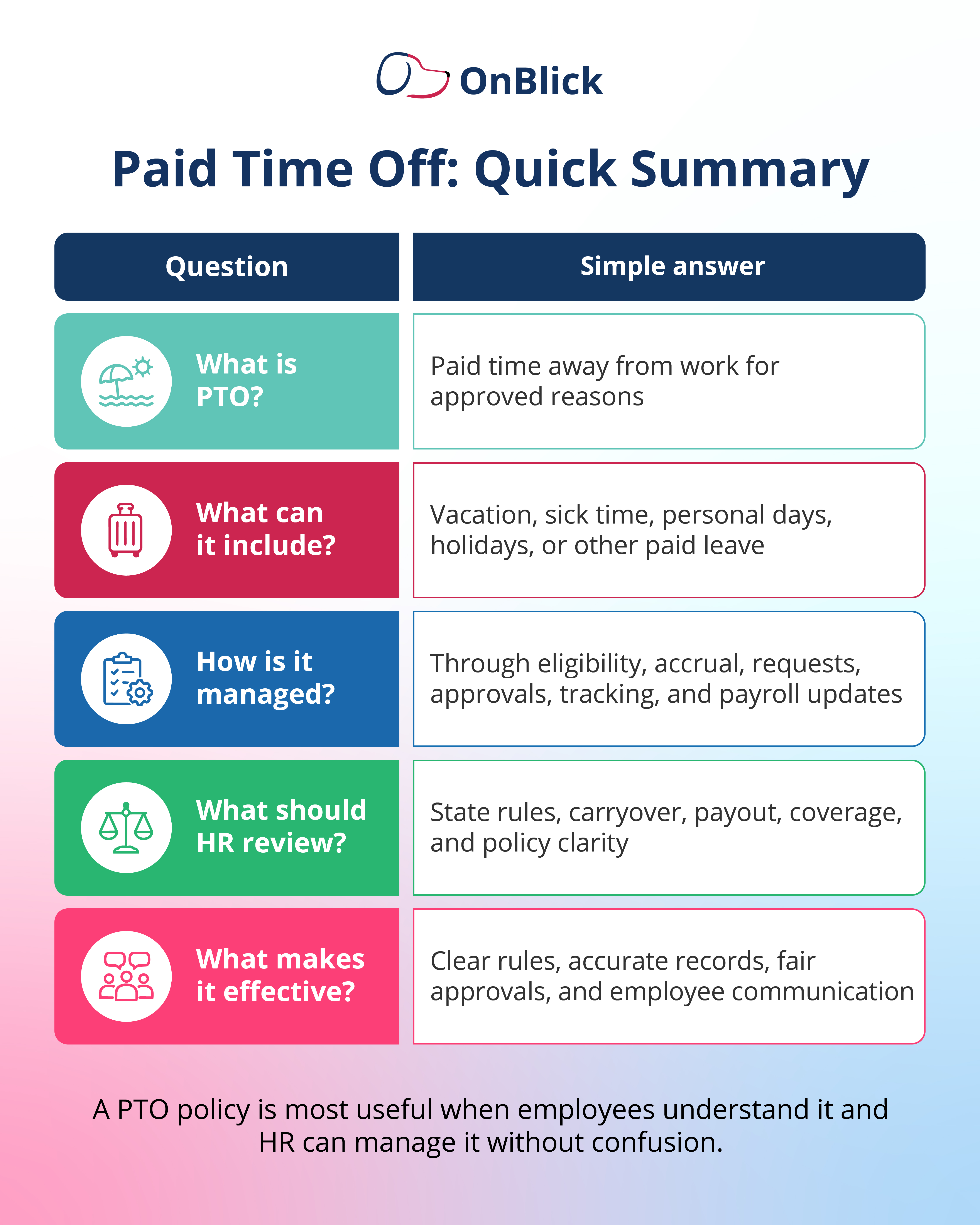
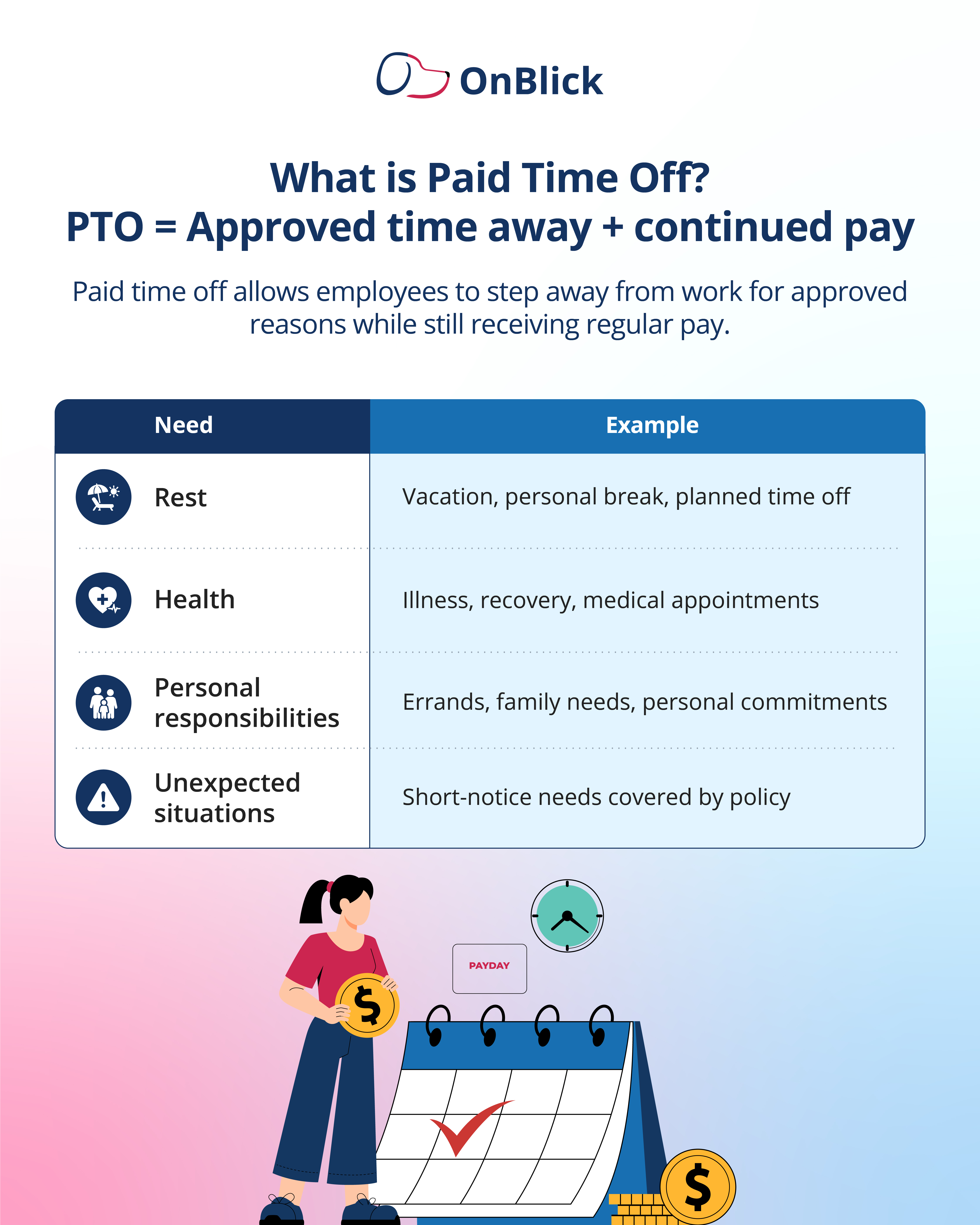
- Paid time off, commonly called PTO, is paid time away from work that employees can use with approval from the employer. It allows employees to take time off for personal needs, rest, illness, appointments, family responsibilities, or other approved reasons without losing regular pay for that time.
- For employers, PTO is part of the broader employee benefits package. It can support employee well-being, help prevent burnout, and make the workplace more attractive to current and future employees. At the same time, PTO needs clear rules, so employees understand how it is earned, requested, approved, used, and tracked.
- A PTO policy may combine different types of leave into one paid time-off bank, or it may separate vacation, sick leave, personal days, and other leave categories. The right approach depends on the employer’s policy, workforce needs, location, and any applicable state or local requirements.
- HR teams should treat PTO as both a benefit and an administrative process. Without accurate tracking, clear approvals, and payroll coordination, PTO can quickly lead to balance errors, coverage issues, and employee confusion.
What does PTO usually include?
- PTO can include different types of paid time away from work, depending on how the employer designs the policy. Some employers use one combined PTO bank, while others keep leave categories separate.
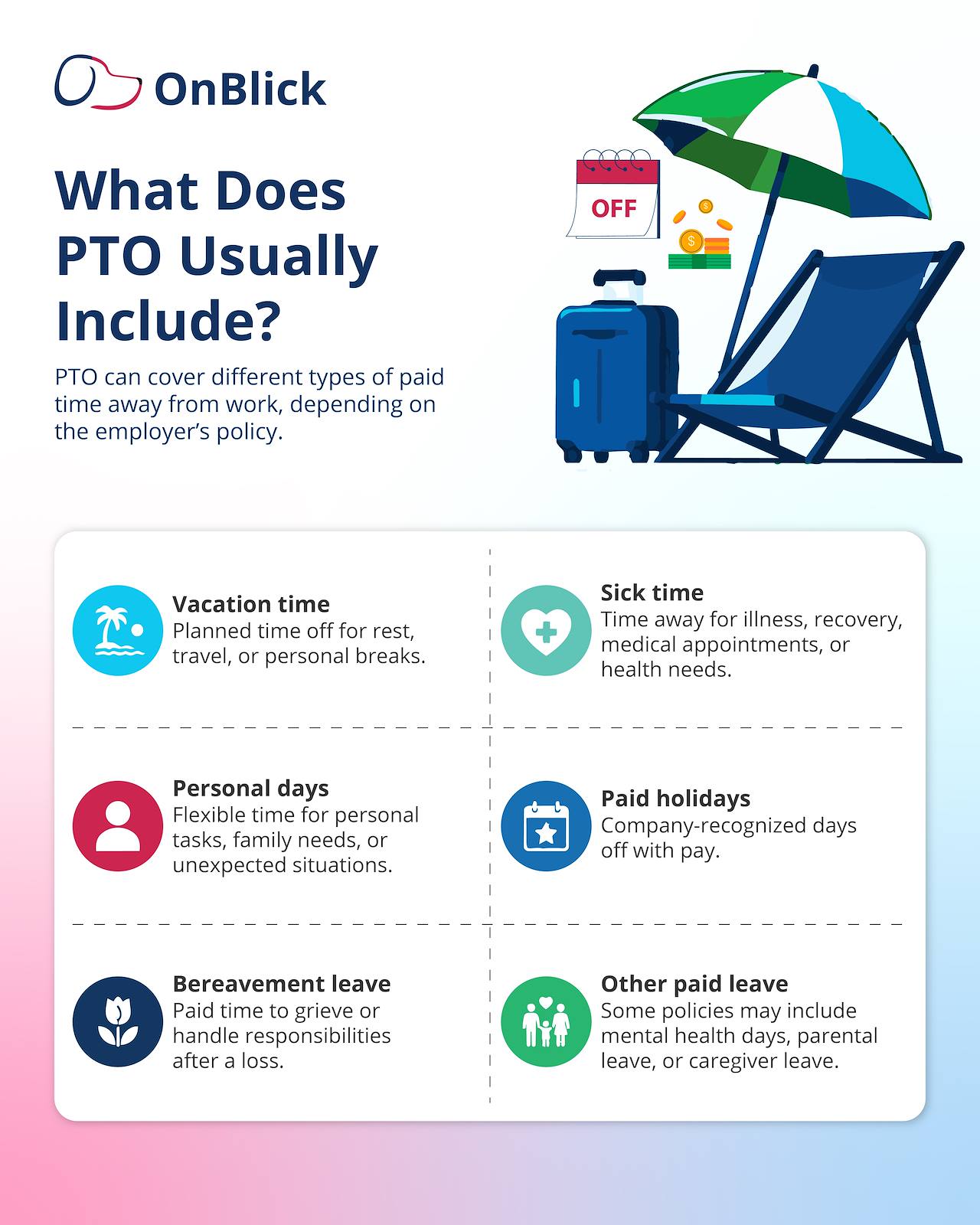
- Common PTO categories include vacation time, sick time, personal days, paid holidays, bereavement leave, mental health days, and other approved paid leave. Some employers may also include paid parental leave, caregiver leave, volunteer time off, or floating holidays as part of their broader time-off policy.
- Vacation time is usually used for planned breaks, travel, rest, or personal time. Sick time is generally used for illness, recovery, medical appointments, or health-related needs. Personal days may give employees flexibility for matters that do not fit neatly into vacation or sick leave.
- Paid holidays are often handled separately from PTO, but they are still part of an employer’s paid time-off program. For example, an employer may provide company holidays in addition to an employee’s PTO balance.
Note: Employees should know what types of time off are included, whether each category has a separate balance, whether notice is required, and how the time will be recorded in payroll and attendance systems.
PTO, Vacation time, and Sick leave: Differences
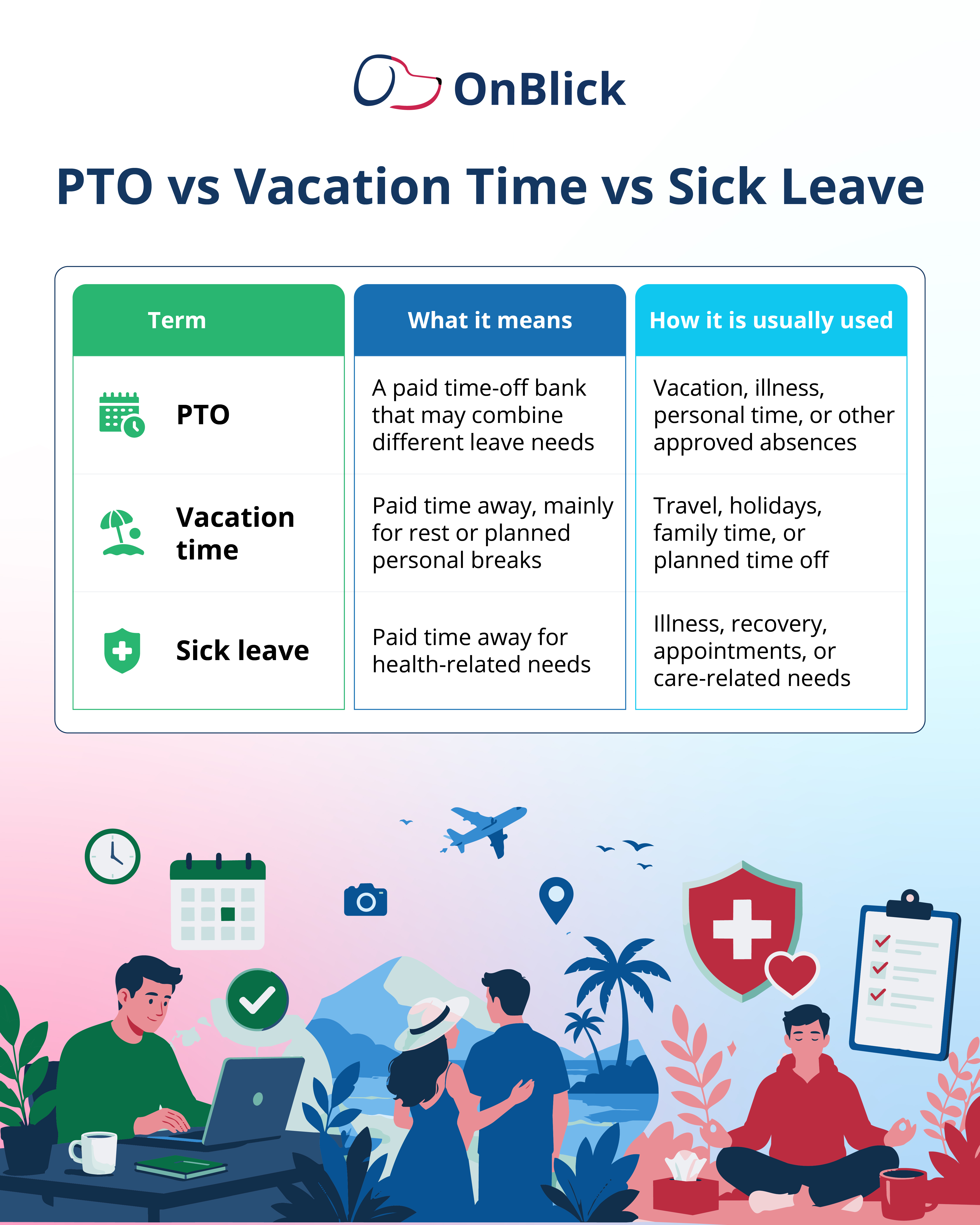
PTO, vacation time, and sick leave are related, but they are not always the same.
- PTO is often a broader paid leave bank that employees can use for different approved reasons. This may include vacation, illness, personal needs, family responsibilities, or other time away from work. A combined PTO policy gives employees more flexibility because they do not always need to label the reason for the absence.
- Vacation time is usually meant for planned time away from work. Employees may use it for rest, travel, holidays, family time, or personal breaks. Employers often require advance notice so managers can plan workloads and coverage.
- Sick leave is usually tied to health-related needs. Employees may use it when they are ill, recovering, attending medical appointments, or caring for a family member, depending on the policy and applicable law.
The difference matters because each approach affects how HR manages leave. A combined PTO bank may be simpler to explain and track, but it can also make it harder to separate illness-related absences from vacation use. Separate vacation and sick leave policies may give employers more control, but they may require more detailed tracking and communication.
For U.S. employers, state and local rules are especially important when sick leave is involved. Some locations have specific paid sick leave requirements, so employers should review applicable rules before combining or changing leave categories.
How does PTO work?
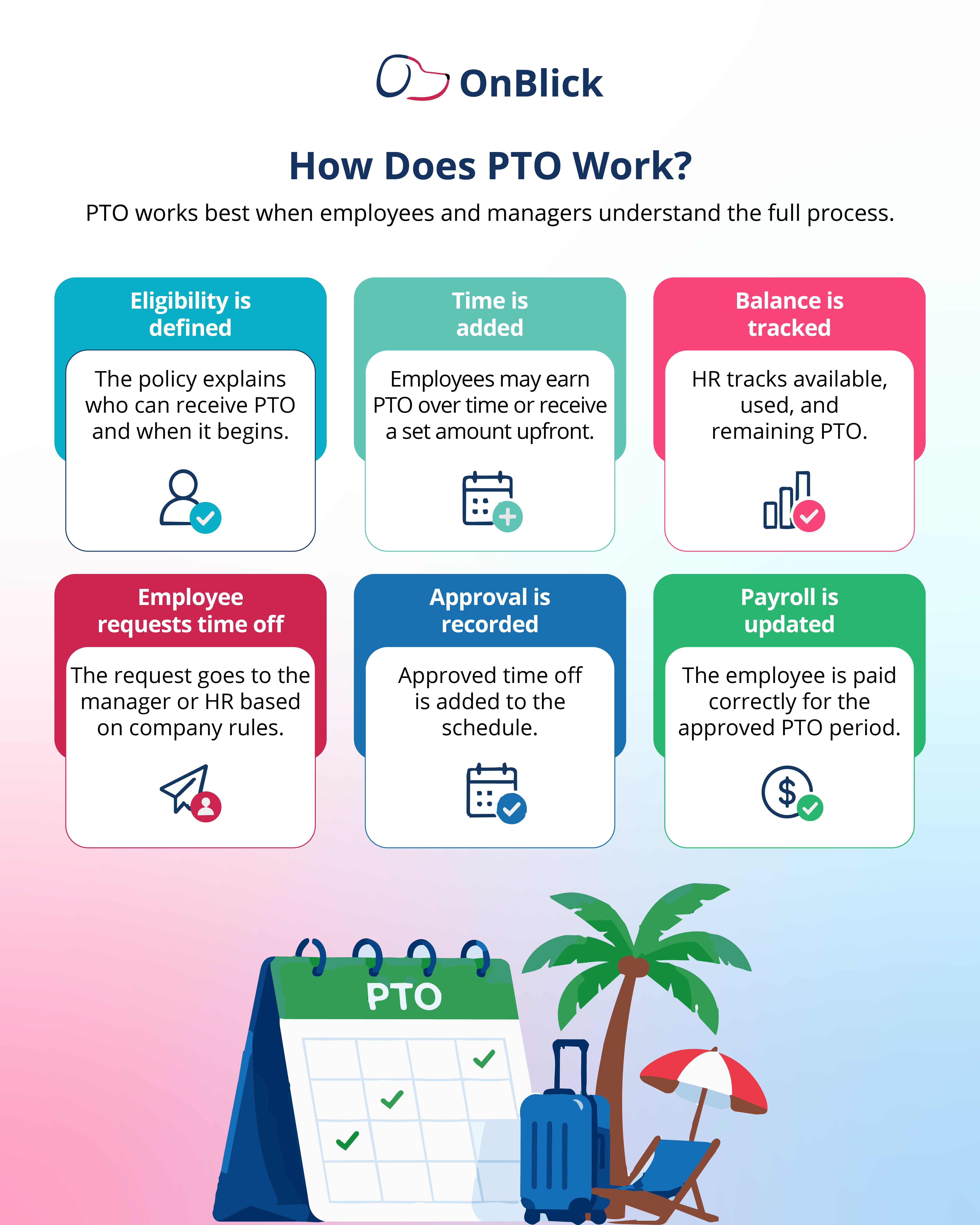
- PTO works through a defined process for earning, requesting, approving, recording, and paying time off. The exact process depends on the employer’s policy, payroll setup, employee classification, and any applicable state or local requirements.
- In many workplaces, employees either earn PTO gradually or receive a set amount at the beginning of the year or policy period. HR tracks the employee’s available balance, used time, and remaining time. When an employee needs time off, they submit a request based on the company’s process, usually through a manager, HR system, or employee self-service portal.
- Once the request is approved, the time off is added to the schedule and reflected in payroll. This helps make sure the employee is paid correctly for the approved absence and that the PTO balance is updated.
- A clear PTO process should answer practical questions. Who approves time off? How much notice is required? Can PTO be used in half-day or hourly increments? What happens if multiple employees request the same dates? How are holidays, sick time, or unpaid leave handled with PTO?
When these details are not clear, PTO can lead to inconsistent approvals, payroll errors, coverage problems, and employee frustration.
Common types of PTO policies
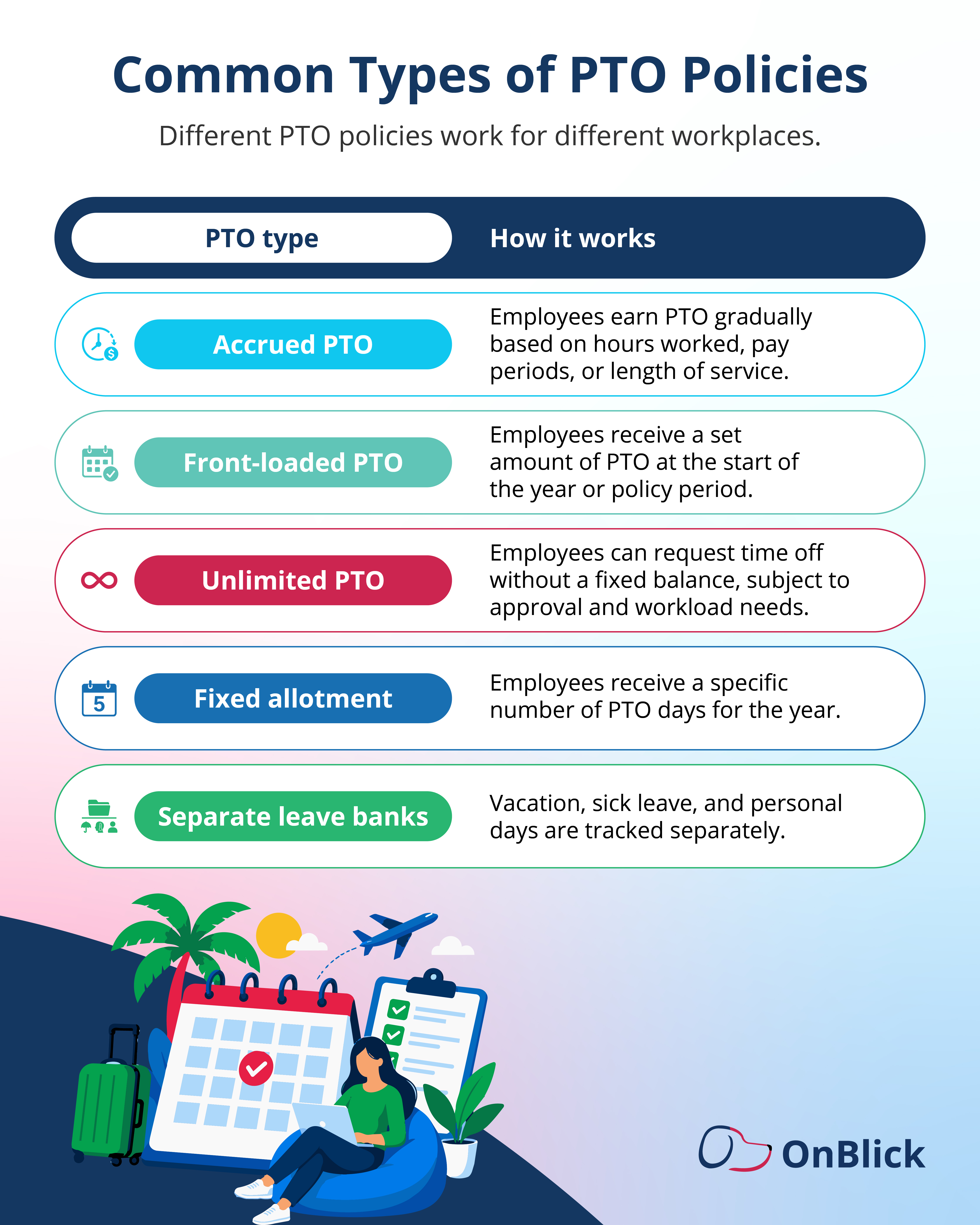
- Employers can structure PTO in different ways. The right model depends on the size of the workforce, business needs, employee expectations, payroll capability, and state or local requirements.
- Accrued PTO is one common model. Employees earn time off gradually, often based on hours worked, pay periods, or length of service. This approach gives employers more control over how PTO builds over time.
- Front-loaded PTO gives employees a set amount of PTO at the beginning of the year or policy period. It is easier for employees to understand, but employers need clear rules for new hires, mid-year exits, and unused balances.
- Fixed allotment PTO gives employees a specific number of days for the year. This can be simple to communicate, especially when the same amount applies to a defined employee group.
- Unlimited PTO does not give employees a fixed balance. Instead, employees request time off when needed, subject to approval, workload, and policy rules. This model requires strong manager consistency because the absence of a balance does not mean time off is automatically approved.
- Separate leave banks keep vacation, sick leave, personal days, and other leave categories apart. This may help employers track different leave reasons more clearly, but it can require more detailed administration.
PTO Accrual, Carryover, and Payout
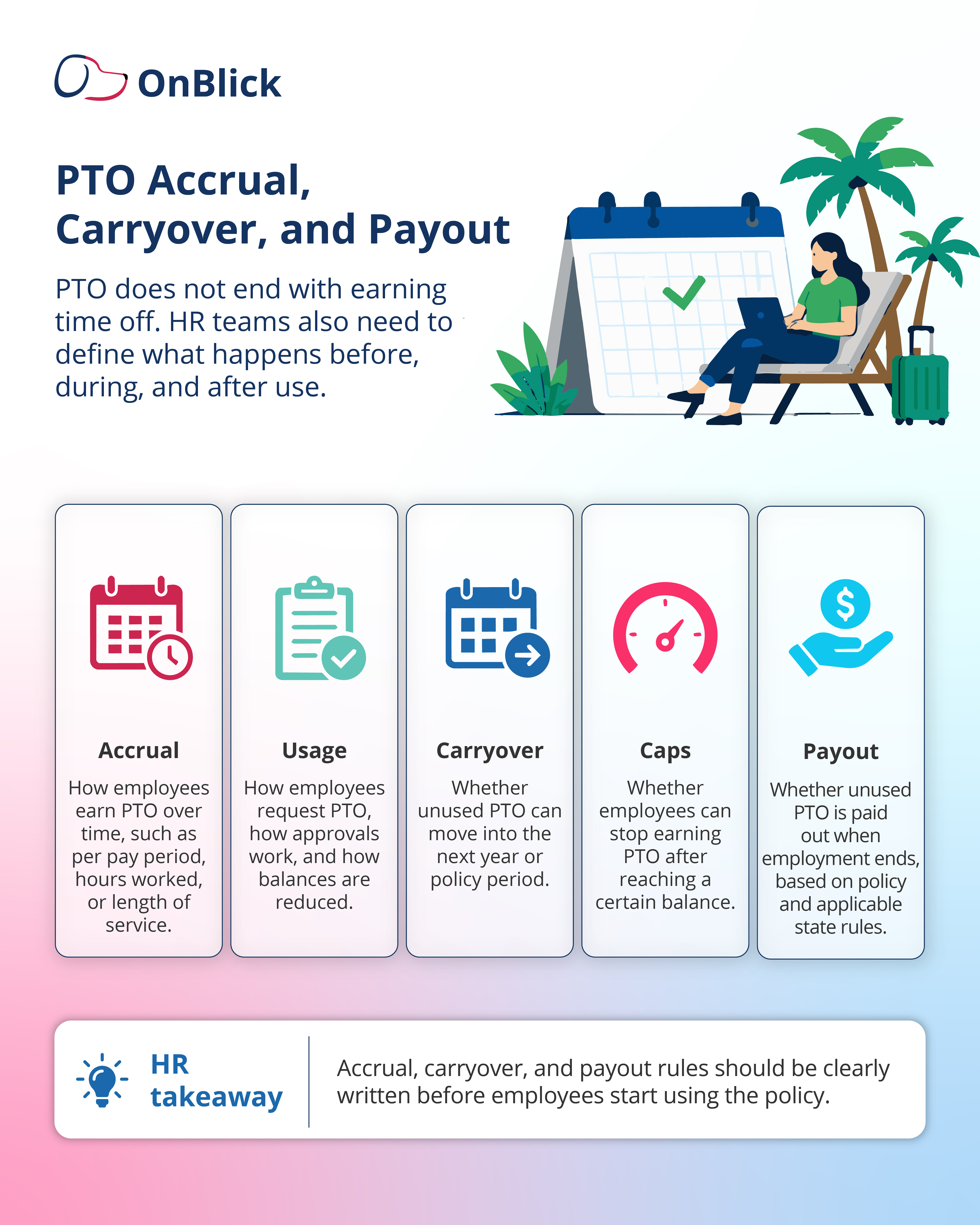
- PTO policies should explain how employees earn time off, what happens to unused time, and whether unused PTO is paid out when employment ends. These details are important because employees often make plans based on their available balance.
- PTO accrual refers to how employees earn paid time off. For example, employees may accrue PTO each pay period, based on hours worked, or after completing a certain length of service. Some employers use different accrual rates for employees with longer tenure.
- Carryover rules explain whether unused PTO can move into the next year or policy period. Some employers allow full carryover, some set a limit, and others require employees to use PTO by a certain deadline. When carryover is limited, employees should receive clear notice so they have enough time to plan.
- Caps are another important policy detail. A cap limits how much PTO an employee can accumulate. Once the cap is reached, the employee may stop earning additional PTO until some time is used, depending on the policy and applicable rules.
- Payout rules explain whether unused PTO will be paid when an employee leaves the company. These rules can depend on employer policy and state law. For this reason, employers should avoid vague language and review payout rules carefully before finalizing the policy.
Is paid time off required by law?
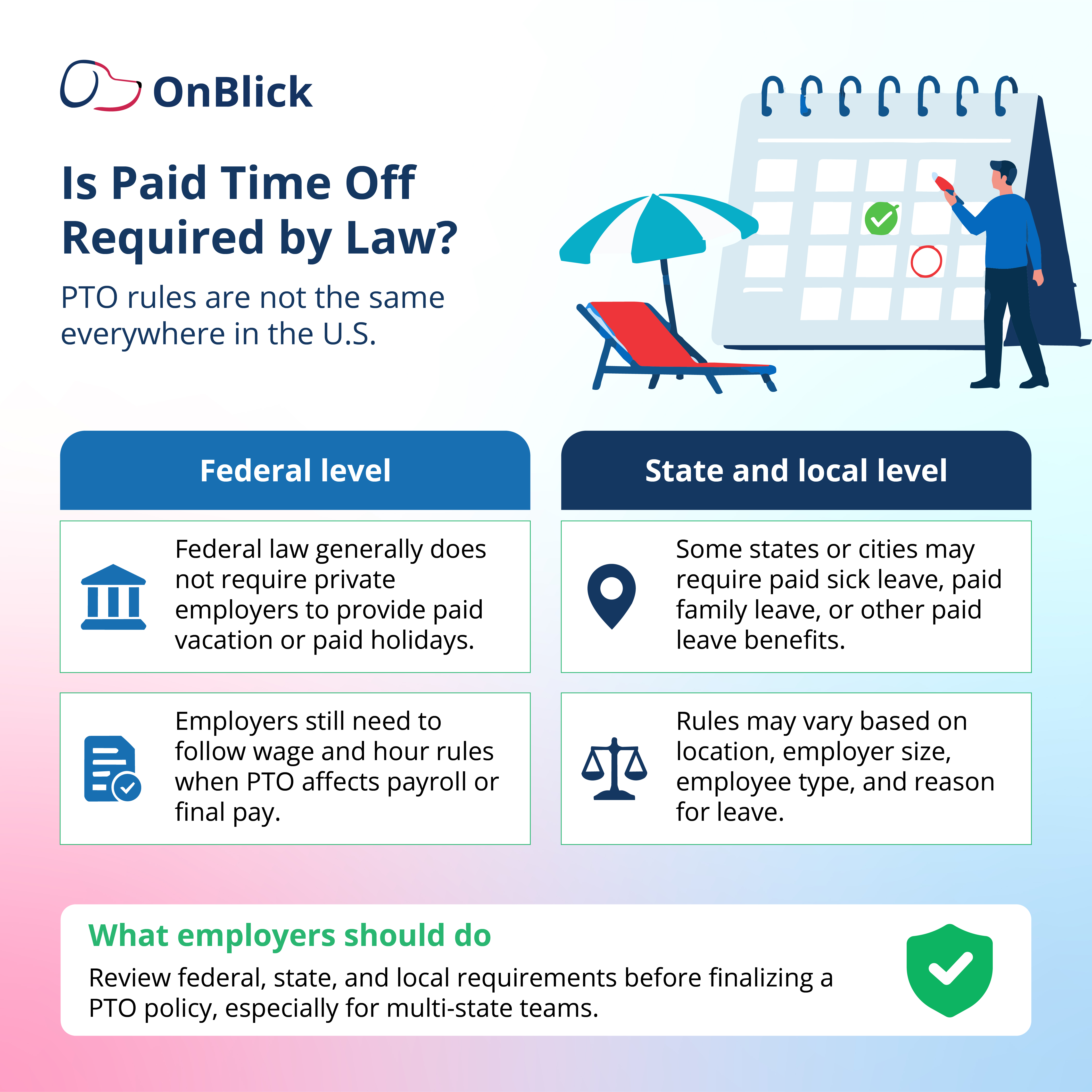
At the federal level, the Fair Labor Standards Act does not require employers to pay employees for time not worked, including vacation, sick leave, or holidays. The U.S. Department of Labor states that these benefits are generally a matter of agreement between the employer and employee.
However, employers should not stop at the federal rule. State and local laws may require certain types of paid leave, such as paid sick leave, paid family leave, or other leave benefits. Requirements can vary based on location, employer size, employee status, and the reason for leave.
Paid sick leave is especially important to review. The Department of Labor notes that there are currently no federal legal requirements for paid sick leave, although the Family and Medical Leave Act may require unpaid sick leave for covered employers and eligible employees.
Employers should also consider how PTO interacts with wage payment, final pay, company policy, employment agreements, and state-specific rules. For example, some states may regulate whether unused vacation or PTO must be paid out when employment ends.
Because PTO laws vary by location, multi-state employers should review their policy before applying the same rules across all employees. HR teams should also update the policy when state or local leave requirements change.
Paid Time Off: Benefits for Employers and Employees
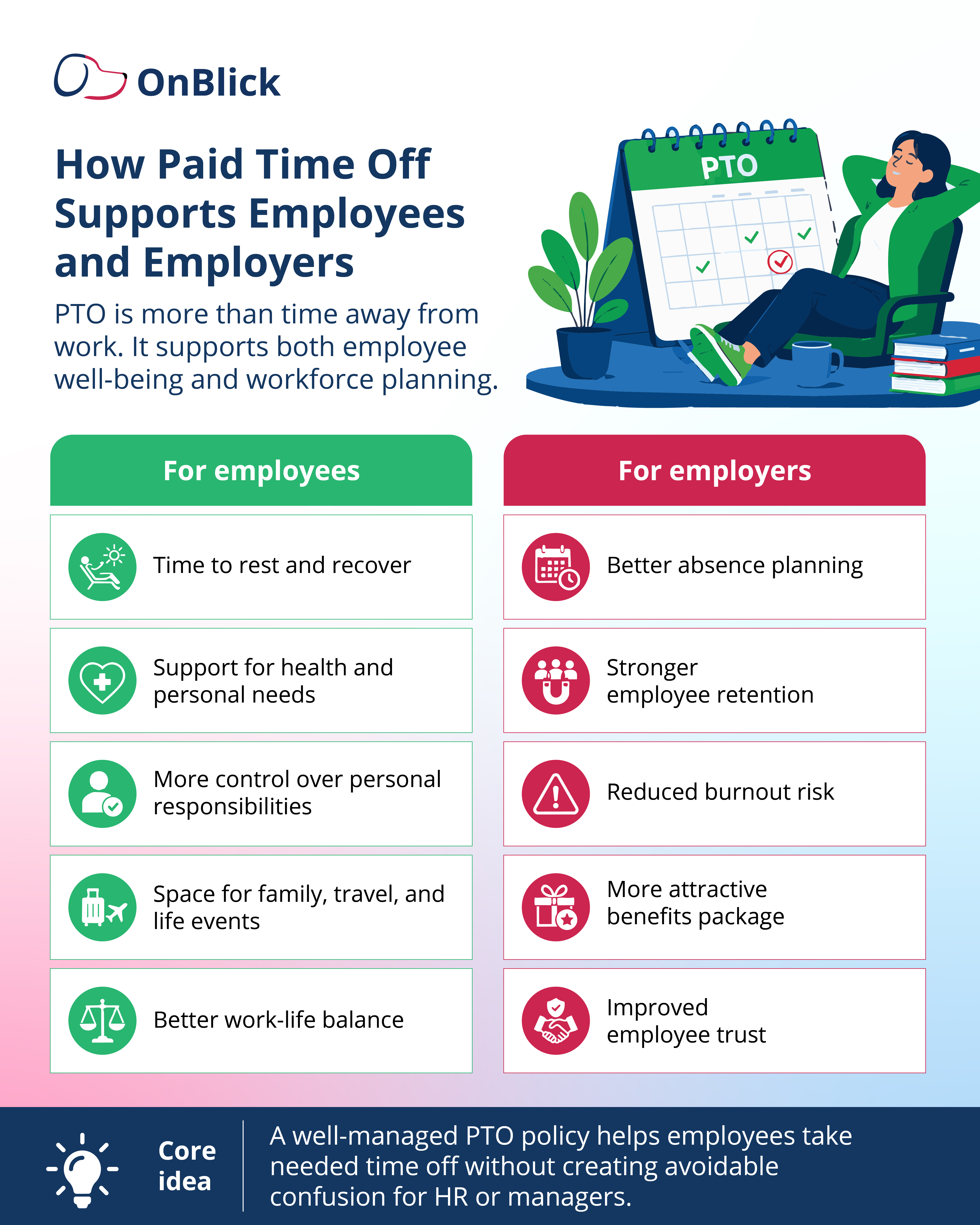
- Paid time off gives employees room to rest, recover, and manage personal responsibilities without losing pay. This matters because employees may need time away for many reasons, including illness, family needs, appointments, travel, or planned breaks from work.
- For employees, PTO can make work feel more manageable. When people know they have paid time available, they may be less likely to delay health needs, postpone personal responsibilities, or work through exhaustion. A clear PTO policy can also reduce stress because employees know how to request time off and what to expect during approval.
- For employers, PTO can support retention and employee satisfaction. A workplace that gives employees reasonable time away from work may be more attractive to candidates and more supportive for current employees. PTO can also help managers plan absences in advance instead of dealing only with unplanned time away.
- A well-managed PTO policy can also improve workforce planning. When requests, approvals, and balances are tracked properly, HR and managers can see who is scheduled to be out, plan coverage, and reduce last-minute staffing issues.
Challenges of Managing PTO
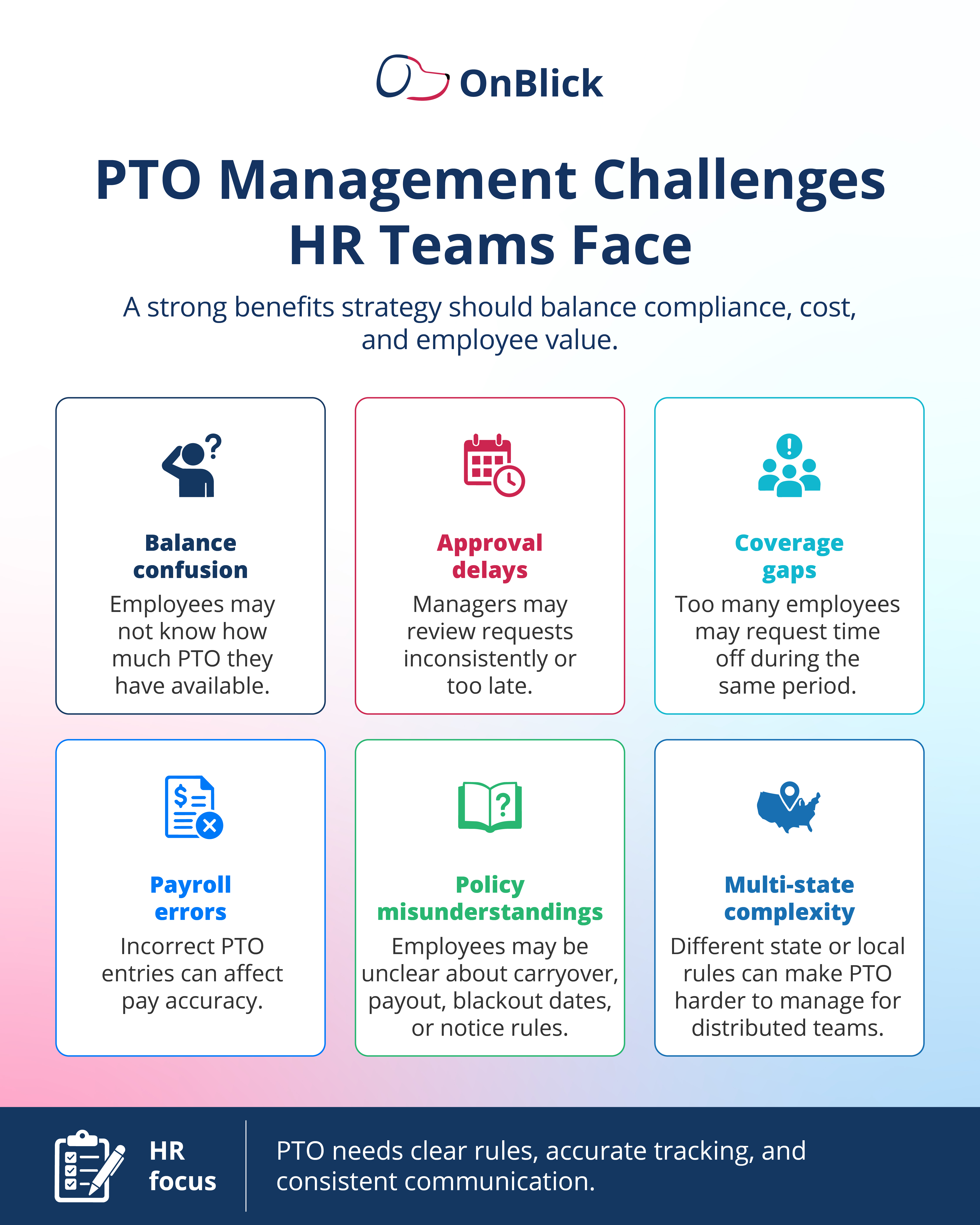
- PTO can be difficult to manage when the policy is unclear, or the process depends too much on manual tracking. Even a generous policy can create employee frustration if balances are wrong; approvals are delayed, or managers apply the rules differently.
- One common challenge is coverage. When several employees request the same dates, managers need a fair way to approve time off while keeping the business running. This can be especially difficult during holidays, school breaks, year-end periods, or busy seasons.
- Another challenge is balance accuracy. Employees need to know how much PTO they have available before making plans. If balances are not updated after payroll, schedule changes, or leave corrections, employees may receive incorrect information.
- HR teams also need to watch for unused PTO. When employees do not take time off, it may point to workload pressure, manager expectations, or fear of falling behind. PTO should be available in practice, not only written into the policy.
- Multi-state employers may face additional complexity. PTO, sick leave, carryover, and payout rules can vary by location. A single policy may need state-specific language or separate rules for certain employee groups.
What should a PTO policy include?
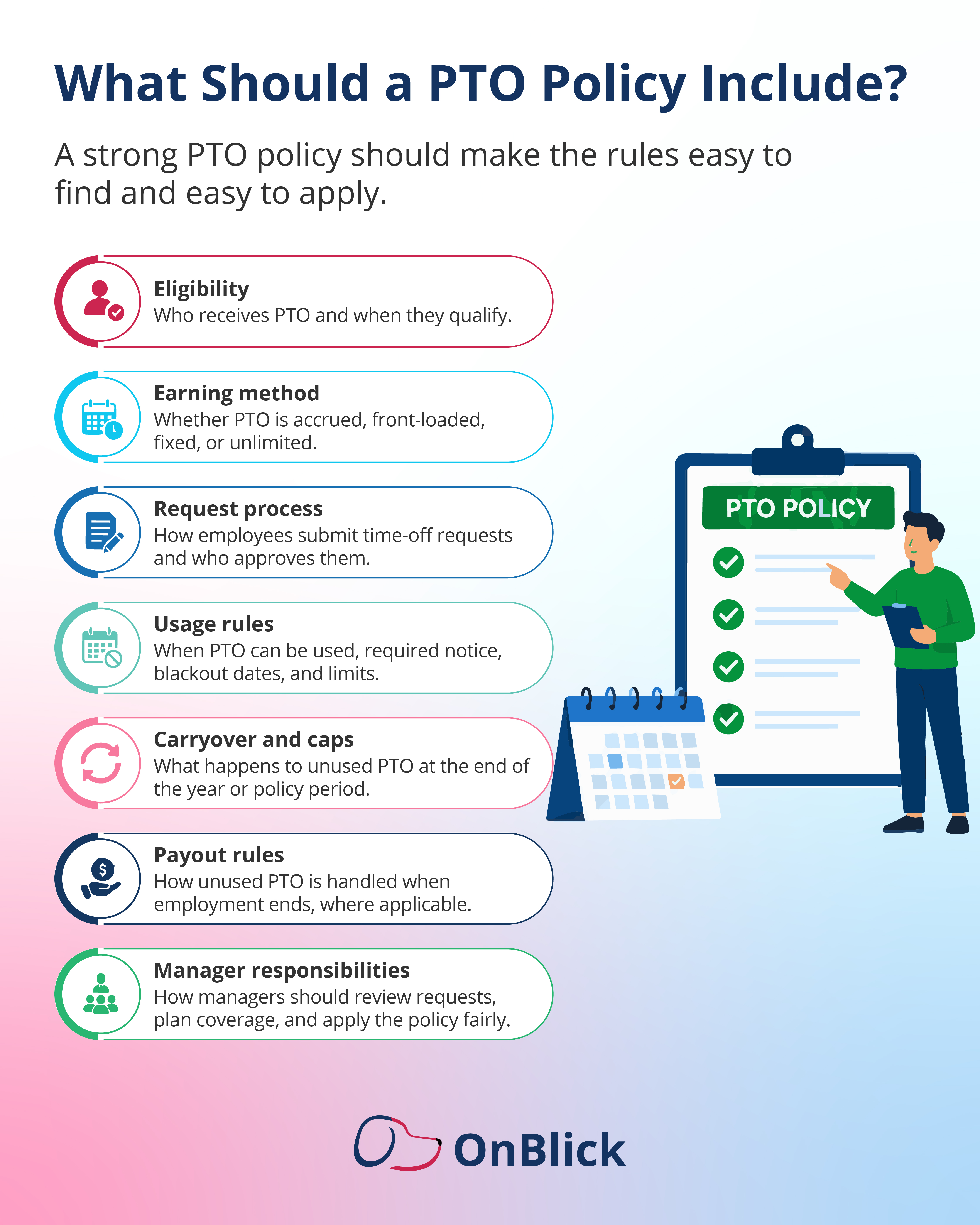
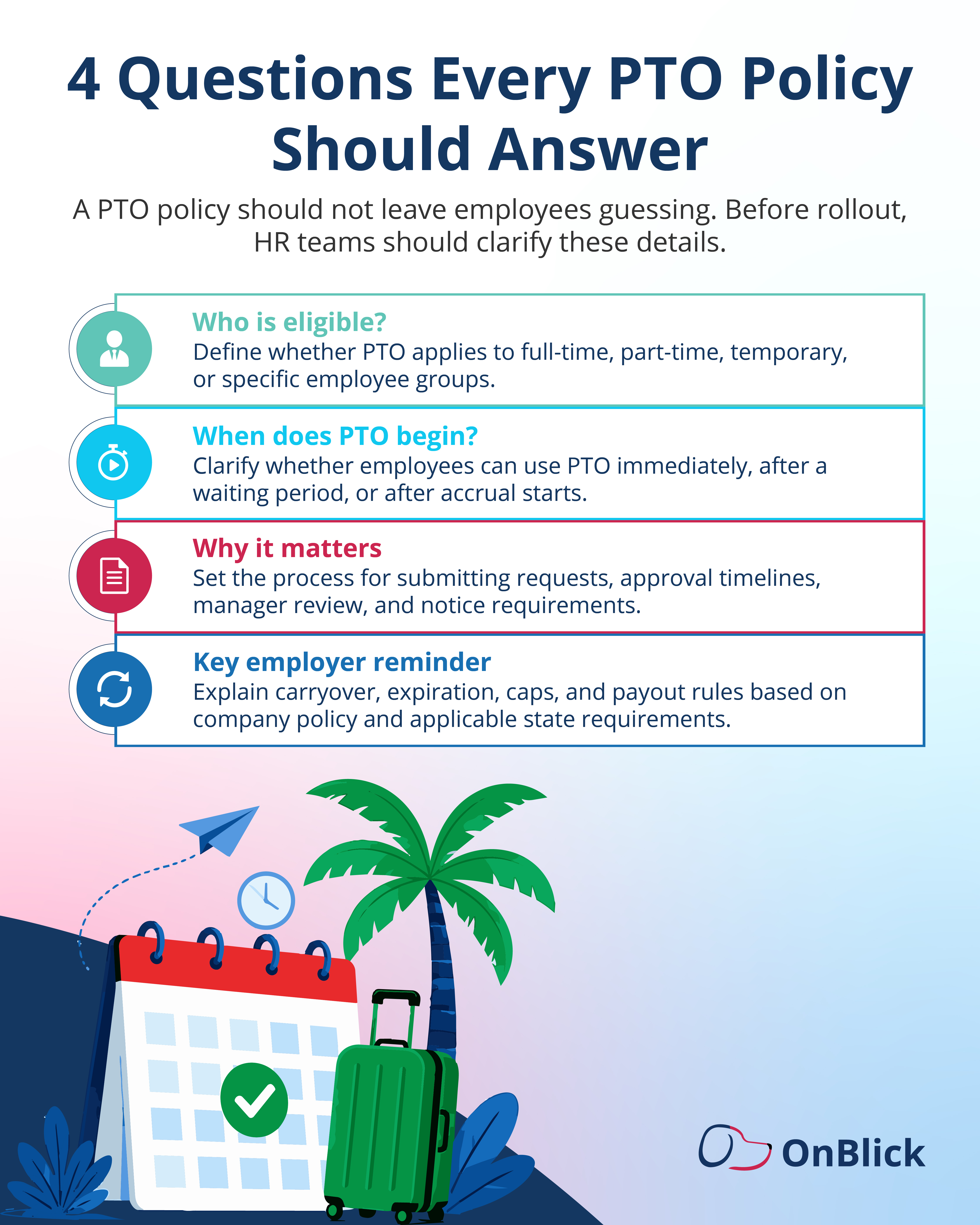
- A PTO policy should clearly explain how paid time off is earned, used, approved, tracked, and handled when employment ends. The goal is to make the policy easy for employees to understand and consistent for managers to apply.
- The policy should start with eligibility. Employers should define which employees qualify for PTO, when eligibility begins, and whether the rules differ for full-time, part-time, temporary, or probationary employees.
- Next, the policy should explain how PTO is provided. This may include accrual rates, front-loaded balances, fixed allotments, unlimited PTO rules, or separate vacation and sick leave banks. Employees should be able to understand how much time they receive and when it becomes available.
- The request and approval process should also be clear. The policy should state how employees request PTO, how much notice is required, who approves the request, and how overlapping requests or busy periods will be handled.
- Employers should also include rules for carryover, caps, payout, holidays, unpaid leave, and changes in employment status. If state or local rules apply, the policy should explain how those requirements affect employees in different locations.
PTO Policy Mistakes Employers Should Avoid
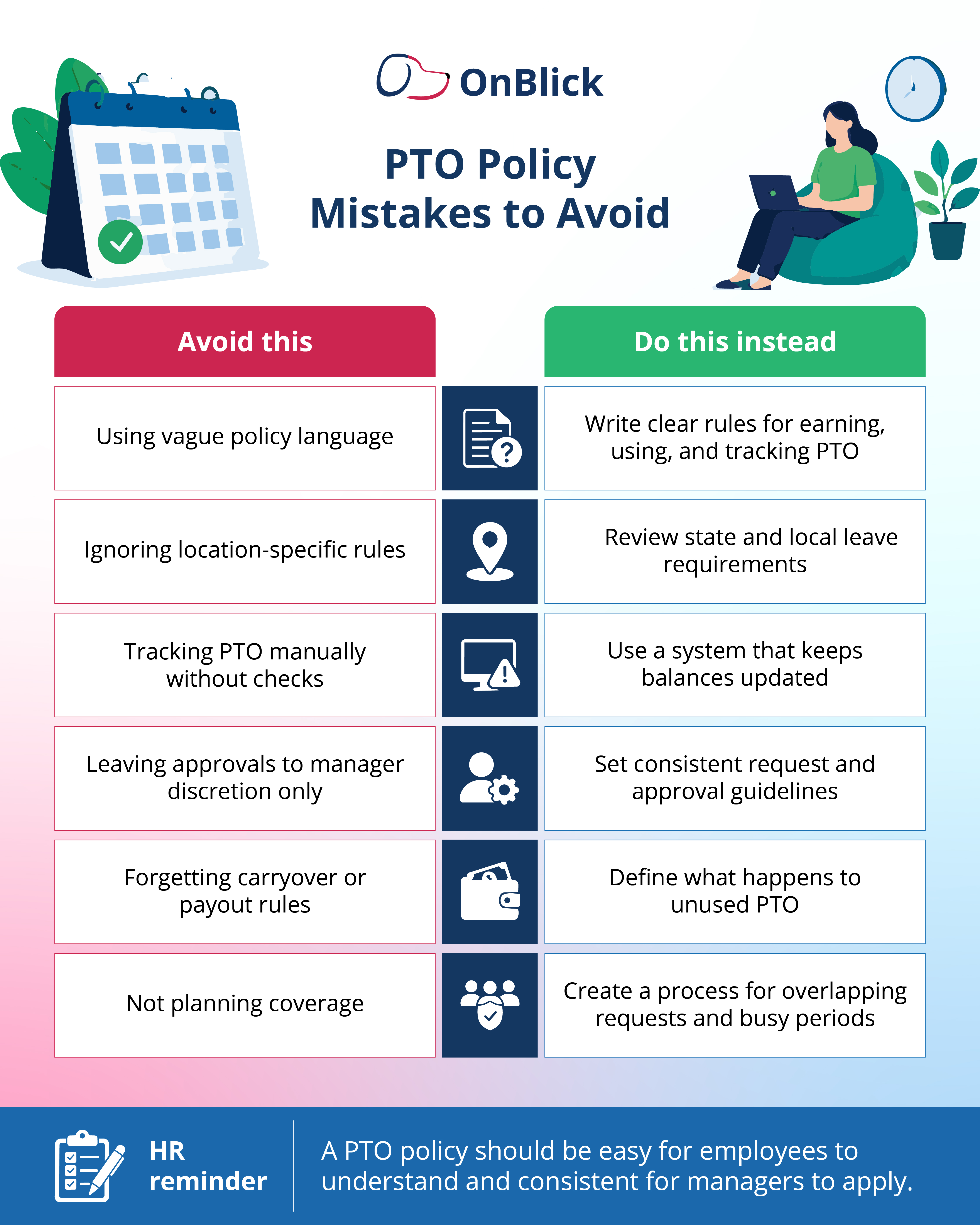
- One mistake employers often make is using vague policy language. If the policy does not explain accrual, usage, approval, carryover, or payout rules clearly, employees and managers may interpret the same policy in different ways.
- Another mistake is failing to review state and local rules. PTO may seem like a company benefit, but rules around paid sick leave, vacation payout, final wages, and carryover can vary by location. This is especially important for employers with remote or multi-state employees.
- Manual tracking can also create problems. Spreadsheets, email approvals, and scattered records may work for a small team for a short time, but they can quickly lead to balance errors, missed updates, and payroll confusion.
- Employers should also avoid inconsistent approvals. If one manager approves PTO easily and another denies similar requests without clear reasoning, employees may see the process as unfair. Clear approval criteria can reduce this issue.
- Another common mistake is not communicating the policy often enough. Employees should not have to search through old documents to understand how PTO works. HR should explain PTO during onboarding, before major holiday periods, and whenever policy updates are made.
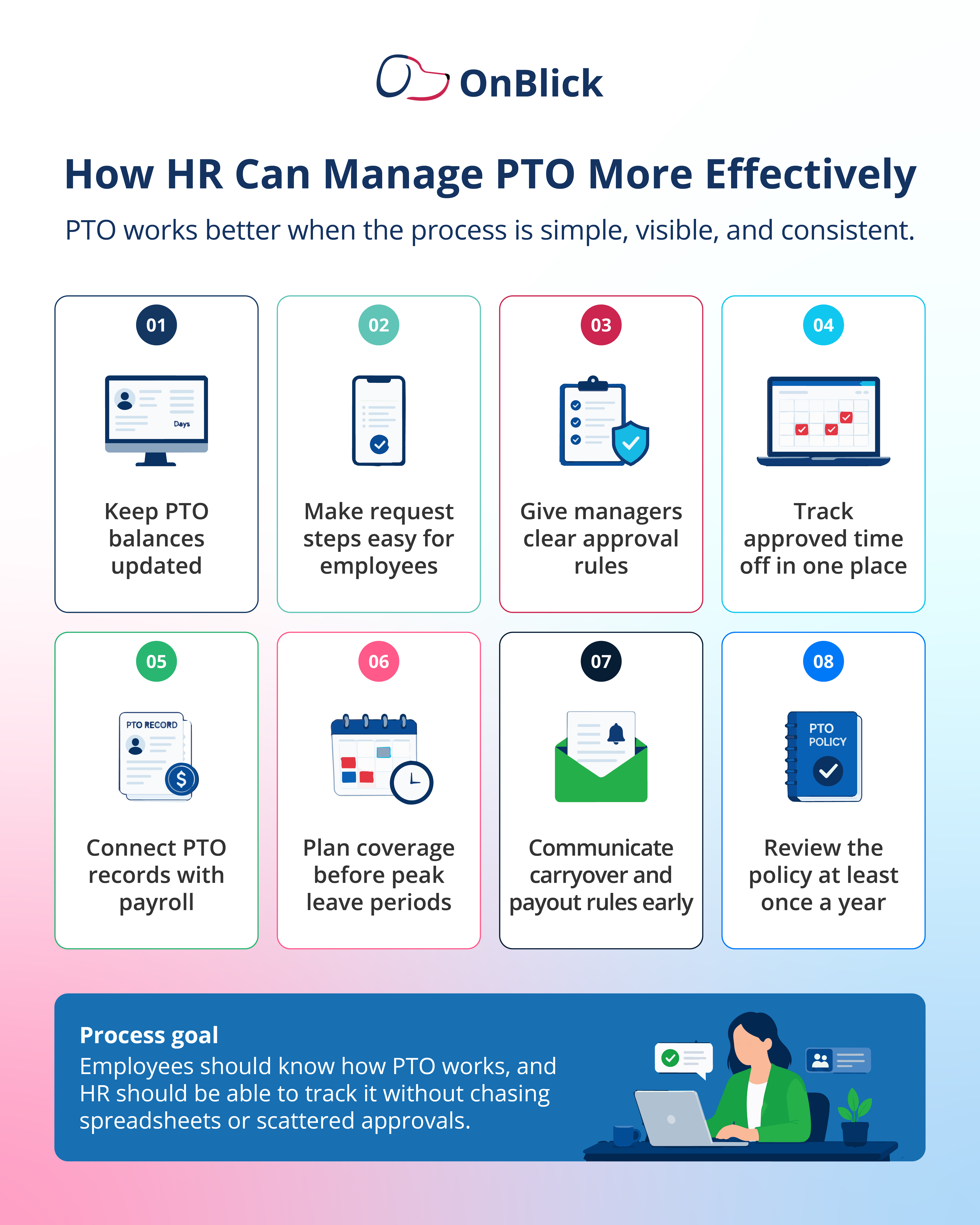
How HR can manage PTO more effectively
HR can manage PTO more effectively by making the process simple, visible, and consistent. Employees should know how to request time off, managers should know how to review requests, and HR should have accurate records for payroll and reporting.
- A strong PTO process starts with accurate employee data. HR teams need to know each employee’s eligibility, work location, classification, schedule, accrual rate, and available balance. These details affect how PTO is earned and used.
- Employee self-service can also reduce repeated questions. When employees can view balances, submit requests, and check approval status in one place, HR spends less time responding to basic PTO queries.
- Managers also need visibility. They should be able to see team availability before approving requests, especially during busy periods. This helps reduce staffing gaps and makes approval decisions easier to explain.
- Payroll coordination is important too. Approved PTO should flow correctly into payroll, so employees are paid accurately, and balances are updated on time. HR should also review PTO reports regularly to identify unused balances, frequent corrections, or policy issues.
How OnBlick helps HR teams manage PTO and leave
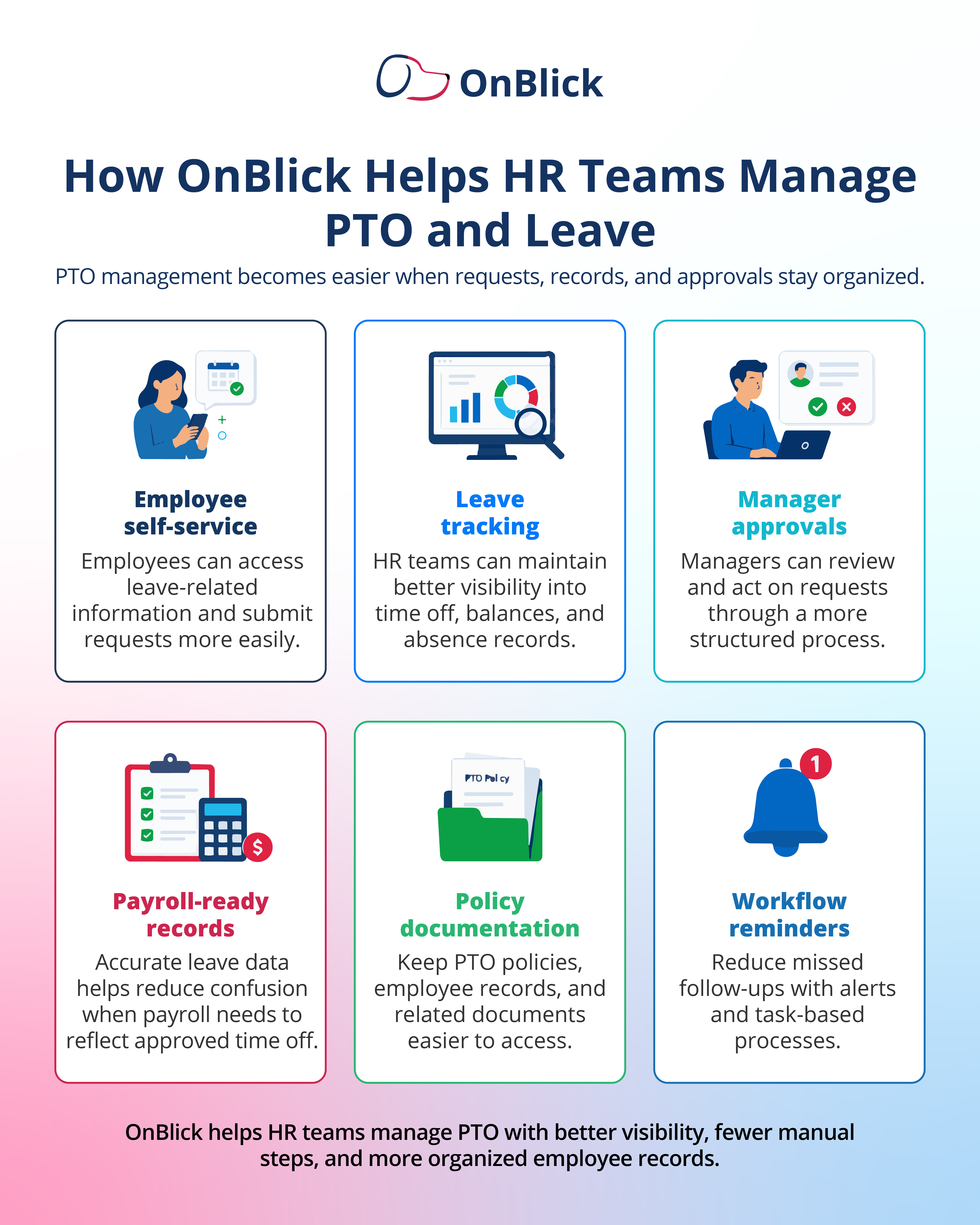
Managing PTO requires accurate records, clear workflows, and timely approvals. OnBlick helps HR teams organize time off, employee information, leave records, and related HR processes on one platform.
- With OnBlick, HR teams can manage employee records, leave requests, approval workflows, time and attendance data, and policy-related documentation more efficiently. This helps reduce scattered files, missed follow-ups, and manual updates.
- OnBlick also supports better visibility for HR and managers. Teams can track leave-related information, maintain employee records, and keep important documents easier to access when questions, audits, or internal reviews arise.
- For employers managing different employee groups, locations, or compliance needs, OnBlick helps bring structure to HR processes. This can be useful when PTO policies differ by role, location, or employee classification.
- By keeping PTO and leave information more organized, OnBlick helps HR teams reduce administrative work and support employees with a clearer time-off process.
Conclusion
Paid time off is an important part of employee benefits and workforce management. It gives employees paid time away from work and helps employers support rest, health needs, personal responsibilities, and planned absences.
For HR teams, PTO requires more than a written policy. It needs clear eligibility rules, accurate tracking, consistent approvals, payroll coordination, and regular review. Employers also need to consider state and local requirements, especially when managing sick leave, carryover, payout, or multi-state employees.
A strong PTO policy should be easy for employees to understand and practical for HR teams to manage. When the process is clear, employees can use their time off with confidence, and employers can manage absence planning with fewer errors and less confusion.
OnBlick helps HR teams manage PTO, leave tracking, employee records, and HR workflows in a more organized way. Schedule a free OnBlick demo to see how we can support your HR operations.
FAQs About Paid Time Off
- How much PTO should employers offer?
The right amount depends on company size, industry, location, budget, employee expectations, and the types of leave already offered. Employers should review market standards, employee needs, and state or local leave requirements before deciding the number of PTO days.
- Should employers use a combined PTO bank or separate leave categories?
A combined PTO bank can be easier for employees to understand and may give them more flexibility. Separate leave categories can give employers more control over how vacation, sick leave, personal days, and other absences are used. The better option depends on the workforce, compliance requirements, payroll setup, and how much tracking HR can manage.
- Can employers set blackout dates for PTO?
Yes, employers may set blackout dates or limit PTO approvals during busy periods, as long as the policy is applied consistently and follows applicable laws. The policy should clearly explain when blackout dates may apply, how employees will be notified, and whether exceptions can be considered.
- How does PTO accrual work?
PTO accrual means employees earn paid time off over time. Employers may calculate accrual based on hours worked, pay periods, length of service, or a set schedule in the PTO policy. For example, an employee may earn a certain number of PTO hours each pay period until they reach the policy limit.
- Can unused PTO carry over to the next year?
It depends on the employer’s policy and applicable state or local rules. Some employers allow unused PTO to carry over fully, some set a carryover limit, and others use a “use-it-by” deadline. Employers should write carryover rules clearly so employees know what happens to unused time.
- Do employers have to pay out unused PTO?
Federal law generally does not require payment for time not worked, such as vacation, sick leave, or holidays. However, payout rules for unused PTO may depend on state law, employer policy, employment agreements, or how the policy is written. Employers should review the rules that apply in each work location.
- Is unlimited PTO better than accrued PTO?
Unlimited PTO can reduce balance tracking and give employees more flexibility, but it requires clear approval rules and manager consistency. Accrued PTO gives employees a defined balance, which may be easier to track and plan around. The better option depends on the workforce, culture, payroll process, and how well managers apply the policy.
- Can an employer deny a PTO request?
Yes, an employer may deny a PTO request based on business needs, staffing levels, notice requirements, policy rules, or overlapping requests. To avoid confusion, the PTO policy should explain how requests are reviewed and whether certain periods may have restrictions.
- Can part-time employees get PTO?
Yes, part-time employees can receive PTO if the employer’s policy allows it or if applicable law requires it. Some employers provide prorated PTO based on hours worked. HR teams should define eligibility rules clearly for full-time, part-time, temporary, and other employee groups.
- What should employers include in a PTO policy?
A PTO policy should include eligibility, accrual or allotment rules, request procedures, approval timelines, usage limits, carryover, caps, payout rules, holidays, sick leave interaction, notice requirements, manager responsibilities, and any state-specific rules that apply.