.gif)



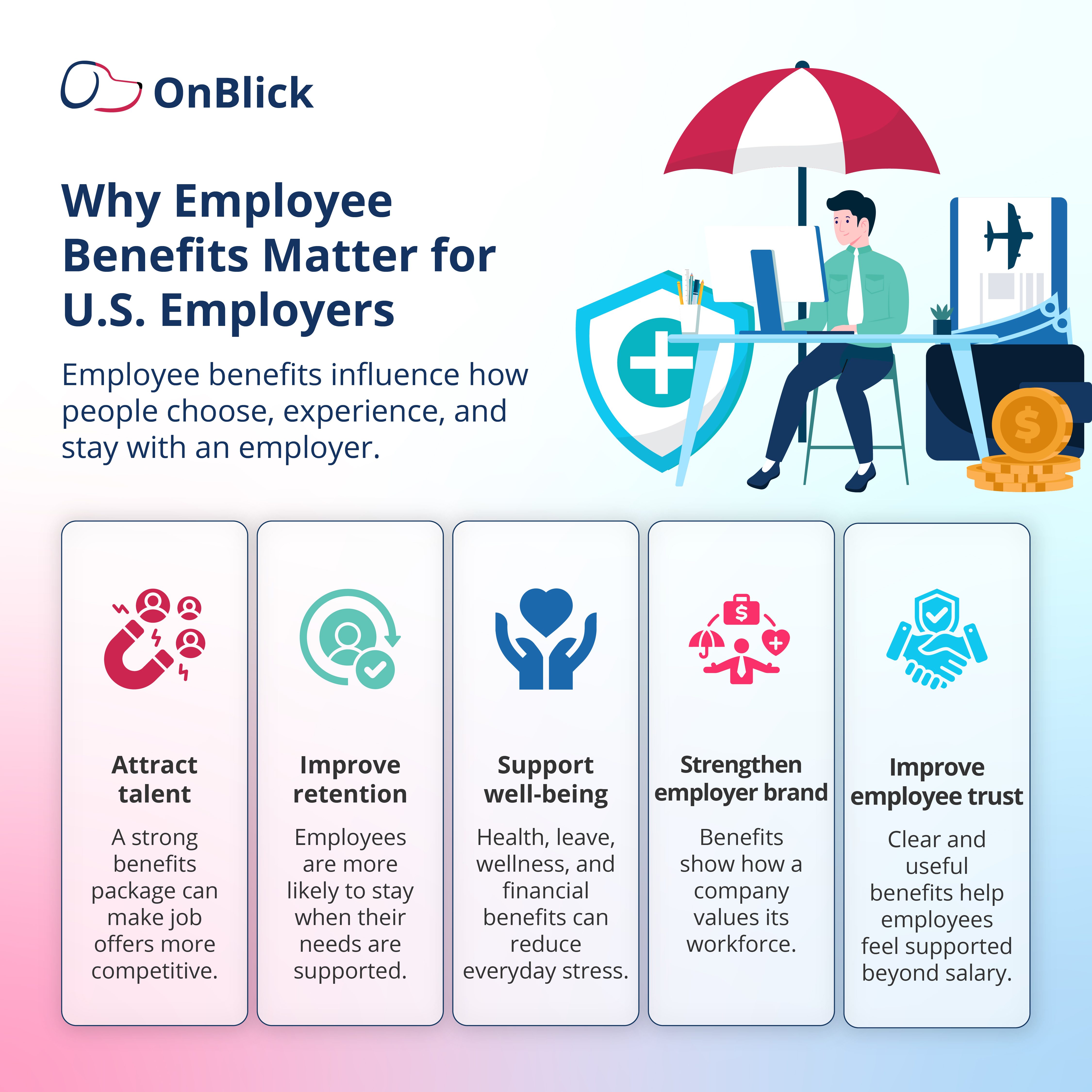
Employee benefits play a major role in how U.S. employers attract and retain talent. For many employees, benefits can influence how they compare job offers, how secure they feel at work, and whether they see long-term value in staying with an organization.
For employers and HR teams, benefits require more than selecting plans. Some benefits are required by law, while others are offered to strengthen the overall compensation package and support employee needs. Benefits can also vary based on employer size, employee classification, work location, and state-specific rules. That makes it important for HR teams to understand what different benefits cover, how they fit together, and what must be managed throughout the employee lifecycle.
This article covers the major types of employee benefits in the U.S., including required benefits, voluntary benefits, health coverage, retirement plans, paid leave, wellness support, perks, and benefits administration considerations for employers.
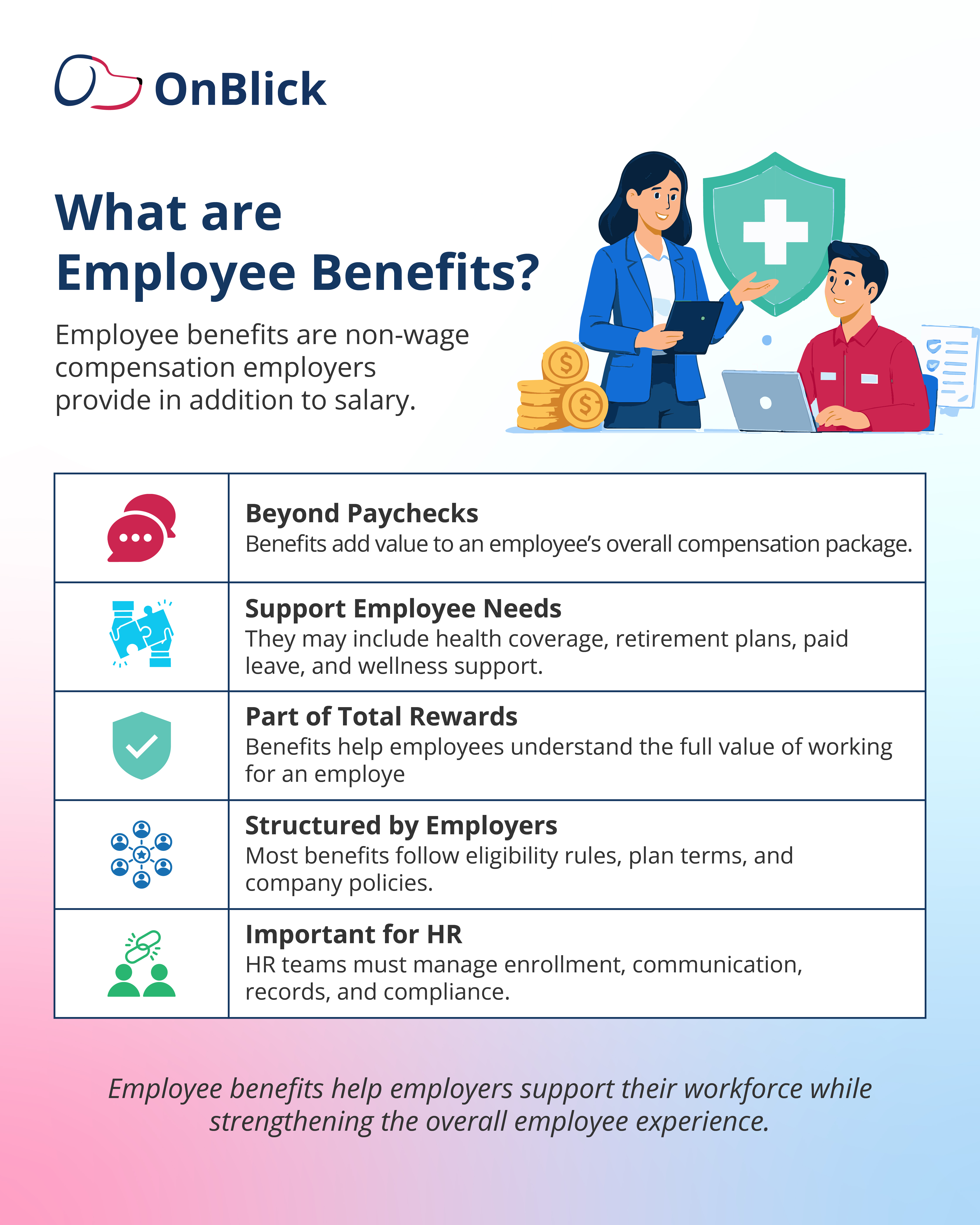
What are employee benefits?
- Employee benefits are forms of compensation that employees receive in addition to their regular wages or salary. They can include health insurance, retirement plans, paid time off, life insurance, disability coverage, wellness support, tuition assistance, commuter benefits, and other employer-provided programs.
- For employees, benefits can reduce out-of-pocket costs, support health and financial security, and make work feel more stable. For employers, benefits are part of the total compensation package and can influence hiring, retention, employee satisfaction, and workforce planning.
- In the U.S., employee benefits usually fall into two broad groups. Some benefits are required by law, such as Social Security and Medicare contributions, unemployment insurance, and workers’ compensation. Other benefits are offered voluntarily by employers, such as health plans, retirement matching, paid leave, wellness programs, and flexible work options.
- A benefits program should not be treated as a one-time HR task. It needs clear eligibility rules, employee communication, payroll coordination, enrollment support, and regular review. When benefits are managed well, employees are more likely to understand what is available to them and how to use it.
Difference between employee benefits, perks, and fringe benefits
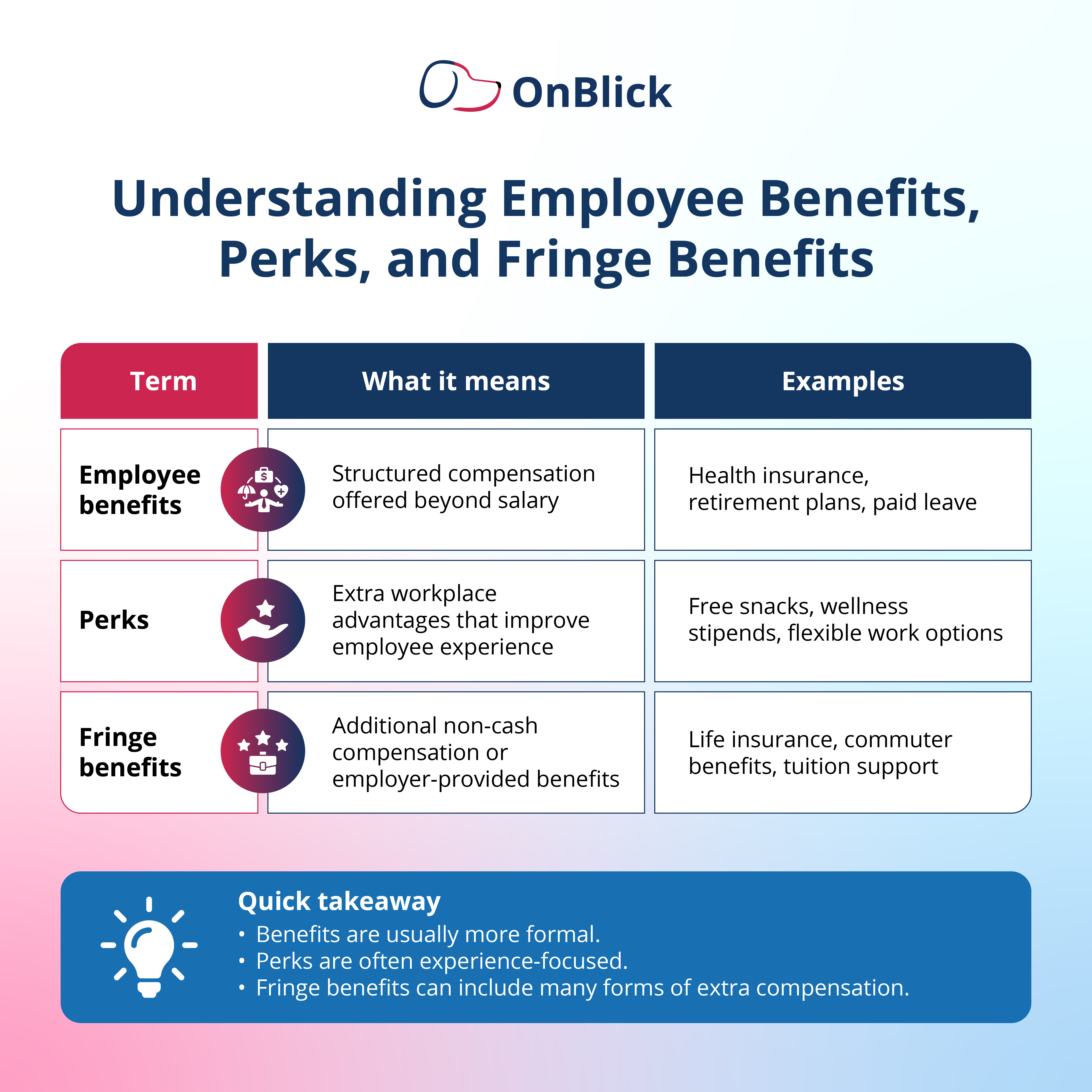
The terms employee benefits, perks, and fringe benefits are often used together, but they do not always mean the same thing.
- Employee benefits are structured forms of compensation provided in addition to salary. These may include health insurance, retirement plans, paid leave, disability coverage, and other formal programs. Benefits often have eligibility rules, enrollment timelines, plan documents, and compliance requirements.
- Perks are extra advantages that improve the employee experience but may not be part of a formal benefits plan. Examples include free meals, company events, casual dress policies, learning stipends, flexible work options, or wellness challenges. Perks can support culture and engagement, but they are usually easier to change than core benefits.
- Fringe benefits are additional forms of compensation provided to employees outside of regular pay. They can include items such as life insurance, commuter assistance, tuition support, company vehicles, dependent care assistance, or certain discounts. Some fringe benefits may also have tax or reporting considerations.
For HR teams, this distinction matters because each category may need different levels of planning, documentation, communication, and compliance review. A free snack program and a health insurance plan should not be managed the same way. One supports the workplace experience. The other affects employee coverage, payroll deductions, vendor coordination, and legal responsibilities.
Why employee benefits matter for U.S. employers
- Employee benefits affect both hiring and employee retention. A candidate may compare salary first, but benefits often shape the final decision. Health coverage, paid leave, retirement support, and flexibility can make an offer more practical and valuable for employees and their families.
- Benefits also influence how employees experience the workplace after joining. When employees understand their coverage, time-off options, and available support programs, they are more likely to feel secure and informed. This can reduce confusion during major life events, health needs, family responsibilities, or financial planning.
- For employers, benefits are part of workforce planning. A strong benefits package can support recruitment, reduce turnover, improve employee satisfaction, and strengthen the company’s reputation as a responsible employer. It can also help HR teams build a more consistent employee experience across onboarding, open enrollment, leave management, and day-to-day support.
- At the same time, benefits carry administrative and compliance responsibilities. Employers need to manage eligibility, plan documents, payroll deductions, employee notices, vendor coordination, and recordkeeping. When these areas are not handled properly, benefits can create employee frustration and compliance risk.
Legally required employee benefits in the U.S.
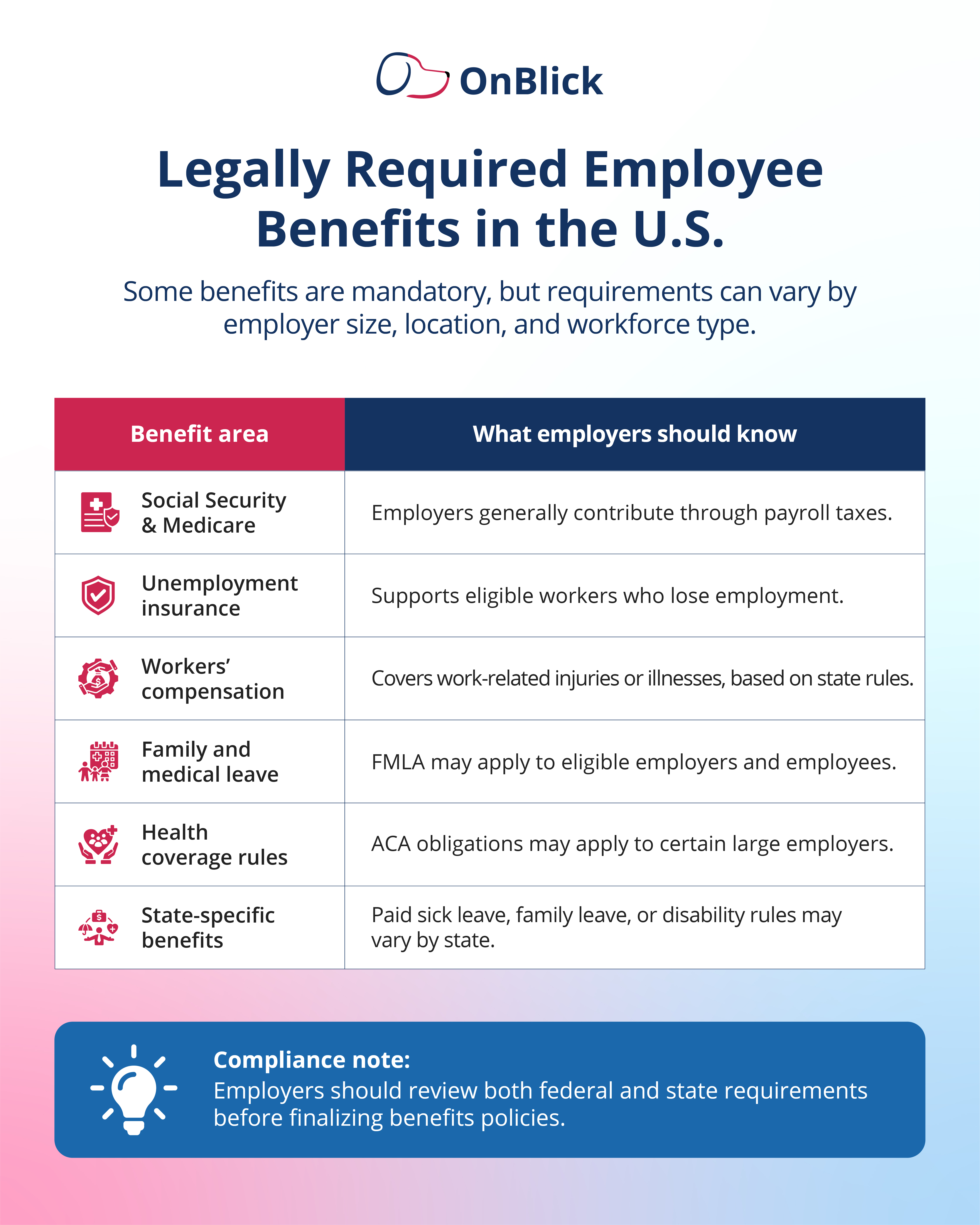
Some employee benefits and employer contributions are required by federal, state, or local law. The exact requirements can vary based on employer size, employee eligibility, industry, and work location.
- Common legally required benefits and employer obligations in the U.S. include Social Security and Medicare contributions, unemployment insurance, and workers’ compensation. Employers generally contribute to Social Security and Medicare through payroll taxes. Unemployment insurance helps provide temporary wage support to eligible workers who lose their jobs, while workers’ compensation rules are mainly handled at the state level and cover work-related injuries or illnesses.
- Family and medical leave may also apply to covered employers and eligible employees. Under the federal Family and Medical Leave Act, eligible employees may take up to 12 workweeks of job-protected leave in a 12-month period for qualifying family and medical reasons. Eligibility rules include length of service, hours worked, and worksite size requirements.
- Health coverage requirements can also apply to certain employers. Under the Affordable Care Act’s employer shared responsibility provisions, applicable large employers generally must offer affordable minimum essential coverage that provides minimum value to full-time employees and their dependents, or they may face a potential employer shared responsibility payment. An employer is generally considered an applicable large employer if it had an average of at least 50 full-time employees, including full-time equivalent employees, during the previous calendar year.
- Employers should also review state and local requirements. Some states or cities may have rules for paid sick leave, paid family leave, disability insurance, or other employee protections. For this reason, HR teams should not rely only on a federal checklist when reviewing required benefits.
Voluntary employee benefits employers commonly offer
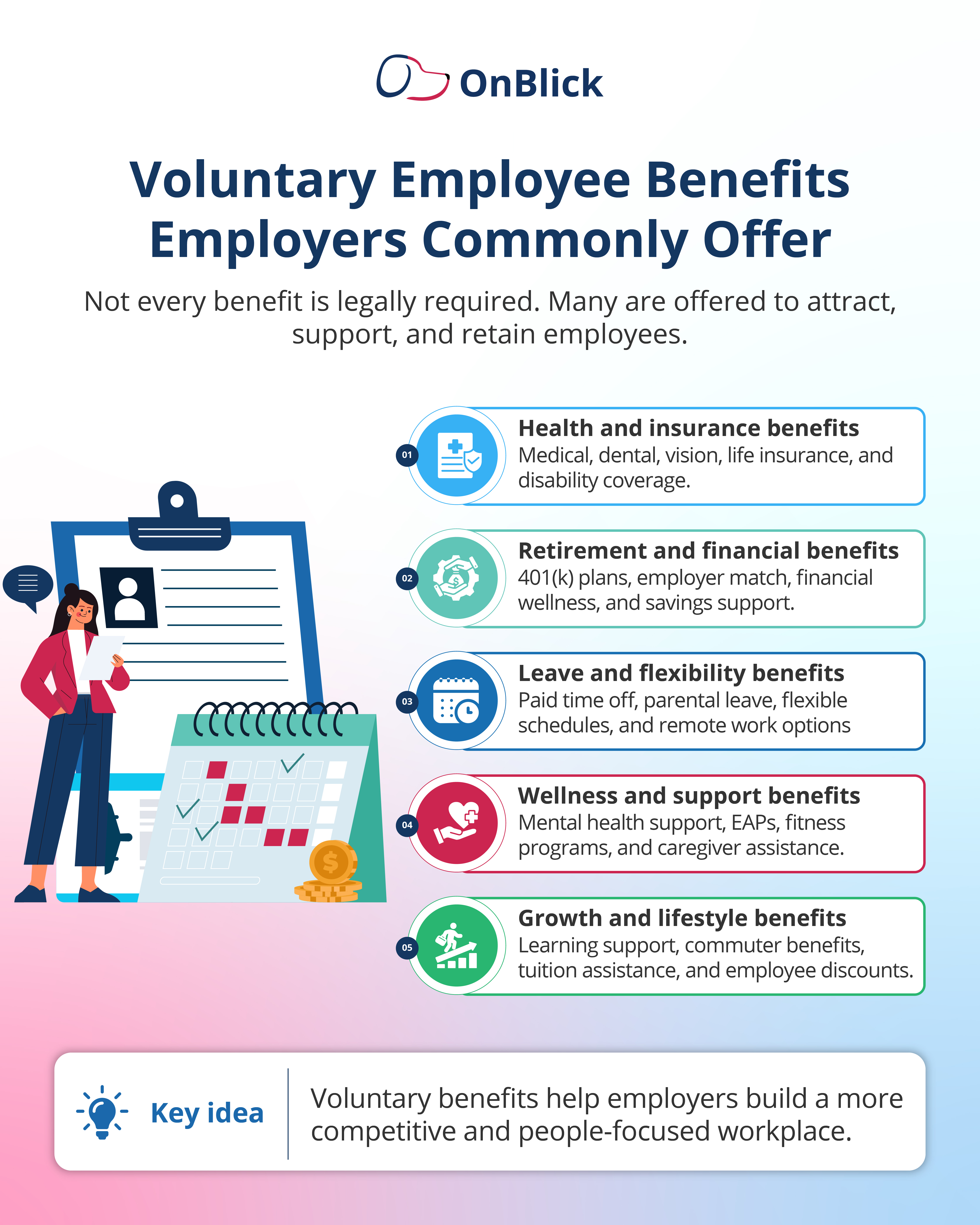
- Voluntary employee benefits are benefits that employers choose to offer beyond legal requirements. These benefits can help employers stay competitive, support employee needs, and improve the overall value of the compensation package.
- Common voluntary benefits include health insurance, dental and vision coverage, life insurance, disability coverage, retirement plans, employer 401(k) matching, paid time off, paid holidays, parental leave, wellness programs, mental health support, tuition assistance, commuter benefits, and flexible work options.
- These benefits can serve different employee needs. Health and insurance benefits support medical and financial protection. Retirement and savings benefits help employees plan for the future. Paid leave and flexibility help employees manage personal and family responsibilities. Wellness and mental health programs can provide additional support beyond traditional medical coverage.
- For HR teams, the goal is not to offer every possible benefit. A better approach is to understand workforce needs, review budget limits, compare market expectations, and choose benefits that employees can understand and use. A smaller benefits package that is clear, well-managed, and relevant may be more effective than a long list of benefits that employees do not understand.
- Voluntary benefits should also be reviewed regularly. Employee needs, workforce structure, provider costs, and compliance requirements can change. Regular review helps employers decide what to keep, adjust, remove, or add during the next benefits cycle.
Health insurance, dental, and vision benefits
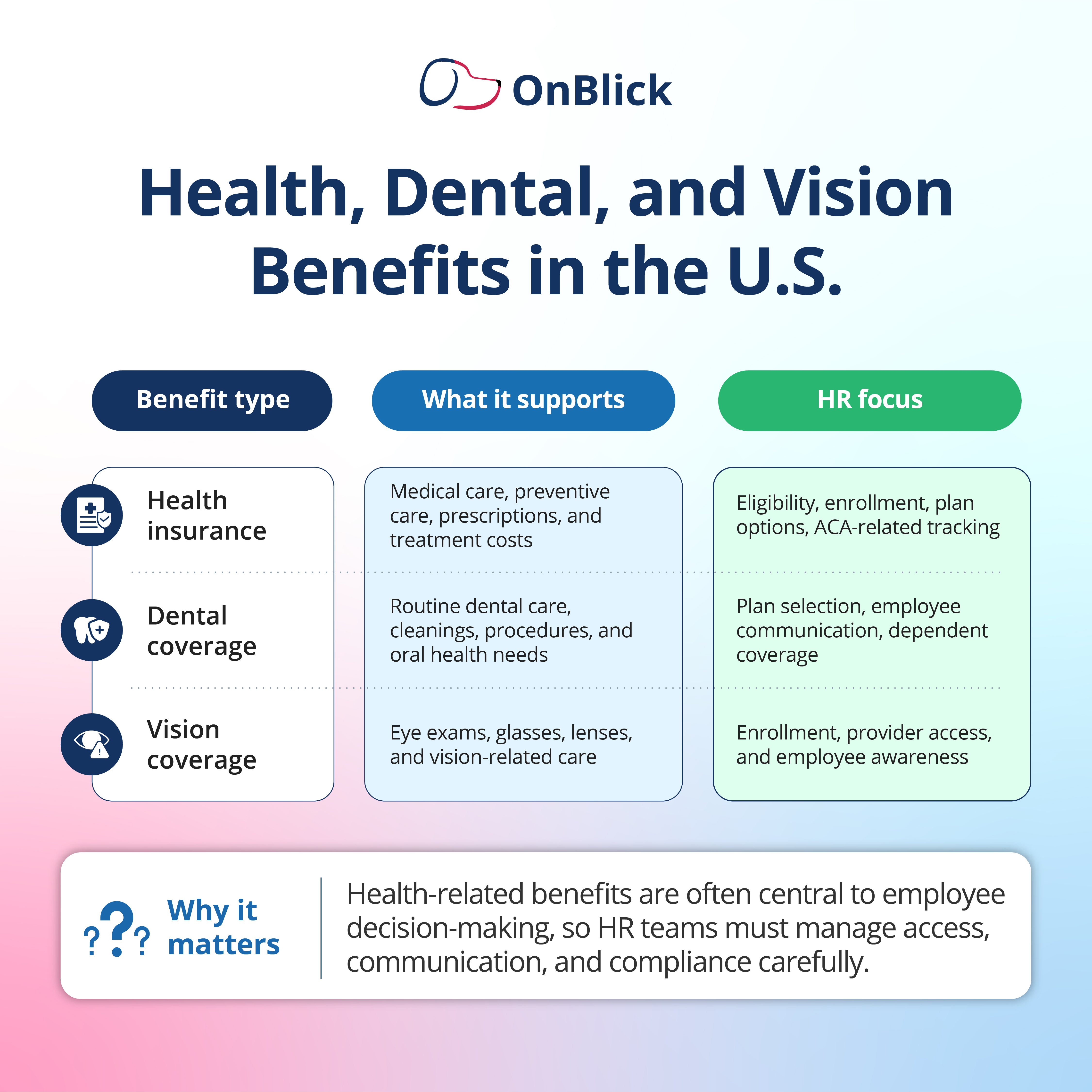
- Health-related benefits are among the most recognized employee benefits in the U.S. For many employees, health coverage is one of the first things they review when comparing job offers or deciding whether a benefits package meets their needs.
- Health insurance may help employees manage medical costs related to doctor visits, preventive care, prescriptions, emergency care, specialist treatment, and other healthcare needs. Depending on the plan, employees may also have access to provider networks, dependent coverage, health savings accounts, or flexible spending accounts.
- Dental and vision benefits are often offered separately from medical coverage. Dental plans may support routine cleanings, exams, fillings, and other dental procedures. Vision plans may cover eye exams, glasses, contact lenses, or related care.
- For HR teams, the work does not end with choosing a plan. Health-related benefits require clear eligibility rules, enrollment support, payroll deduction accuracy, dependent coverage management, employee notices, and vendor coordination. Employees also need simple communication that explains what is covered, what costs may apply, and when they can make changes.
Retirement and financial security benefits
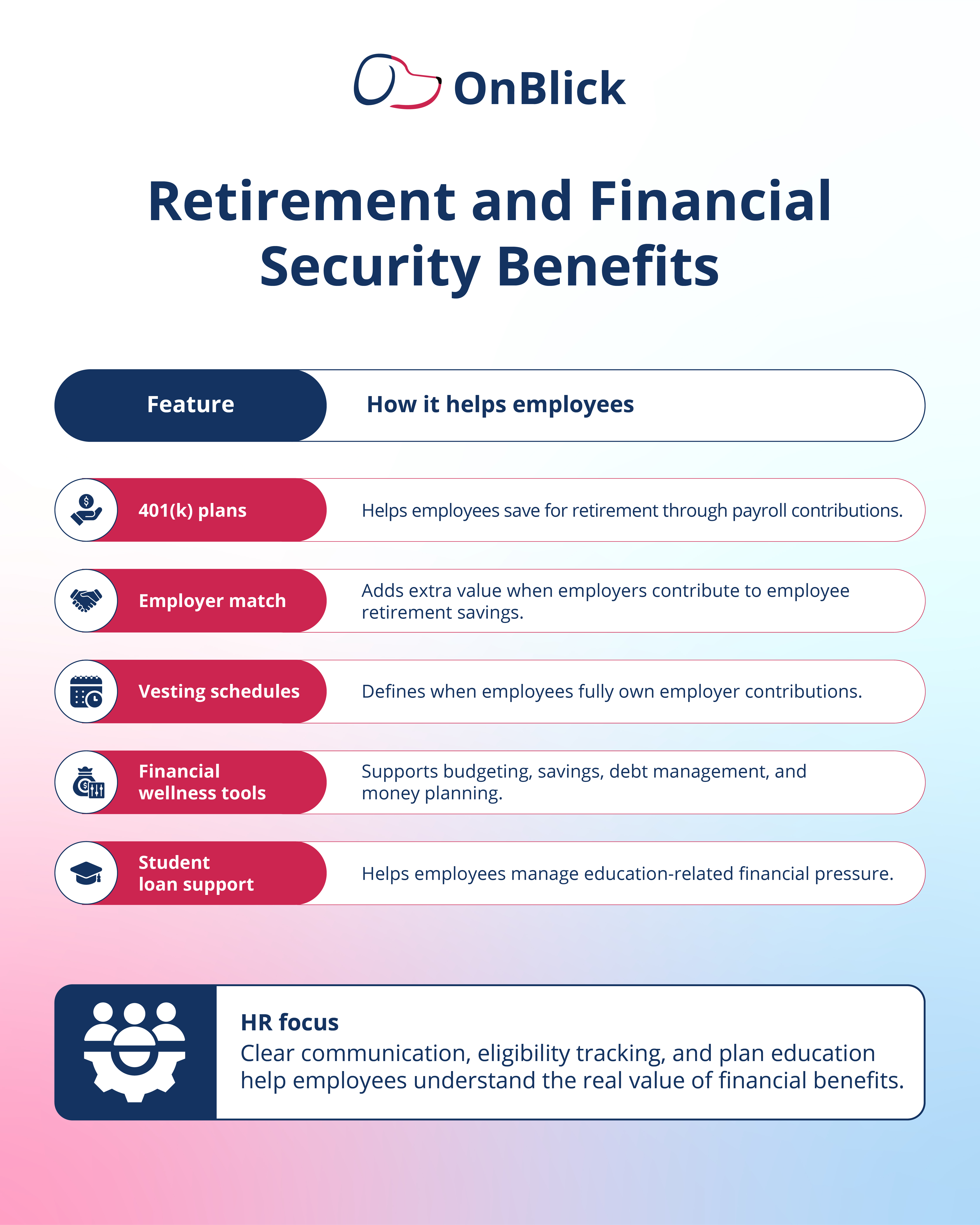
- Retirement and financial benefits help employees plan beyond their current paycheck. These benefits can support long-term savings, reduce financial stress, and make the overall compensation package more valuable.
- A common retirement benefit in the U.S. is a 401(k) plan. Employees can contribute part of their pay to the plan, and some employers choose to match a portion of those contributions. Employer matching can make the benefit more attractive because it adds extra value to the employee’s savings.
- Employers may also offer financial wellness programs, savings education, budgeting tools, student loan support, emergency savings options, or access to financial planning resources. These benefits can be useful for employees at different life stages, from early-career workers managing debt to older employees preparing for retirement.
- HR teams should make retirement and financial benefits easy to understand. Employees need to know who is eligible, when they can enroll, how contributions work, whether an employer match applies, and what vesting rules mean. Clear communication can help employees make better decisions and avoid missing valuable benefits.
Paid leave, PTO, and work-life balance benefits
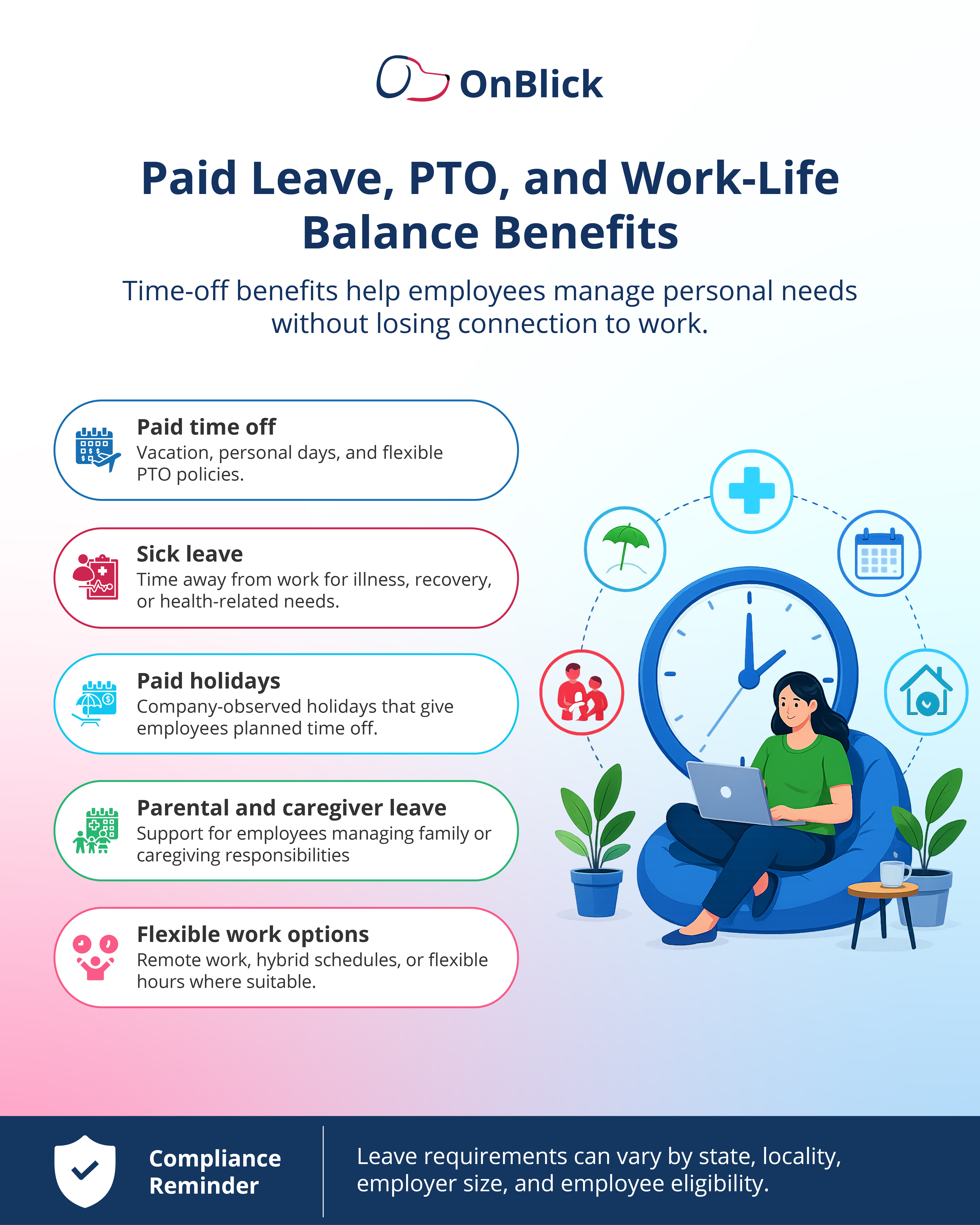
- Paid leave and time-off benefits help employees manage personal, family, health, and rest-related needs while staying connected to work. These benefits can include vacation days, sick leave, paid holidays, parental leave, caregiver leave, bereavement leave, and personal days.
- Some leave requirements are set by federal, state, or local law. Others are created by the employer as part of its benefits policy. This means HR teams need to understand which leave rules apply, which employees are eligible, how leave is requested, and how time away from work is recorded.
- Paid time off policies can differ from one employer to another. Some companies separate vacation and sick leave, while others use a combined PTO bank. Some employers offer fixed holidays, while others provide floating holidays or flexible time-off options.
- Work-life balance benefits may also include remote work, hybrid schedules, flexible hours, reduced schedules, or caregiver support. These benefits can be helpful, but they need clear rules. Employees should understand how requests are approved, how schedules are tracked, and how flexibility fits with business needs.
Wellness, mental health, and employee support benefits
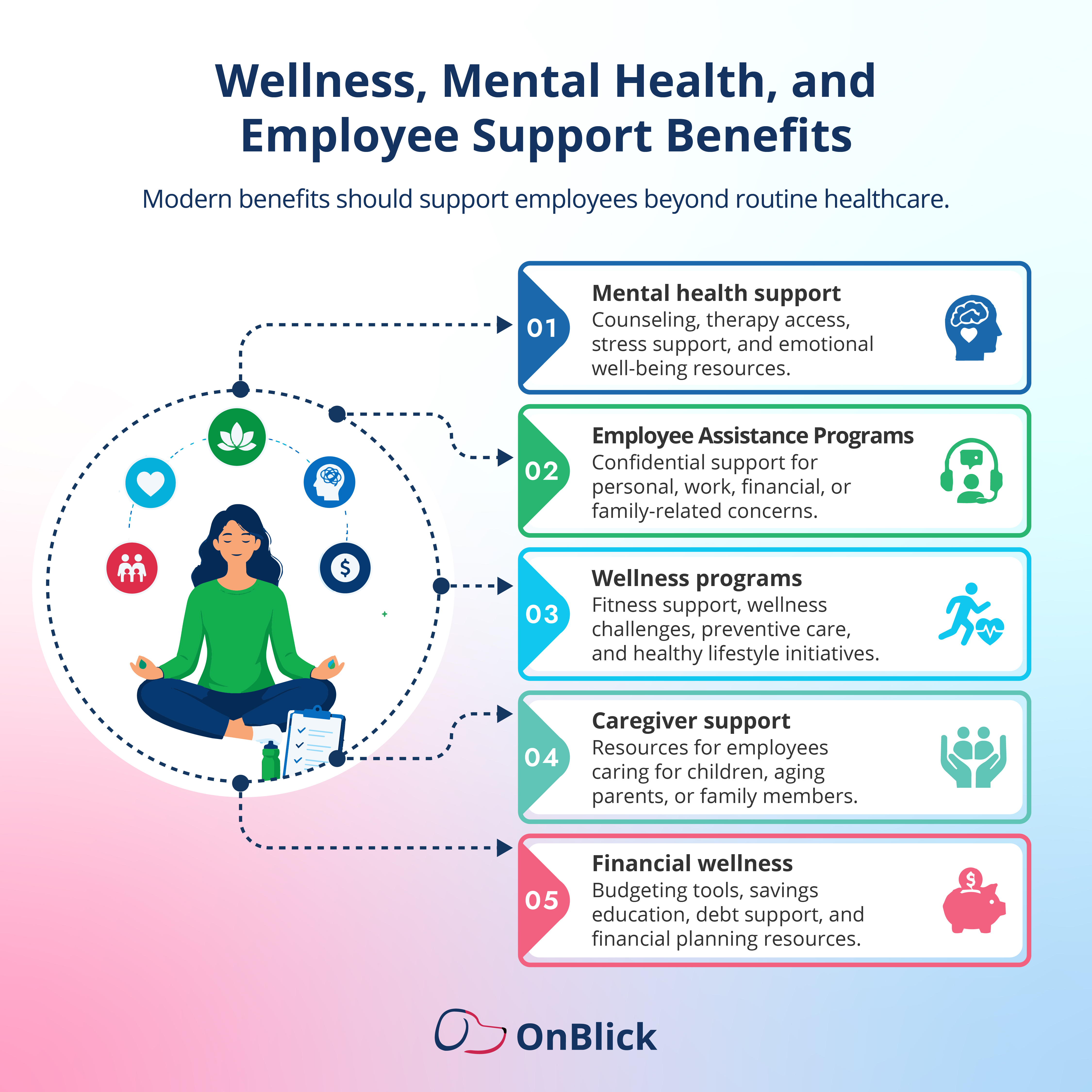
- Wellness and employee support benefits go beyond medical coverage. They are designed to help employees manage stress, health habits, family responsibilities, financial concerns, and personal challenges that may affect work and well-being.
- Employers may offer mental health support, counseling access, employee assistance programs, stress management resources, wellness stipends, fitness support, preventive care programs, caregiver support, or financial wellness education. These benefits can help employees access support before small concerns become larger problems.
- Employee assistance programs can be especially useful because they often provide confidential support for personal, family, work, legal, financial, or emotional concerns. When employees know these services exist and understand how to access them, they may be more likely to seek help early.
- For employers, communication is important. Wellness benefits often go unused when employees do not know what is available or are unsure whether support is confidential. HR teams should explain these benefits in plain language and repeat the information during onboarding, open enrollment, and key employee communication moments.
What goes into an employee benefits package?
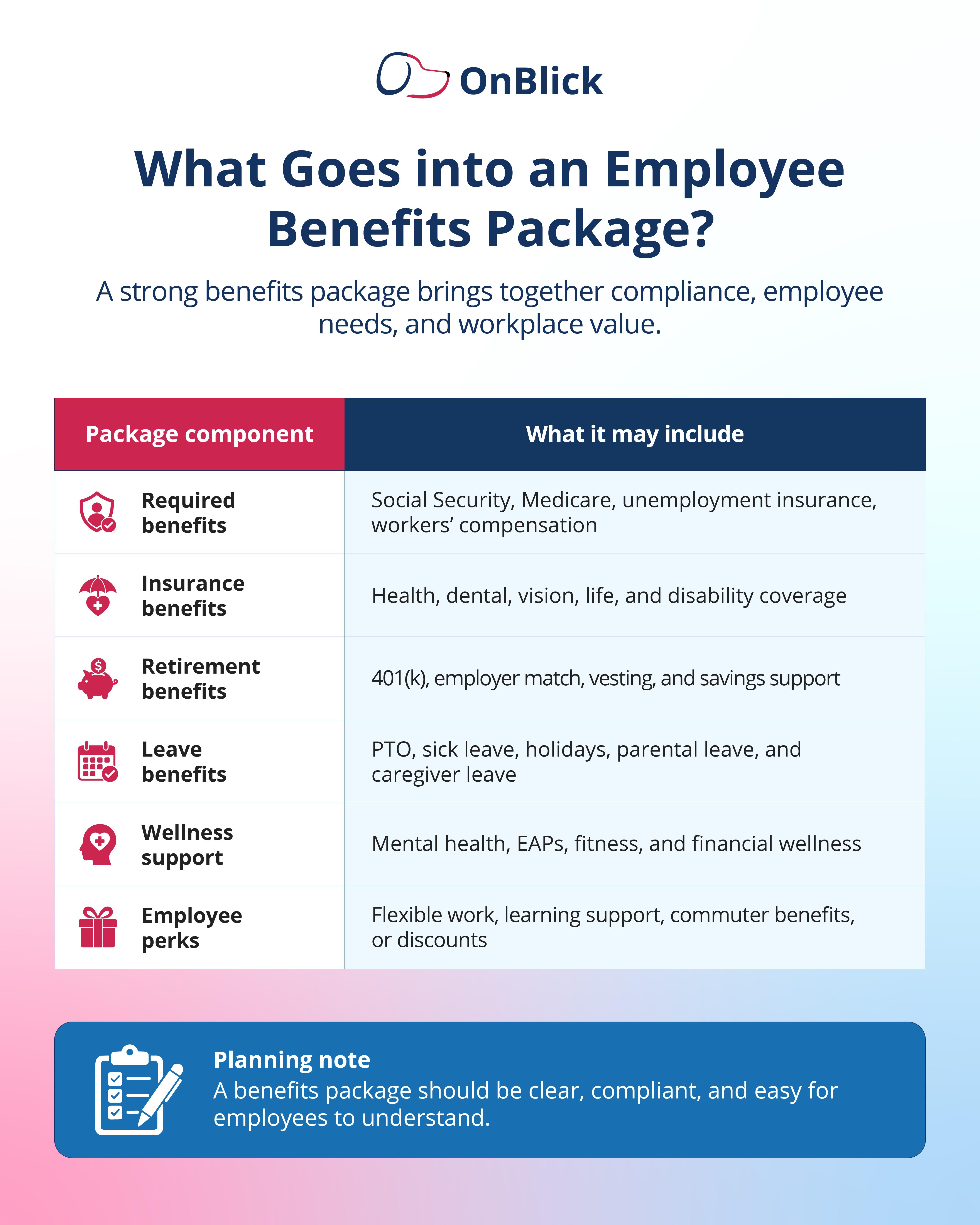
An employee benefits package is the full set of benefits an employer offers to eligible employees. It may include required benefits, health coverage, retirement plans, paid leave, insurance, wellness support, employee perks, and other forms of non-wage compensation.
A typical benefits package may include:
- Health, dental, and vision coverage
- Life insurance and disability coverage
- 401(k) or other retirement plans
- Paid time off, sick leave, and holidays
- Parental leave or caregiver leave
- Wellness and mental health support
- Employee assistance programs
- Commuter benefits or lifestyle benefits
- Tuition assistance or learning support
- Flexible work options, where suitable
The right package will not look the same for every employer. A small business may focus on a smaller set of high-value benefits, while a larger employer may offer broader coverage, more plan options, and more formal administration.
A benefits package should also be easy to understand. Employees need clear information about eligibility, enrollment deadlines, coverage levels, contribution amounts, dependent coverage, and how to request support. When this information is unclear, employees may miss benefits or make decisions based on incomplete information.
How benefits vary by state, employer size, and workforce type
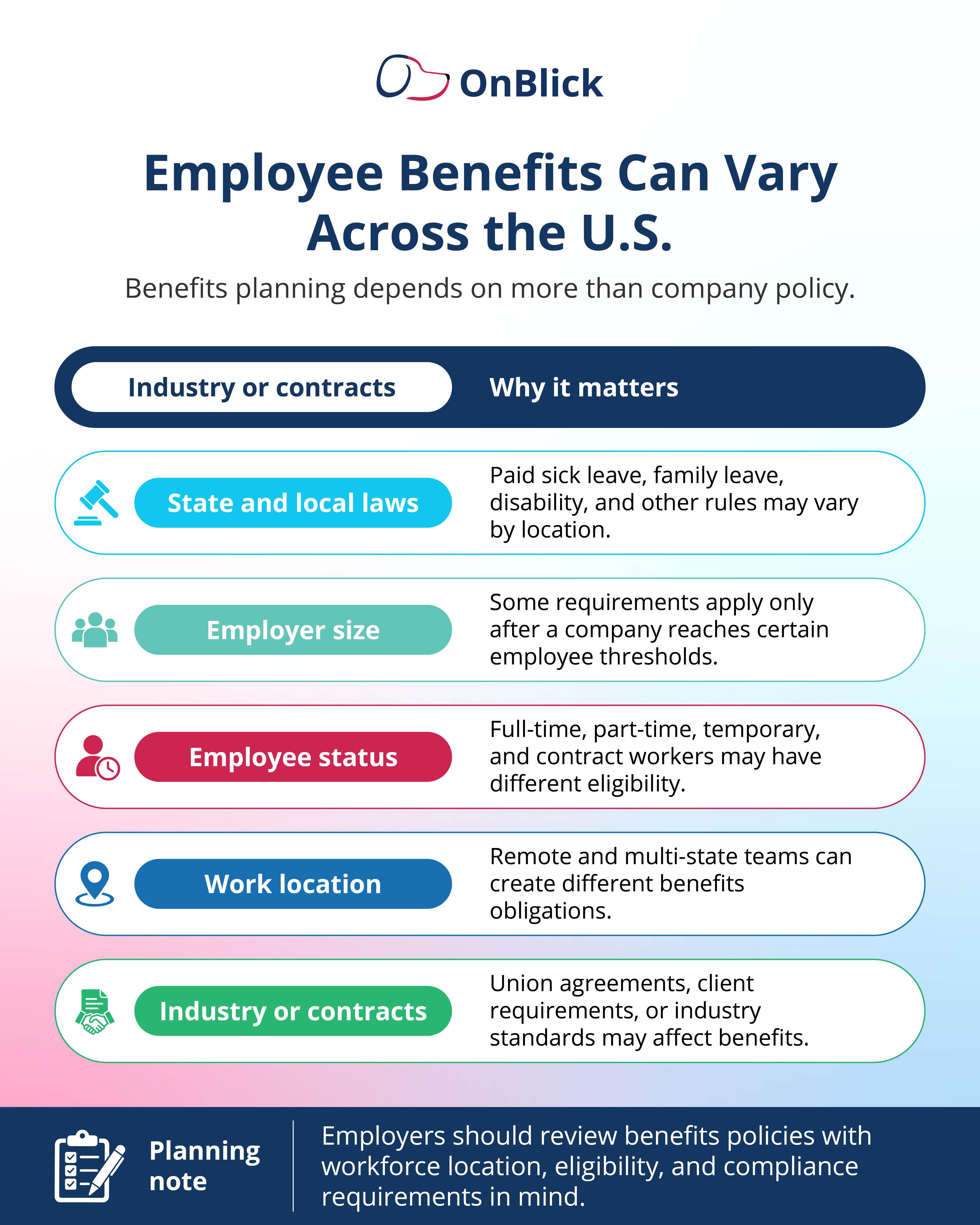
- Employee benefits in the U.S. are not shaped by one rule alone. Requirements and eligibility can vary based on federal law, state and local rules, employer size, employee classification, and work location.
- Employer size is an important factor. Some requirements apply only when an employer reaches a certain number of employees. For example, large employers may have different health coverage responsibilities than smaller employers. Leave obligations can also depend on employer size and employee eligibility.
- State and local rules also matter. Some locations have paid sick leave, paid family leave, disability insurance, or other employee protection requirements. A company with employees in more than one state may need different policies or processes depending on where employees work.
- Workforce type can also affect benefits decisions. Full-time employees, part-time employees, temporary workers, seasonal workers, and contractors may not have the same eligibility. Remote and hybrid work can add another layer of complexity because employee location may affect applicable requirements.
- For HR teams, this means benefits planning should be reviewed carefully before policies are finalized. A policy that works for one location or employee group may not be suitable for another.
Benefits administration: what HR teams must manage
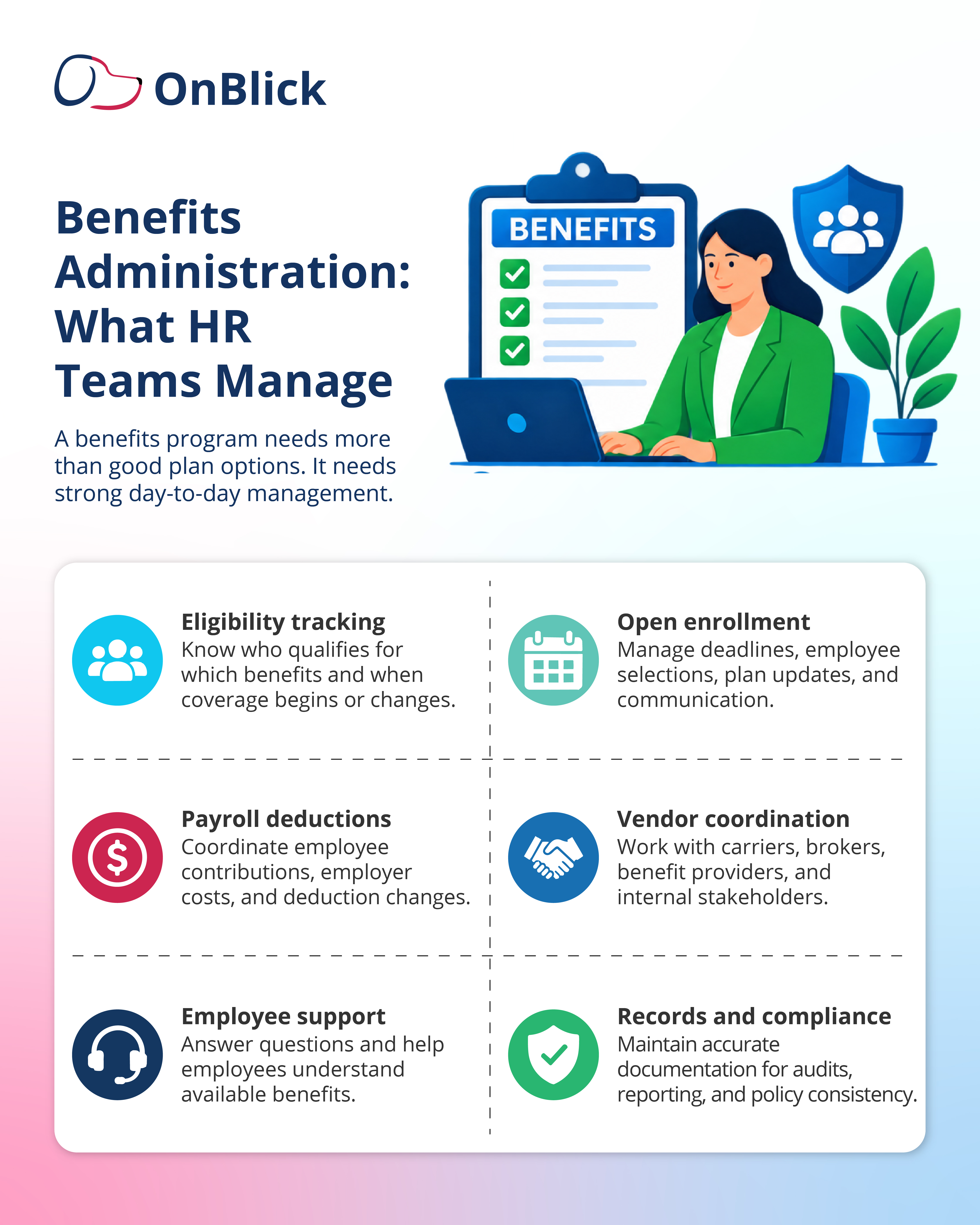
- Benefits administration is the day-to-day work of managing employee benefits from enrollment to ongoing support. It includes the processes, records, communication, approvals, payroll coordination, and vendor follow-up needed to keep benefits running properly.
- HR teams may need to manage eligibility tracking, open enrollment, new hire enrollment, qualifying life events, dependent changes, payroll deductions, employee questions, provider updates, benefit documents, notices, and compliance records.
- Accuracy matters because small errors can create larger issues. An incorrect eligibility date, missed deduction, delayed enrollment, or outdated employee record can affect coverage, payroll, employee trust, and compliance.
- Benefits administration also requires regular communication. Employees need to know what benefits are available, when they can enroll, what actions they need to take, and where to go for help. HR teams should keep benefits information simple, current, and easy to access.
- A well-managed benefits process can reduce repeated questions, improve employee confidence, and help HR teams spend less time correcting avoidable issues.
Common benefits mistakes employers should avoid
- Even a good benefits package can create problems if it is poorly managed or poorly communicated. Employers should review both the benefits they offer and the process used to administer them.
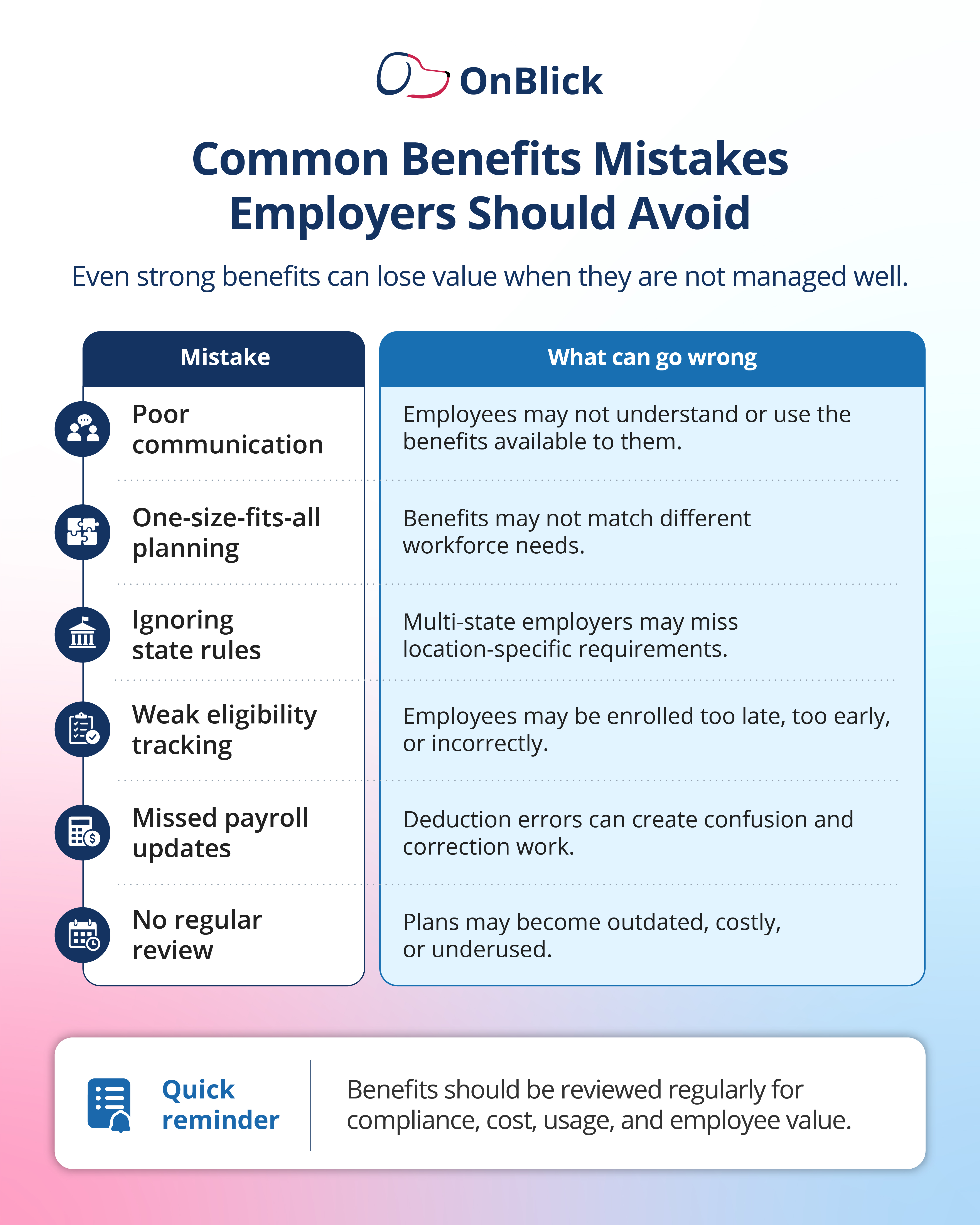
- One common mistake is unclear communication. Employees may not understand what is available, who is eligible, how much they need to contribute, or when they can make changes. This can lead to low usage, missed enrollment, and repeated HR questions.
- Another mistake is using the same benefits approach for every employee group. A workforce may include employees with different family needs, health priorities, financial goals, age groups, locations, and work arrangements. Benefits should be reviewed with these differences in mind.
- Employers may also overlook state and local requirements, especially when hiring across multiple locations. This can create gaps in leave policies, sick time rules, disability coverage, or other required benefits.
- Other common issues include weak eligibility tracking, missed payroll updates, outdated plan information, poor vendor coordination, and lack of annual review. These problems can affect both compliance and employee experience.
How to build a competitive employee benefits strategy
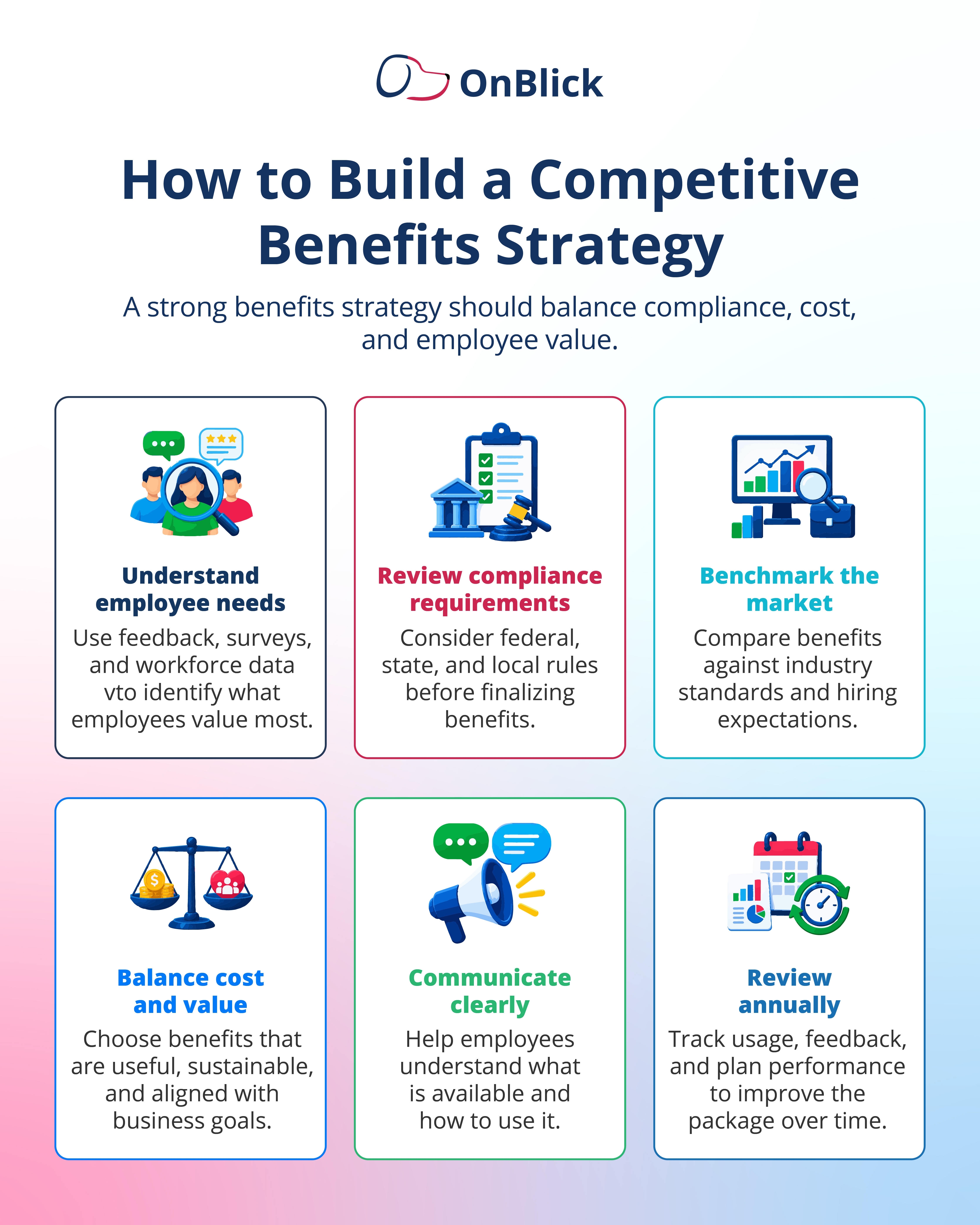
- A strong employee benefits strategy starts with understanding what employees need and what the employer can manage well. The goal is not to offer the longest list of benefits. The goal is to offer benefits that are useful, clear, compliant, and financially sustainable.
- Employers can begin by reviewing employee feedback, workforce demographics, hiring challenges, turnover patterns, and market expectations. This can help HR teams identify which benefits are most valuable to employees and which benefits may no longer be useful.
- Budget is also important. Employers should look at plan costs, employee contribution levels, provider fees, administrative workload, and expected usage. A benefit that looks attractive on paper may not be effective if employees cannot afford it or do not understand how to use it.
- A competitive strategy should also include regular review. HR teams should assess benefits during each planning cycle, compare usage with cost, review employee questions, update communication materials, and check whether any legal requirements have changed.
- The strongest benefits programs are usually the ones employees understand and use. Clear policies, simple communication, accurate records, and timely support can make a benefits package more valuable in practice.
How OnBlick helps HR teams manage benefits and compliance
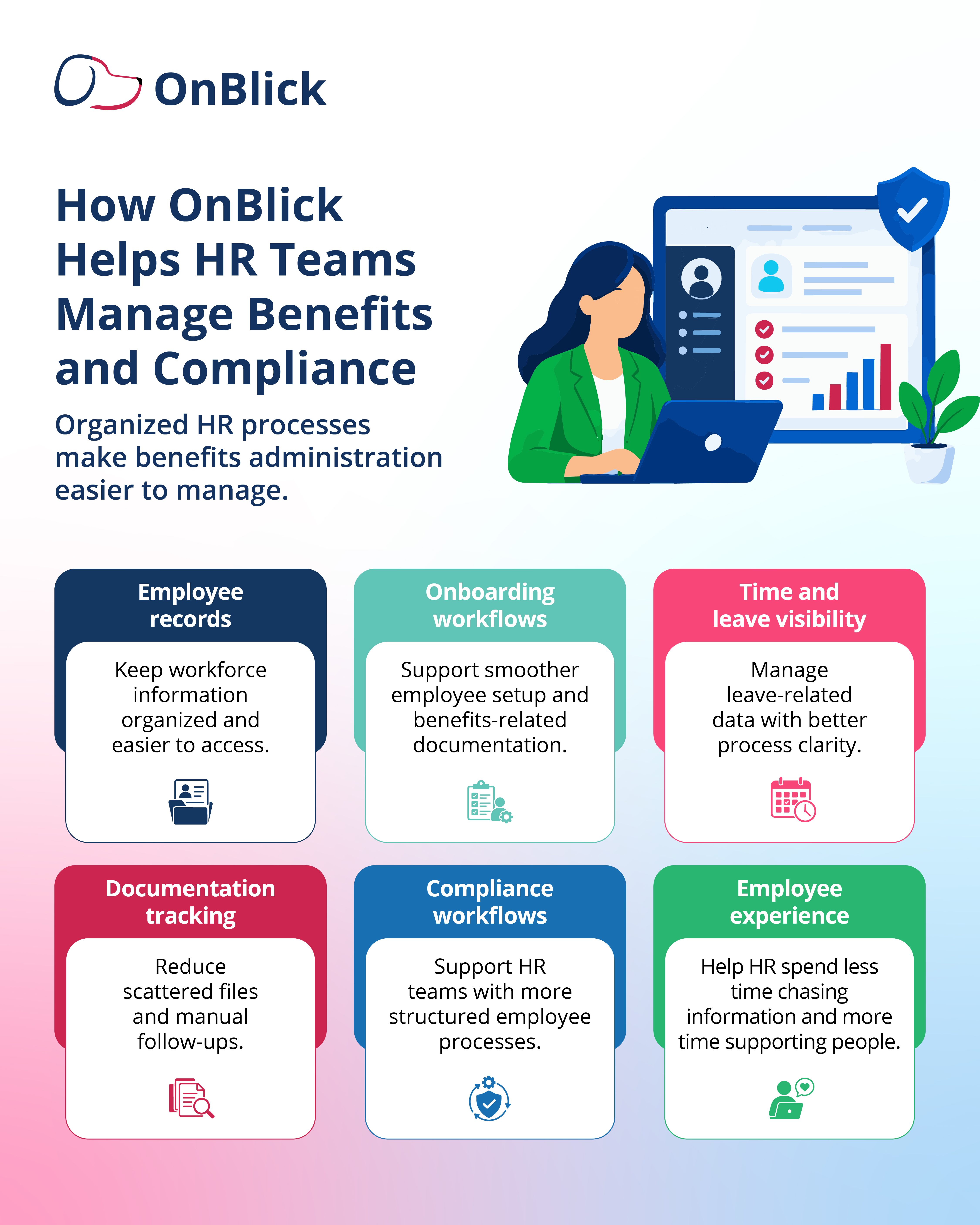
Managing employee benefits requires accurate employee data, organized documents, clear workflows, and timely follow-up. OnBlick helps HR teams bring these pieces together so benefits-related work does not depend only on spreadsheets, scattered files, or manual reminders.
With OnBlick, HR teams can manage employee records, onboarding workflows, document collection, task assignments, and employee self-service processes from a structured platform. This can help HR teams keep employee information organized and reduce repeated follow-ups during onboarding and benefits-related documentation.
OnBlick also supports time, leave, workforce visibility, role-based access, document storage, alerts, and workflow-based notifications. These capabilities can help HR teams track important employee updates, maintain records, and support smoother day-to-day administration.
For employers managing HR and immigration compliance together, OnBlick also helps connect employee lifecycle data with compliance-related workflows such as I-9, work authorization tracking, document management, and audit-ready reporting.
By keeping employee information, documents, and workflows more organized, OnBlick helps HR teams reduce manual work and give employees a more consistent support experience. Book a free OnBlick demo to see the product in action.
FAQs about employee benefits in the U.S.
1. What does employee benefits mean?
Employee benefits mean the extra compensation and support an employer provides beyond regular pay. These may include insurance, retirement savings, paid leave, wellness support, flexible work options, and other programs that add value to employment.
2. What is an employer-paid benefit?
An employer-paid benefit is a benefit where the employer pays some or all of the cost. For example, an employer may pay part of a health insurance premium, contribute to a retirement plan, cover life insurance, or fund an employee assistance program.
3. What makes a good employee benefits package?
A good benefits package is useful, clear, affordable, and aligned with employee needs. It should cover the basics employees care about, explain eligibility and costs clearly, and be simple for HR teams to manage.
4. How much do employee benefits cost employers?
The cost depends on the type of benefits offered, employer size, plan design, employee participation, location, and provider pricing. Health coverage, retirement contributions, paid leave, insurance, and vendor fees can all affect the total cost.
5. How can small businesses offer benefits on a limited budget?
Small businesses can begin with a focused package instead of trying to match large employers. Options may include PTO, flexible schedules, basic health coverage options, retirement savings support, wellness resources, learning stipends, or low-cost employee support programs.
6. Do part-time employees get benefits?
Part-time employees may receive benefits, but it depends on the employer’s policy, benefit plan rules, hours worked, location, and applicable legal requirements. Some employers offer limited benefits to part-time workers to improve retention and hiring.
7. What benefits do employees value most?
Employees often value benefits that support health, financial security, flexibility, family needs, and work-life balance. Health insurance, paid time off, retirement support, mental health resources, and flexible work options are often high-priority benefits.
8. How often should employers review their benefits package?
Employers should review their benefits package at least once a year, especially before open enrollment. They should also review it when hiring needs change, employee feedback shows gaps, costs increase, or new federal, state, or local rules apply.
9. What is benefits administration?
Benefits administration is the process of managing employee benefits. It includes eligibility tracking, enrollment, payroll deductions, employee communication, vendor coordination, recordkeeping, and support for benefit-related questions.
10. How can employers make benefits easier for employees to understand?
Employers can use plain-language benefit summaries, clear enrollment instructions, FAQs, reminders, employee self-service tools, and regular communication. Employees are more likely to use benefits when they know what is available, what it costs, and how to access it.
Conclusion
Employee benefits are a major part of the employer-employee relationship in the U.S. They affect hiring, retention, employee trust, and the way people experience work beyond salary.
For HR teams, benefits require careful planning and daily management. Employers need to understand which benefits are required, which benefits are voluntary, how eligibility works, and how federal, state, and local rules may affect their policies. They also need clear processes for enrollment, payroll coordination, employee communication, recordkeeping, and ongoing review.
A strong benefits package does not have to include every possible option. It should match workforce needs, meet compliance requirements, fit the employer’s budget, and remain easy for employees to understand and use.
With the right systems and processes, employers can make benefits administration more organized, reduce manual work, and give employees better support throughout the employee lifecycle.