.gif)



For many employers, Public Access Files (PAFs) are one of the most misunderstood parts of H-1B compliance. They tend to be created in a hurry, stored “somewhere,” and revisited only when a question or investigation arises. If you have ever searched online for “public access file h1b” or “h1b public access file”, you have probably seen how scattered the guidance can be.
Yet a missing or incomplete public access file can become a serious issue in a DOL review, even when everything else about the H-1B process is handled correctly. A well-prepared PAF, tied clearly to each LCA file, is often the first sign that an employer takes H-1B compliance seriously.
In this article, we break down what a PAF is, what it must contain, and how to create and maintain these files in a way that is consistent, transparent, and audit-ready for every H-1B public access file h1b requirement.
What Is a Public Access File (PAF)?
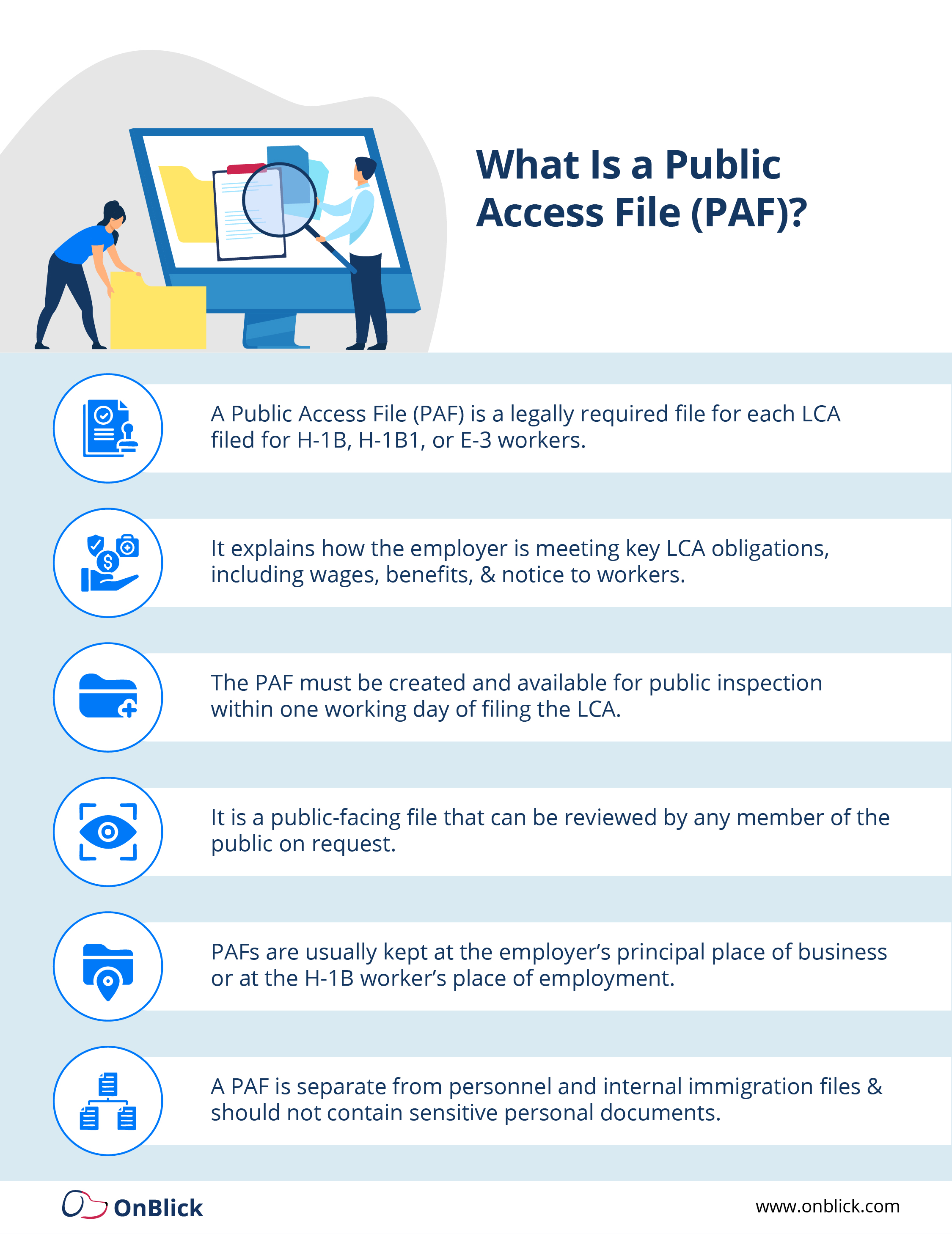
A Public Access File (PAF) is a file that H-1B, H-1B1, and E-3 employers are legally required to create and maintain for each Labor Condition Application (LCA) they file. It is tied to a specific LCA file, and it is meant to give the public insight into how the employer is meeting key LCA obligations, including wages and notice to workers.
The PAF must be created very early in the process. DOL guidance states that the required materials must be available to the public within one working day of filing the LCA, and many practitioners recommend establishing the PAF by the time the LCA is submitted.
By design, the PAF is public-facing. Any member of the public can request access, and the employer must make the file available: typically at the principal place of business or at the H-1B worker’s place of employment. When someone asks about your “h1b public access file”, this is the file they are entitled to see.
It is important to distinguish the PAF from other records. It is not the employee’s personnel file and not the private “compliance” or payroll file that may contain detailed wage calculations or sensitive personal data. Those records are retained separately and shared only with the Department of Labor in the event of an investigation.
When HR understands the PAF as a specific, LCA-linked, public access file h1b with defined contents, it becomes much easier to build consistent practices around it.
Are Public Access Files Optional or Mandatory?
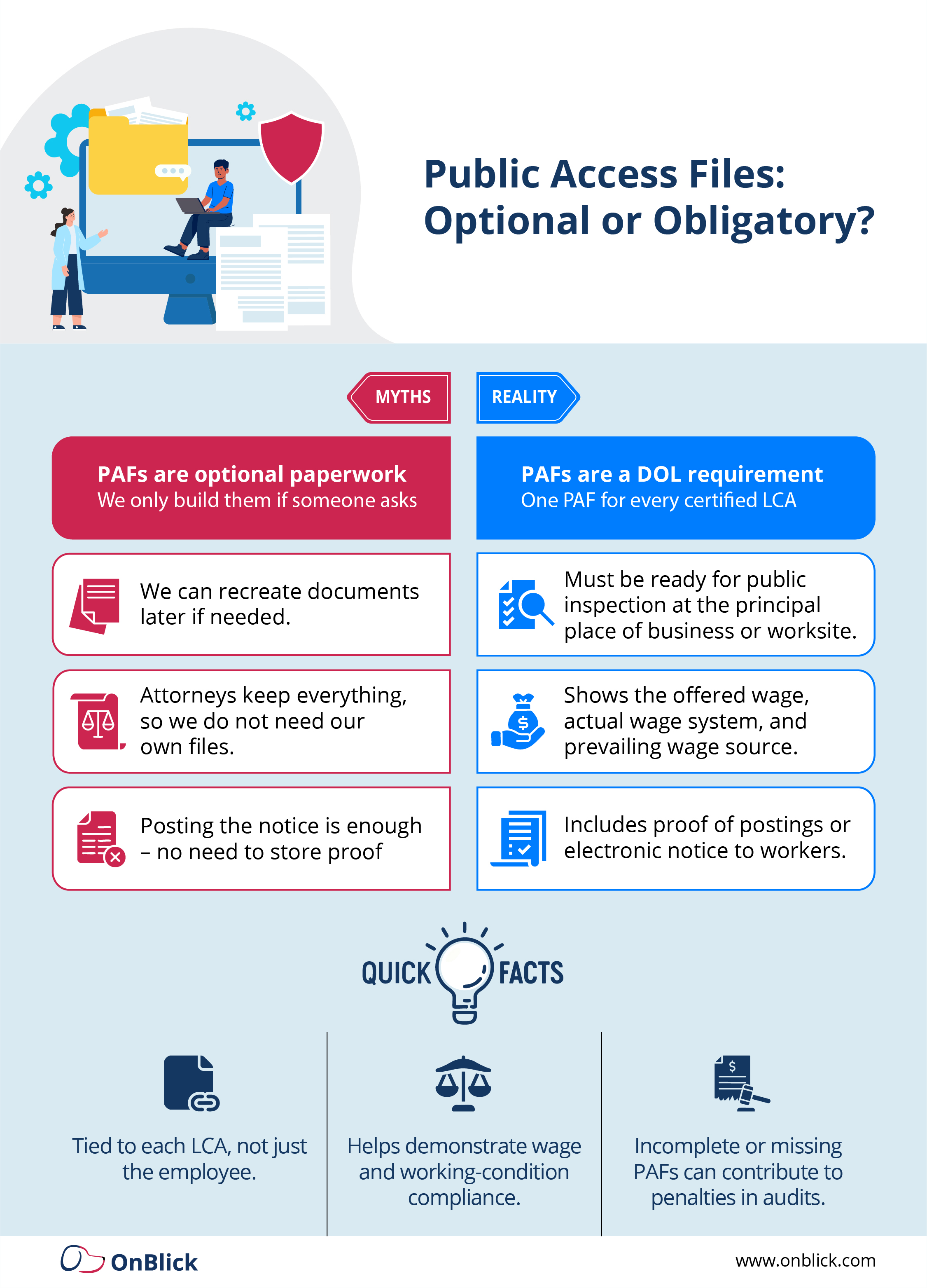
Public Access Files are not optional. H-1B, H-1B1, and E-3 employers are legally required to create and maintain a PAF for each LCA they file, and to make it available for public inspection. DOL guidance makes it clear that the file must be ready within one working day of filing the LCA and accessible at the employer’s principal place of business or the worksite.
Despite this, several myths still circulate in HR and immigration teams:
- Myth: “PAFs are only needed if someone asks for them.”
Fact: Employers must create a PAF proactively for each covered LCA, even if no one ever requests access. - Myth: “Our attorney keeps everything, so we don’t need a PAF.”
Fact: Counsel can help, but the legal obligation to maintain a compliant public access file rests with the employer, not the attorney. - Myth: “We can show any internal file if the DOL or public asks.”
Fact: The PAF is a specific, LCA-linked file with defined contents; payroll and personnel records are separate and not a substitute.
Understanding that every H-1B public access file is mandatory, time-bound, and purpose-built helps HR treat it as a core part of H-1B compliance rather than an optional extra.
Why Public Access Files Matter for H-1B Employers
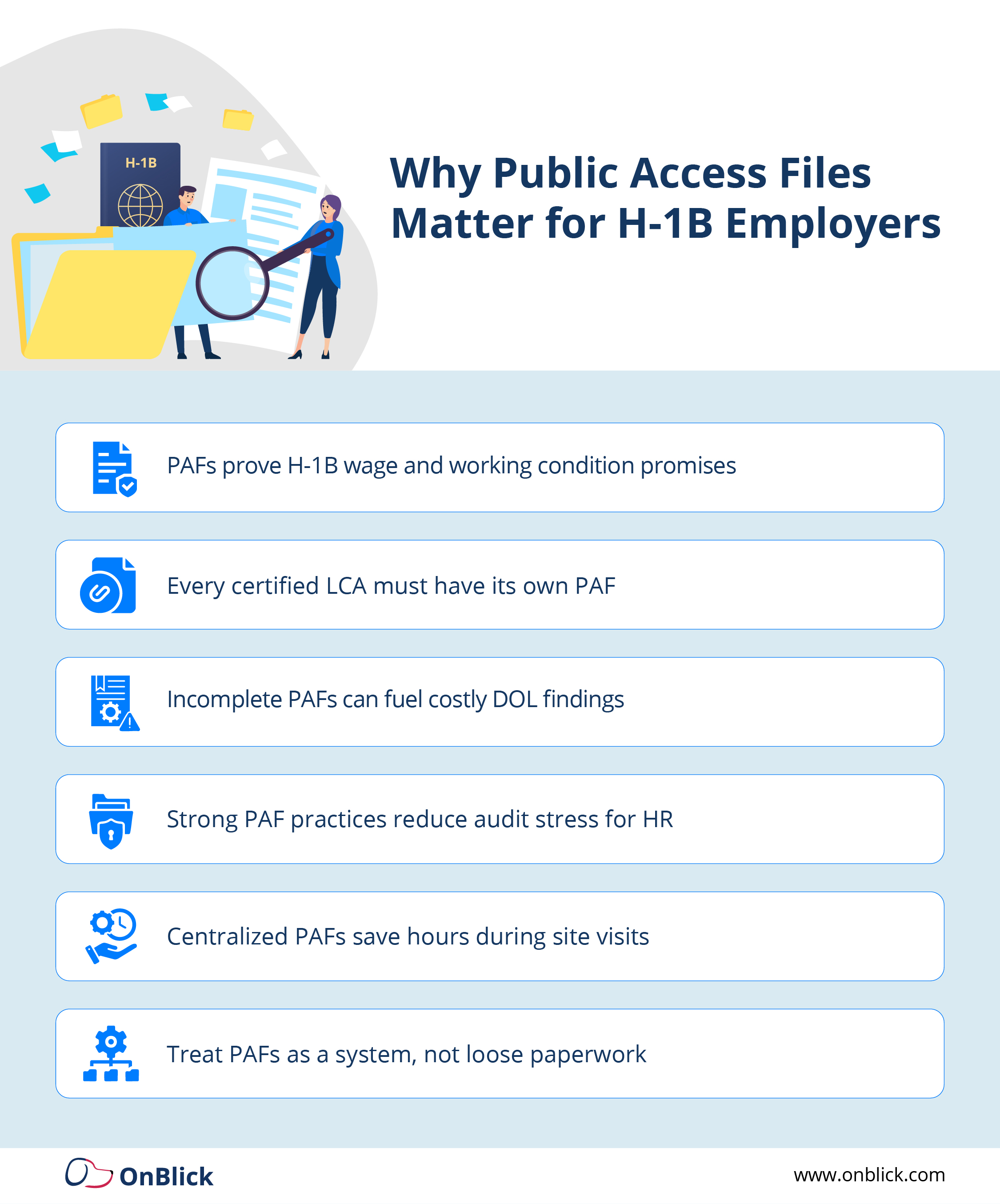
Public Access Files may feel administrative, but they sit at the heart of H-1B wage and working-condition commitments. Each h1b public access file shows how an employer has met the core promises made in the Labor Condition Application: especially around wages, benefits, and notice to workers. When a file is missing or incomplete, it raises questions about whether those promises were actually honoured.
For the Department of Labor, PAFs are often the first checkpoint in an investigation. They are quick to review and provide an early indicator of how seriously an employer treats LCA compliance. If PAFs are disorganized or absent, it can signal broader issues and invite deeper scrutiny into payroll records, worksites, and treatment of H-1B workers.
Well-maintained PAFs also help employers. They keep key documents in one place, make it easier to respond to employee or public questions, and reduce last-minute scrambling when records are requested. For HR and compliance teams managing multiple LCAs and locations, good PAF habits are a simple way to show structure, transparency, and control in the H-1B process.
Required Contents of a Public Access File
For each LCA you file, the public access file must include a specific set of documents that show how you are meeting your wage and notice obligations. The Department of Labor lists these requirements in its regulations and guidance, and employers are expected to have them ready within one working day of filing the LCA.
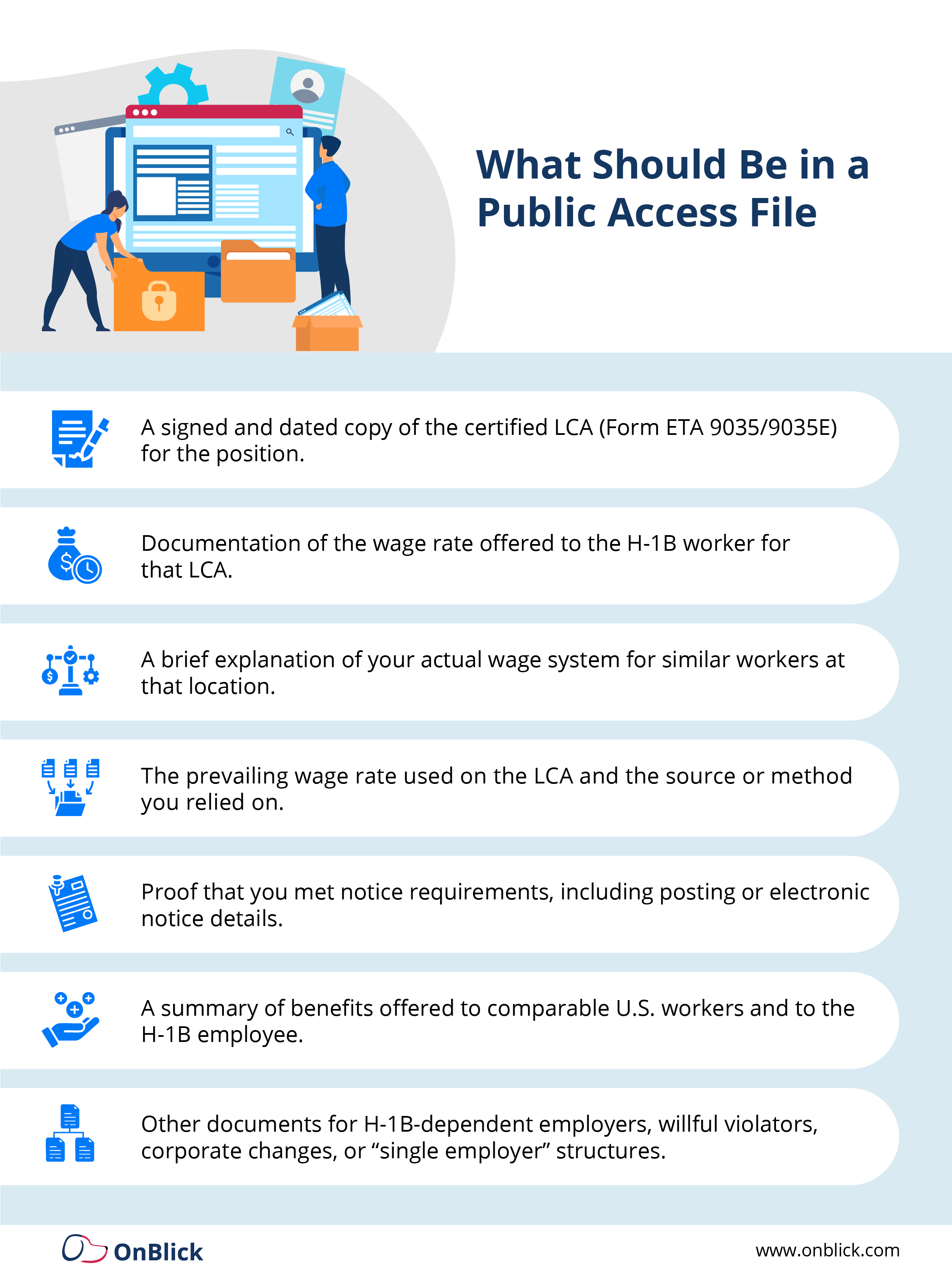
At a minimum, each h1b public access file should contain:
- Certified LCA: A copy of the certified Labor Condition Application (Form ETA 9035/9035E), signed and dated by the employer if filed electronically.
- Wage rate for the worker: Documentation showing the pay rate offered to the H-1B worker for the role covered by the LCA.
- Explanation of the actual wage system: A brief statement describing how you determine the actual wage for workers in that occupation and work location (for example, based on experience, education, and internal pay scales).
- Prevailing wage and source: The prevailing wage rate used on the LCA, along with the source (such as an OES wage level, survey, or CBA) and any relevant documentation.
- Notice documentation: Proof that you met notice requirements, such as posting notices or electronic announcements, with dates and locations or a description of how electronic notice was provided.
- Summary of benefits: A summary of benefits offered to U.S. workers in the same occupation and to the H-1B worker, plus a statement if there is any meaningful difference.
In some cases, additional items are required. H-1B-dependent employers and willful violators must include documentation related to extra attestations, such as recruitment and non-displacement obligations. Employers that rely on a “single employer” definition or that have undergone a corporate change may need to add a list of related entities or a summary of the corporate transaction and assumption of LCA obligations.
Keeping these elements together, consistently labeled, and clearly tied to the underlying LCA file makes it much easier to show that your H-1B program is aligned with what you certified to the Department of Labor.
How to Create a Public Access File Step by Step
Creating a public access file is easier when you follow the same steps for every LCA. The goal is to build a repeatable process so that each file is complete, clearly labelled, and ready for inspection if requested.
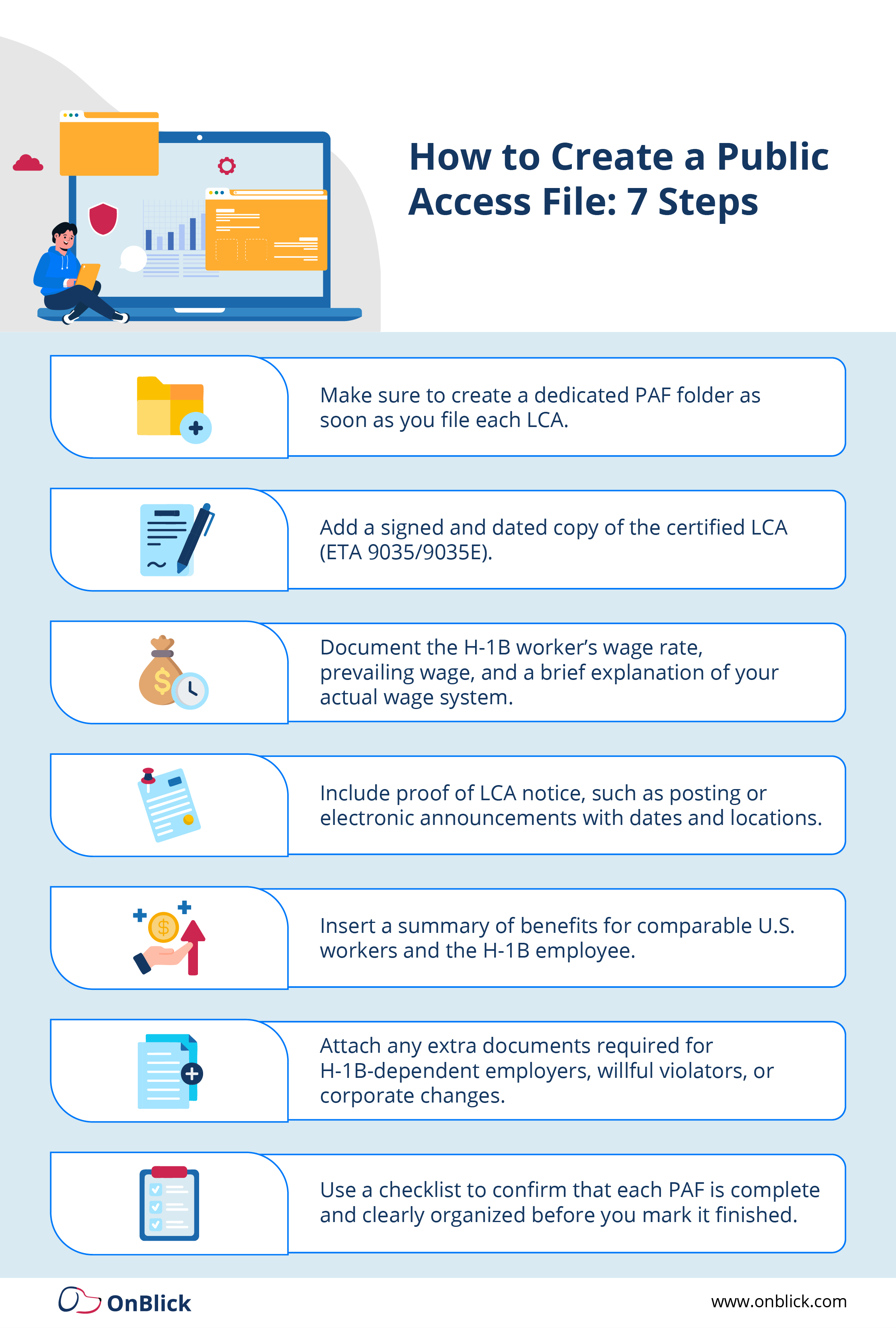
Step 1: Set up the PAF folder
As soon as the LCA is filed, create a dedicated PAF folder (physical or electronic) labeled with the LCA number, position title, and work location. Link it to the corresponding LCA file in your case management or lca application tracking system.
Step 2: Add the certified LCA
Once the LCA is certified, place a copy of the signed and dated ETA 9035/9035E in the folder. This is the core document that anchors the h1b public access file.
Step 3: Document the wage details
Insert a short note or memo stating the H-1B worker’s wage rate, the prevailing wage and source, and a brief explanation of your actual wage system for similar workers at that location.
Step 4: Include notice and posting evidence
Add proof that notice requirements were met, such as print or screenshot copies of postings, emails, intranet notices, or union notifications, along with dates and locations.
Step 5: Add benefits information
Include a summary of benefits offered to comparable U.S. workers and to the H-1B employee, noting any material differences if they exist.
Step 6: Attach any additional required documents
If you are H-1B-dependent, a willful violator, or impacted by a corporate change, add the extra attestations and supporting documents required for those situations.
Step 7: Review the file against a checklist
Before marking the PAF complete, compare it to a standard checklist to confirm that all required items are present and clearly organized. Over time, this checklist becomes an internal lca application tracking control for every PAF associated with that LCA file.
Maintaining PAFs: Access, Updates, and Retention
Having a complete public access file is only the first step. H-1B employers also need to keep PAFs in the right place, make them available when requested, and know how long to retain them.
Access and location
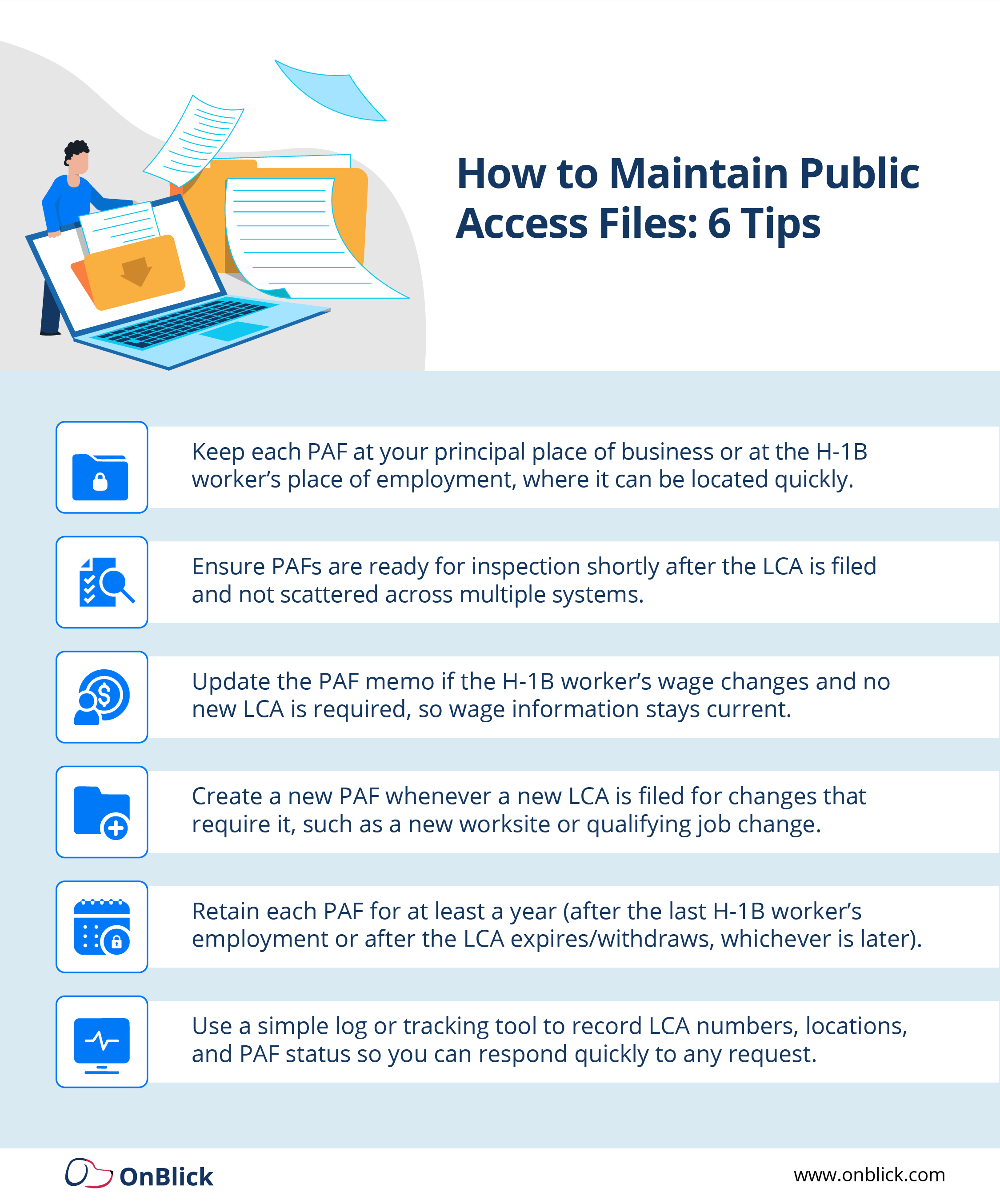
PAFs must be available for public inspection at the employer’s principal place of business or at the H-1B worker’s place of employment. They should be organized so HR can locate a specific file quickly when an employee, member of the public, or DOL officer asks to review it. A simple log or lca application tracking dashboard makes this much easier.
Timely availability
While the regulations do not specify a precise response time, the expectation is that PAFs are ready within one working day of filing the LCA and can be produced without delay. If files are scattered across email, local drives, or individual desks, it becomes difficult to meet this standard consistently.
Updates and changes
If there are material changes that trigger a new LCA (for example, a new worksite or significant job change), a new public access file h1b will usually be required for that LCA. For wage increases or minor adjustments that do not require a new LCA, it is a good practice to update the PAF memo that explains the wage system and the worker’s current rate.
Retention period
PAFs must be retained for the longer of:
- one year beyond the last date on which any H-1B worker is employed under the LCA, or
- one year from the date the LCA has expired or been withdrawn.
After this period, employers may securely dispose of the PAF, provided all other recordkeeping obligations (such as payroll and other DOL files) are met separately.
Keeping PAFs centralized, clearly labelled by LCA, and tracked with simple logs or lca application tracking software makes it much easier to show that your practices are consistent over time.
Common PAF Mistakes and Compliance Risks
Even when employers know PAFs are required, the same types of errors tend to repeat across LCAs. Most of these issues are preventable, but they can still create problems in a DOL review.
Common mistakes include:
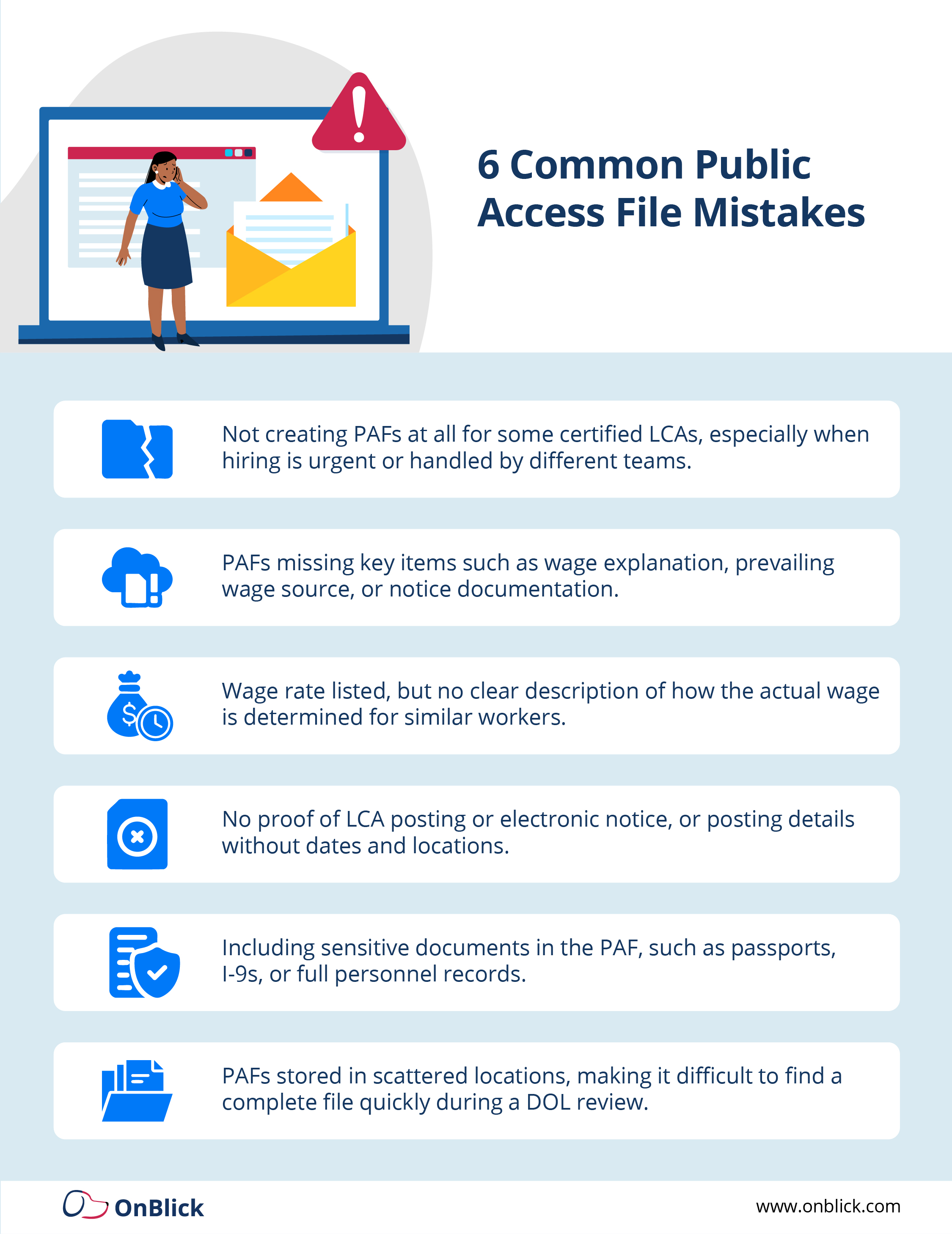
- Not creating a PAF at all for certain LCAs, especially when hiring is urgent or handled by different offices.
- Creating a PAF folder but leaving out key components such as the wage explanation, notice evidence, or prevailing wage source.
- Listing the H-1B worker’s wage but failing to explain the actual wage system, or omitting prevailing wage details and source.
- Meeting notice requirements but forgetting to keep proof of where and when notice was given, or how electronic notice was provided.
- Putting too much into the PAF, such as paystubs, I-9s, copies of passports, or other personal data that belong in confidential files, not in a public access file h1b.
- Allowing PAFs to become outdated or hard to locate. If HR cannot quickly find and present a complete file when asked, it undermines confidence in the employer’s H-1B and LCA practices.
Best Practices to Keep PAFs Audit-Ready
Keeping Public Access Files audit-ready is mostly about consistency. When every LCA follows the same checklist and timeline, PAFs become easier to create, maintain, and retrieve.
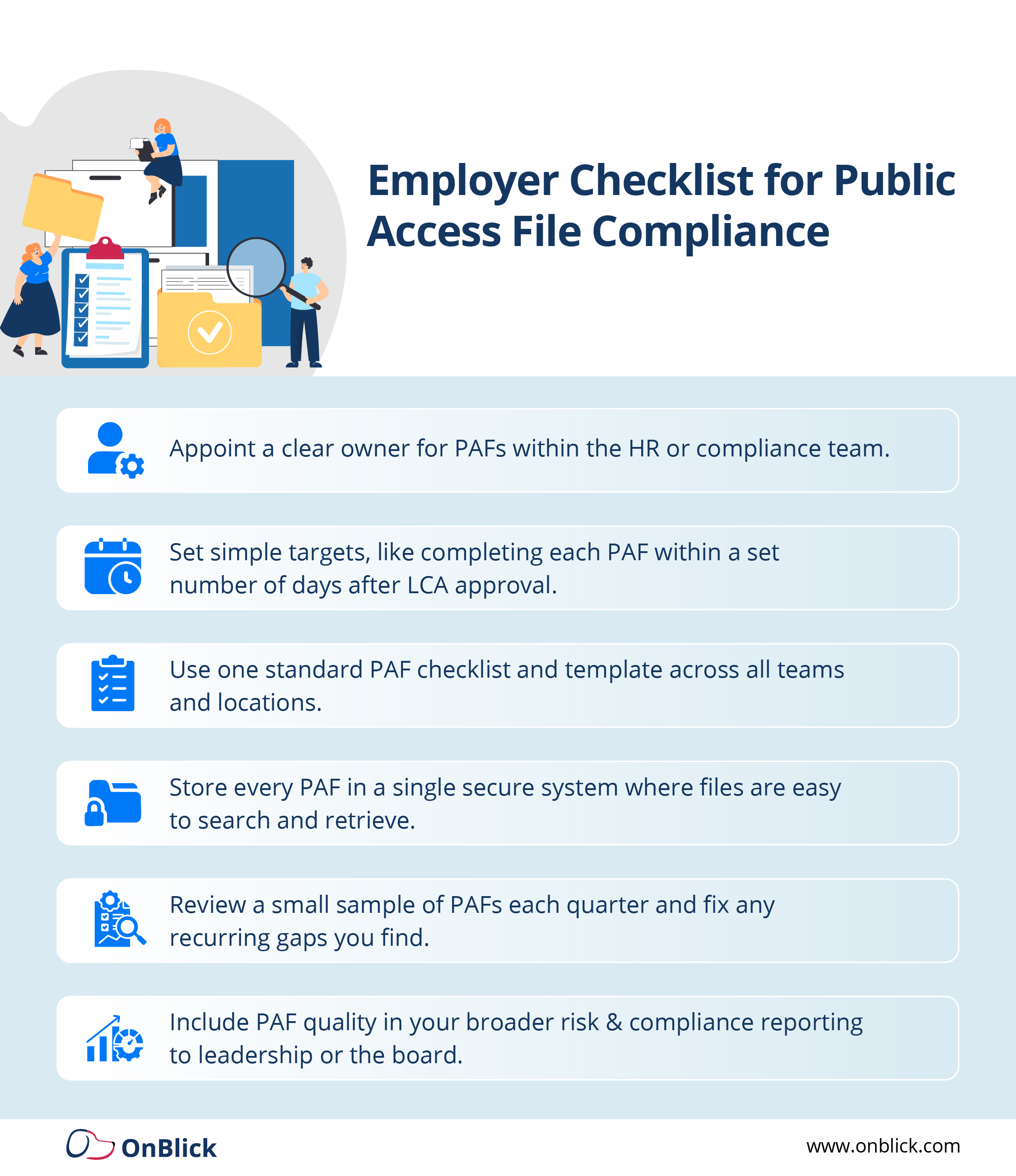
- Use a standard PAF checklist or template for every LCA.
This should cover all required contents, including the certified LCA, wage documentation, actual wage explanation, prevailing wage source, posting evidence, and benefits summary. A simple, reusable template reduces variation between teams and locations. - Maintain a central tracking log for LCAs and PAFs.
Record the LCA number, position title, work location, filing date, and PAF status. Treat this as your internal lca application tracking view so you always know which h1b public access file is complete and which needs follow-up. - Build PAF tasks into your LCA workflow and timelines.
For example, create the PAF folder when the LCA is filed, and set an internal deadline to complete all contents within one working day of certification. When PAFs are treated as an integral step rather than an afterthought, compliance becomes more reliable. - Schedule periodic internal reviews of PAFs.
Sample files across different locations or business units, check them against the checklist, and document common gaps. Use these reviews to adjust processes, clarify responsibilities, or provide targeted training. - Train the right people.
Anyone involved in H-1B and LCA processes: HR, immigration coordinators, and relevant managers, should understand what a public access file is, what it contains, and what should never be included. Short, practical training with real examples can significantly improve the quality of your files.
Together, these practices make PAFs a predictable, well-managed part of your H-1B compliance program.
Summary
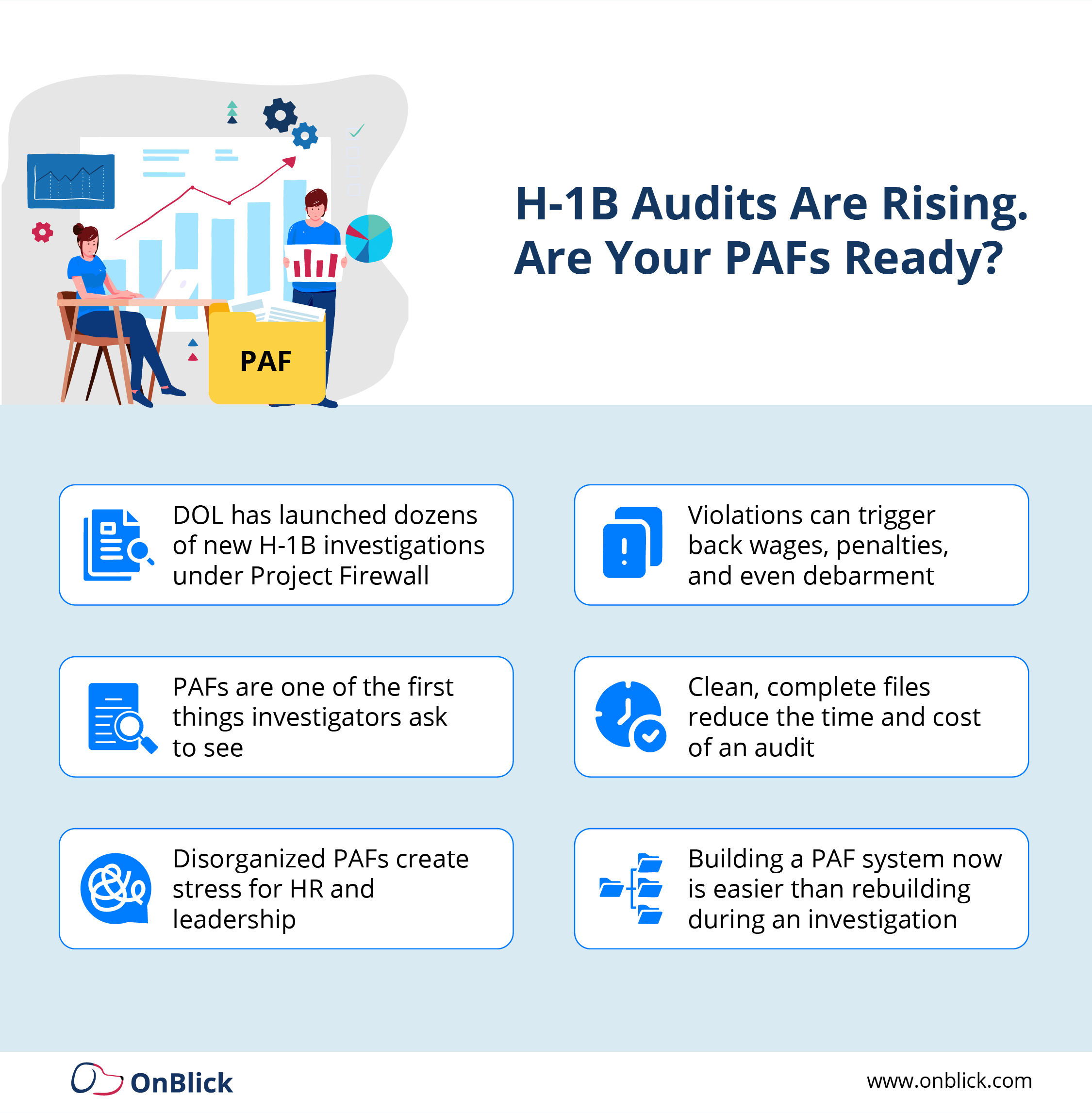
Public Access Files are a small but critical part of H-1B and LCA compliance. They show how employers set wages, provide notice, and meet key obligations for each LCA, and they are often the first records reviewed in a DOL inquiry. When PAFs are missing, incomplete, or hard to locate, it undermines confidence in the employer’s broader H-1B practices.
By understanding what a PAF is, why it matters, and what belongs inside, HR and compliance teams can move from ad hoc folders to a clear, repeatable structure. Standard checklists, central tracking, and periodic internal reviews help keep files audit-ready. With the right tools and habits, PAFs become straightforward to manage, even when you juggle multiple LCAs, worksites, and H-1B employees.
Key Takeaways
- PAFs are mandatory for each LCA filed for H-1B, H-1B1, and E-3 workers and must be ready within one working day of filing.
- Each public access file has defined contents, including the certified LCA, wage details, actual wage explanation, prevailing wage source, notice evidence, and benefits summary.
- Common mistakes include not creating PAFs for all LCAs, missing wage or notice documentation, mixing in confidential records, and poor organization.
- Best practices such as standard templates, central logs, clear timelines, and internal reviews keep PAFs consistent and DOL audit-ready.
- Tools like OnBlick can streamline PAF creation, storage, and lca application tracking, giving employers better visibility and control over this key part of H-1B compliance.
Frequently Asked Questions About Public Access Files
What does PAF stand for?
PAF stands for Public Access File. It is a specific, LCA-linked file that H-1B, H-1B1, and E-3 employers must create and maintain to document how they are meeting certain Labor Condition Application (LCA) obligations.
What is PAF for H-1B?
For H-1B employers, a PAF is the public access file h1b that shows key details about each certified LCA, including the wage rate, prevailing wage and its source, the employer’s actual wage system, notice documentation, and a summary of benefits. It is designed to be available for public inspection and is often the first document reviewed in a DOL inquiry.
Where to keep a Public Access File?
You must keep each public access file at your principal place of business or at the H-1B worker’s place of employment so it can be made available for public inspection. Whether you use paper folders or electronic storage, PAFs should be organized in a way that allows HR to quickly locate any h1b public access file when an employee, member of the public, or DOL officer asks to review it.
What is an LCA?
An LCA, or Labor Condition Application, is the form an employer files with the Department of Labor as part of the H-1B process. It outlines wage levels, working conditions, and work locations for one or more H-1B positions. The PAF is tied to this LCA file and documents how the employer is meeting the commitments made in that application.
Who can request to see a PAF?
Any member of the public, including current employees, job applicants, or third parties, can request to inspect a PAF. When someone asks to see your public access file for h1b visa, you are expected to provide access to the relevant PAF at a reasonable time and location, consistent with DOL regulations.
How long do you need to keep a PAF?
You must retain each PAF for the longer of: one year beyond the last date any H-1B worker is employed under the LCA, or one year from the date the LCA expires or is withdrawn. After that, you may securely dispose of the public access file, as long as other required records (such as payroll and other DOL files) are kept according to their own retention rules.
What should not be included in a PAF?
A PAF should not contain sensitive personal or confidential records such as paystubs, full payroll reports, I-9s, copies of passports, or detailed immigration filings. Those documents belong in internal HR or legal files, not in an H-1B public access file that is open to public inspection. The PAF should include only the specific materials required by DOL regulations.
How is a PAF different from an employee’s personnel file?
A PAF is a public, LCA-specific compliance record. An employee’s personnel file is a private HR record that can include performance reviews, disciplinary notes, payroll details, and other sensitive information. The public access file exists to document LCA wage and notice obligations; the personnel file exists to manage the employment relationship and should not be shared for public inspection.
How OnBlick Helps With Public Access Files
Public Access File compliance depends on discipline: the right contents, created on time, and stored in the right place. OnBlick is designed to help H-1B employers turn that discipline into a simple, repeatable workflow that also supports LCA file and lca application tracking needs.
With OnBlick, HR teams can create PAF templates tied to each LCA, so required items like the certified LCA, wage explanation, prevailing wage details, notice evidence, and benefits summary are captured in a consistent way. This reduces the risk of missing components or reinventing the structure for every public access file h1b.
The platform provides a central dashboard for LCAs and PAFs, allowing you to track LCA numbers, locations, filing dates, PAF status, and related LCA file documentation in one view. Files can be stored securely and organized by LCA, worksite, or legal entity, making it easier to retrieve a specific PAF quickly when there is a request or review.
For employers who manage multiple H-1B workers or worksites, OnBlick helps bring structure, visibility, and documentation to PAF management, so Public Access Files become a controlled part of your H-1B program rather than a scattered set of folders.
Schedule a free and personalized OnBlick demo to see how it's done.