
.gif)



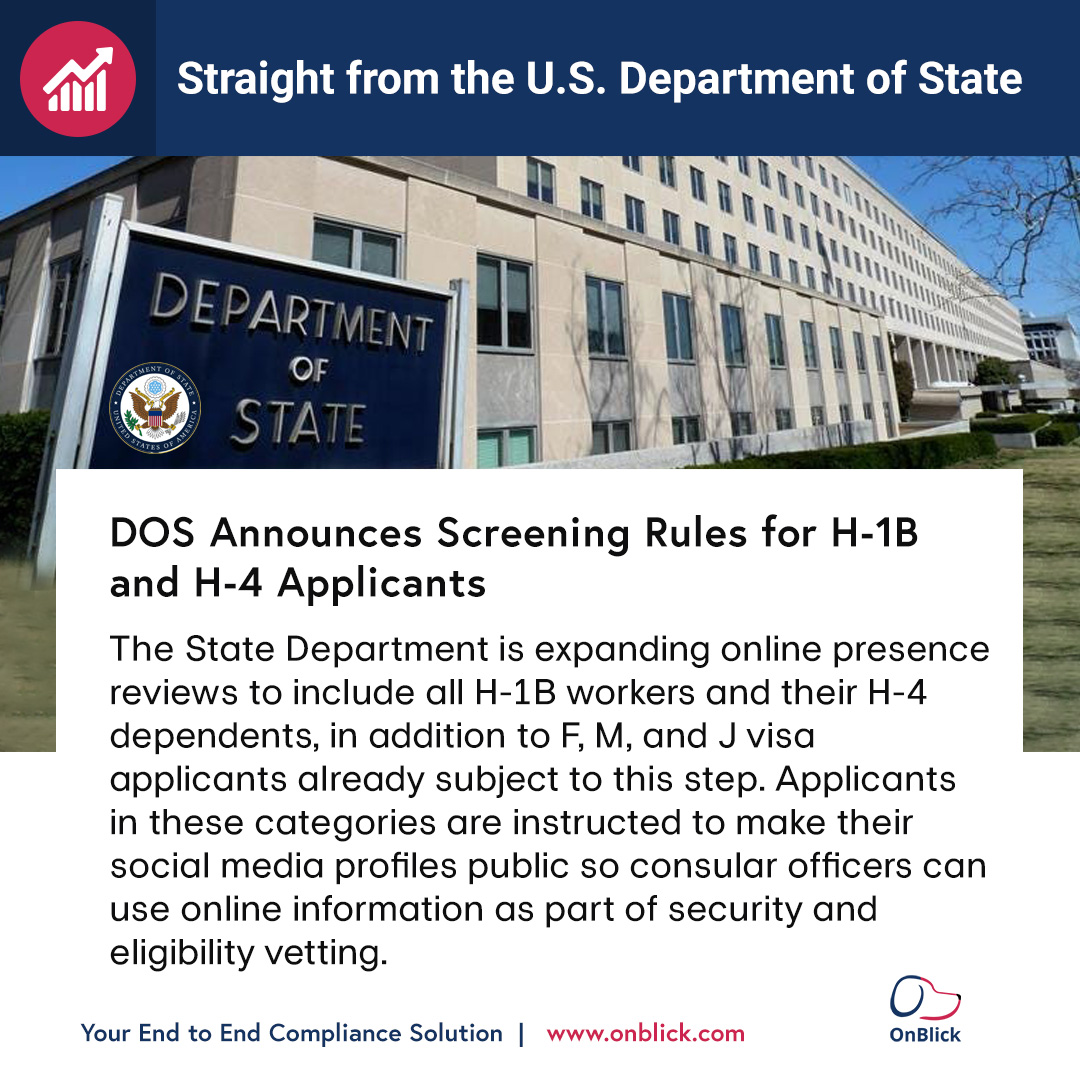
On December 3, 2025, the U.S. Department of State announced that it will expand its existing “online presence review” requirement to cover all H-1B specialty occupation workers and their H-4 dependent family members applying for visas at U.S. consulates abroad.
Beginning December 15, 2025, consular officers will review the digital footprint of these applicants as part of the visa adjudication process, in addition to the F, M, and J student and exchange visitor applicants who are already subject to this review.
To facilitate this vetting, the State Department has instructed applicants in these categories to change the privacy settings on all social media profiles to “public.” The agency notes that it uses all available information in visa screening and vetting to identify applicants who may be inadmissible to the United States, including those who pose a national security or public safety risk.
This blog summarizes the new requirement, explains how the online presence review fits into the visa process, and outlines the potential impact on H-1B/H-4 applicants and U.S. employers that rely on them.
What Has Changed?
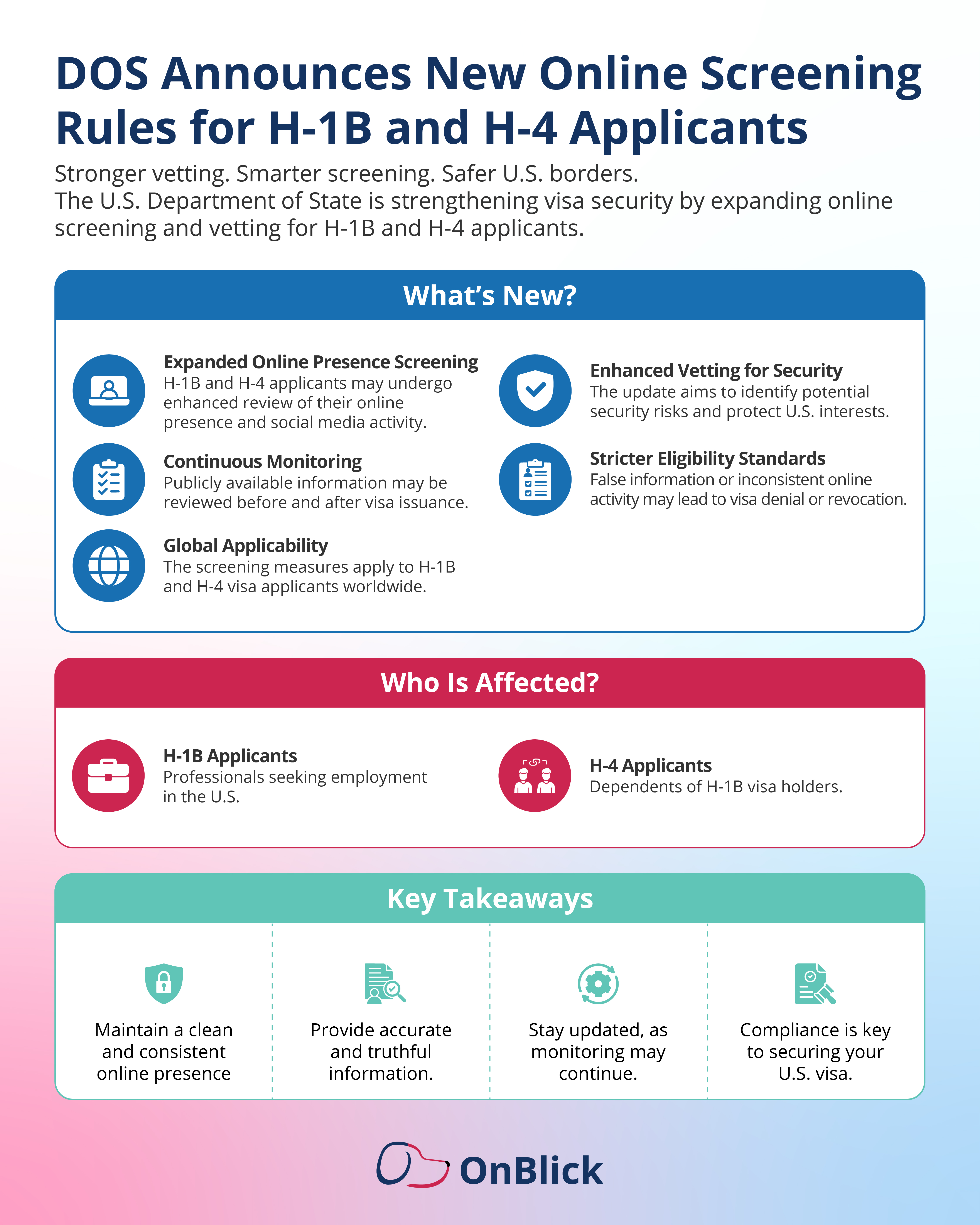
Online presence review now includes H-1B and H-4
The State Department will now require all H-1B and H-4 visa applicants to undergo an online presence review, similar to the process that has applied to many F, M, and J applicants since mid-2025.
In practice, this means:
- Consular officers will review an applicant’s social media accounts and activity, as well as other publicly available online information.
- Applicants for H-1B and H-4 visas are instructed to set the privacy settings of all social media profiles to “public.”
- The review may include posts, comments, connections, work history, and other publicly visible content that helps officers decide whether the applicant is eligible for a visa.
This online vetting is in addition to the standard checks already performed through forms, interviews, and security databases.
What are DOS officers looking for?
The State Department announcement itself does not spell out detailed criteria, but guidance reported in connection with the student and exchange visitor policy indicates that officers may look for:
- Signs of hostility toward U.S. citizens, institutions, or governing principles
- Links to, or support for, terrorism or other security threats
- Indicators of involvement in activities that could compromise U.S. intellectual property or spread false information for political or other reasons
- Patterns of conduct that raise questions about whether the applicant will respect U.S. law and comply with their visa status
If officers find information they consider derogatory, they may:
- Refuse the visa, or
- Place the case into extended administrative processing for further background checks, which can significantly delay issuance.
Who Is Affected by the DOS Online Screening Rule?
The expanded requirement applies to:
- H-1B visa applicants (specialty occupation workers) applying at U.S. consulates abroad
- H-4 dependents (spouses and certain children of H-1B workers) applying for visas
- F, M, and J applicants, who are already under the online presence review, are also reminded to maintain public profiles
This change is especially relevant to Indian and other high-volume H-1B markets, where a large share of skilled workers and their families apply each year.
The policy applies to both first-time and renewal visa applicants in these categories.
DOS New Rule: Impact on Employees and H-4 Dependents
Social media and privacy expectations
The most immediate change for individuals is the requirement to make social media profiles public so consular officers can review them. Applicants who previously kept accounts private, or who maintain multiple profiles, now need to:
- Review all existing accounts for accuracy, consistency, and professionalism
- Be mindful of posts, comments, and public interactions that could be misinterpreted in a security or eligibility context
- Avoid last-minute mass deletions that may look unusual and prompt further scrutiny
While many applicants may have concerns about privacy and expression, ignoring the instruction to maintain public profiles can increase uncertainty in the visa process.
Longer processing times and possible delays
Online presence review adds another step to consular adjudication. As officers spend additional time reviewing digital activity, applicants may see:
- Longer interview-to-issuance timelines
- More frequent use of administrative processing
- Delays that disrupt travel plans or work start dates
Applicants planning international travel should build in extra time and avoid scheduling visa stamping too close to critical return or project dates.
Possible link to 221(g) delays and refusals
The expansion of online presence review also increases the potential for 221(g) administrative processing, a common form of delay where consular officers request more time to complete background checks before deciding a case. Because officers must now review additional online information for H-1B and H-4 applicants, visa cases may be held under 221(g) when:
- social media or online activity raises questions the officer needs more time to evaluate
- information online does not match the applicant’s forms or work history
- the officer identifies potential security concerns requiring further review
- the applicant’s profile is limited, inconsistent, or appears curated in a way that requires additional verification
A 221(g) delay does not indicate wrongdoing, but it can significantly extend visa processing times. Applicants should plan travel with this possibility in mind, and employers may need contingency plans if key staff face unexpected visa holds.
Risk of refusals based on online content
In more serious cases, information found online may lead to outright refusals. This can happen if officers believe posts or activity suggest security concerns, misrepresentation, or intent inconsistent with the visa category. Content that appears to endorse violence or unlawful conduct, misstates qualifications or work history, or conflicts with information on the visa application can trigger a finding of ineligibility.
Applicants should not fabricate a new online identity, but they should be aware that their public presence is now part of the record consular officers will review when deciding H-1B and H-4 visa applications.
DOS Announcement: Impact on Employers
For employers that rely on H-1B workers and support H-4 dependents, the expanded screening requirement has several practical implications.
1. Travel and visa planning becomes more complex
Because online presence review can lengthen processing, employers should:
- Build additional time into international travel planning for H-1B employees and H-4 family members
- Avoid scheduling critical project dates immediately after expected visa stamping
- Encourage employees to schedule consular appointments as early as possible when travel is necessary
Even well prepared applicants may experience unpredictable delays triggered by further security checks.
2. Communication and education for employees
HR and mobility teams should consider providing clear, neutral guidance on the new requirement, such as:
- Explaining that consular officers will review social media and other online activity
- Encouraging employees and dependents to ensure their public profiles are professional, accurate, and consistent with their immigration forms
- Clarifying that employees are responsible for their own content and that employers cannot and should not direct their personal views
This should be framed as informational support, not as monitoring or controlling private expression.
3. Increased risk to project timelines and staffing
If key H-1B staff or their dependents encounter delays in visa issuance, project schedules and on-site staffing may be affected. H-1B employers may need contingency plans such as:
- Remote work from abroad where permitted
- Temporary reassignment of responsibilities
- Adjustments to client timelines or deliverables
Teams that heavily depend on frequent stamping travel should pay particular attention to this risk.
4. Alignment with broader compliance posture
The expansion of online presence review fits within a larger pattern of stricter vetting, increased fee burdens, and closer scrutiny of employment-based immigration. Organizations that invest in strong immigration compliance practices, documentation, and planning are better placed to handle these cumulative changes.
How does OnBlick help?
OnBlick will continue to monitor State Department announcements and share updates as new information emerges on visa screening and work authorization issues. Our focus is to support HR and compliance teams with structured processes, clear documentation, and better visibility into immigration-related risks that can affect hiring and mobility.
If you would like to understand how we support your organization’s H-1B compliance and workforce planning, book a free OnBlick demo today.


.png)


