.gif)



Floating holidays give employees more choice in how they use paid time off. Unlike fixed company holidays, which apply to everyone on the same date, a floating holiday usually allows employees to take a paid day off on a date that matters to them, subject to company policy and approval.
For employers, floating holidays can support a more flexible benefits policy, but the rules need to be clear. HR teams should define eligibility, request steps, pay treatment, carryover, expiration, payout, and tracking so employees, managers, and payroll teams understand how the benefit works.
This article explains what floating holidays mean, how they work, how they differ from PTO and paid holidays, and what employers should include in a floating holiday policy.
What is a floating holiday?
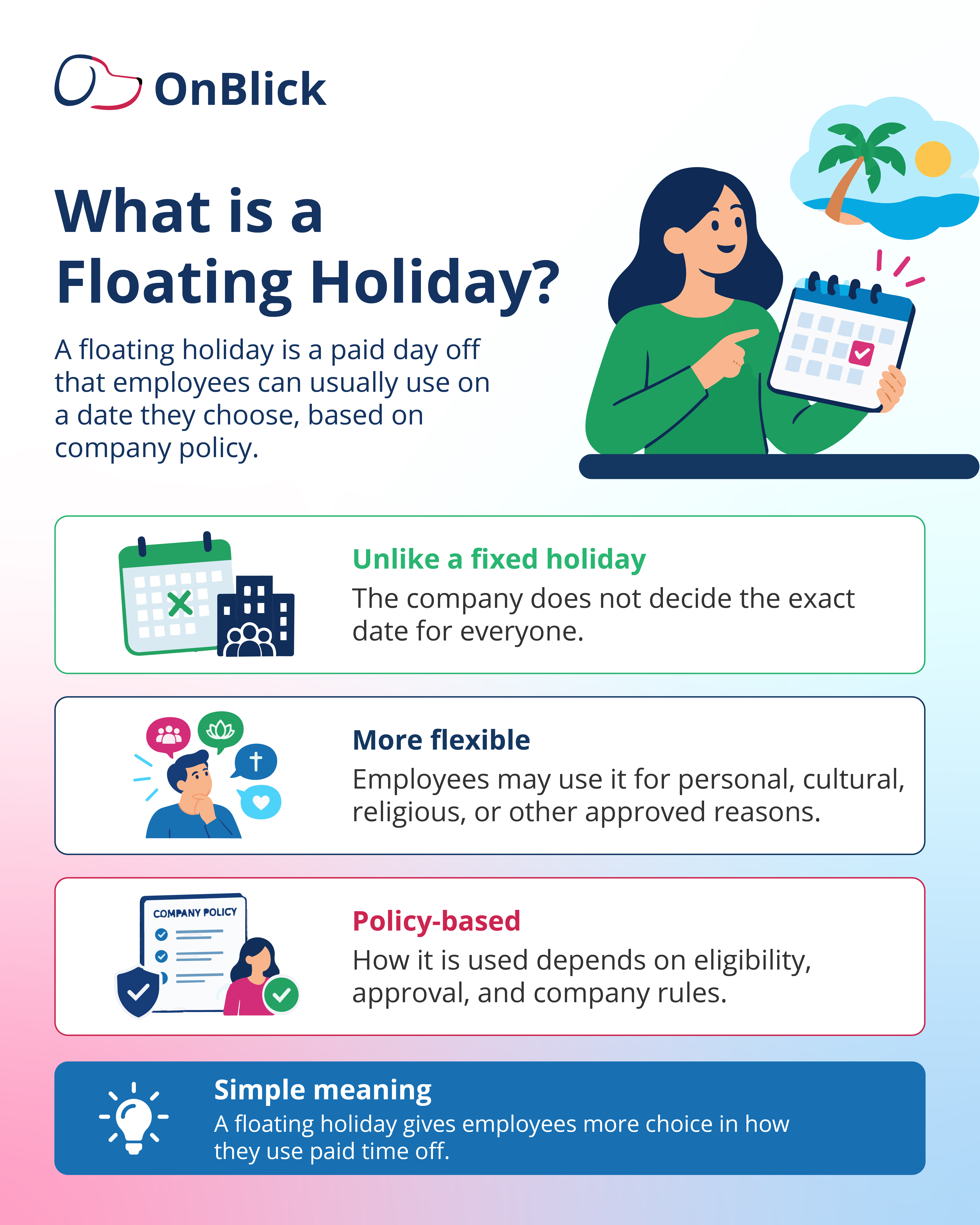
- A floating holiday is a paid day off that employees can usually use on a date they choose, instead of taking time off only on company-designated holidays. It gives employees more flexibility to observe a personal, religious, cultural, or family-related date that may not be included in the employer’s standard holiday calendar.
- For example, an employer may provide ten fixed paid holidays and one or two floating holidays each year. Fixed holidays apply to the whole company on specific dates, while floating holidays are used by individual employees based on request, approval, and policy rules.
- A floating holiday is still a formal paid leave benefit. It should not be treated as an informal day off. Employers need to define how many floating holidays are available, when employees receive them, how they can be used, and whether unused days expire or carry over.
- In the workplace, floating holidays are often used to give employees more choice without requiring the employer to add many fixed holidays to the company calendar. This makes them useful for teams with diverse cultural, religious, regional, or personal time-off needs.
Why do employers offer floating holidays?
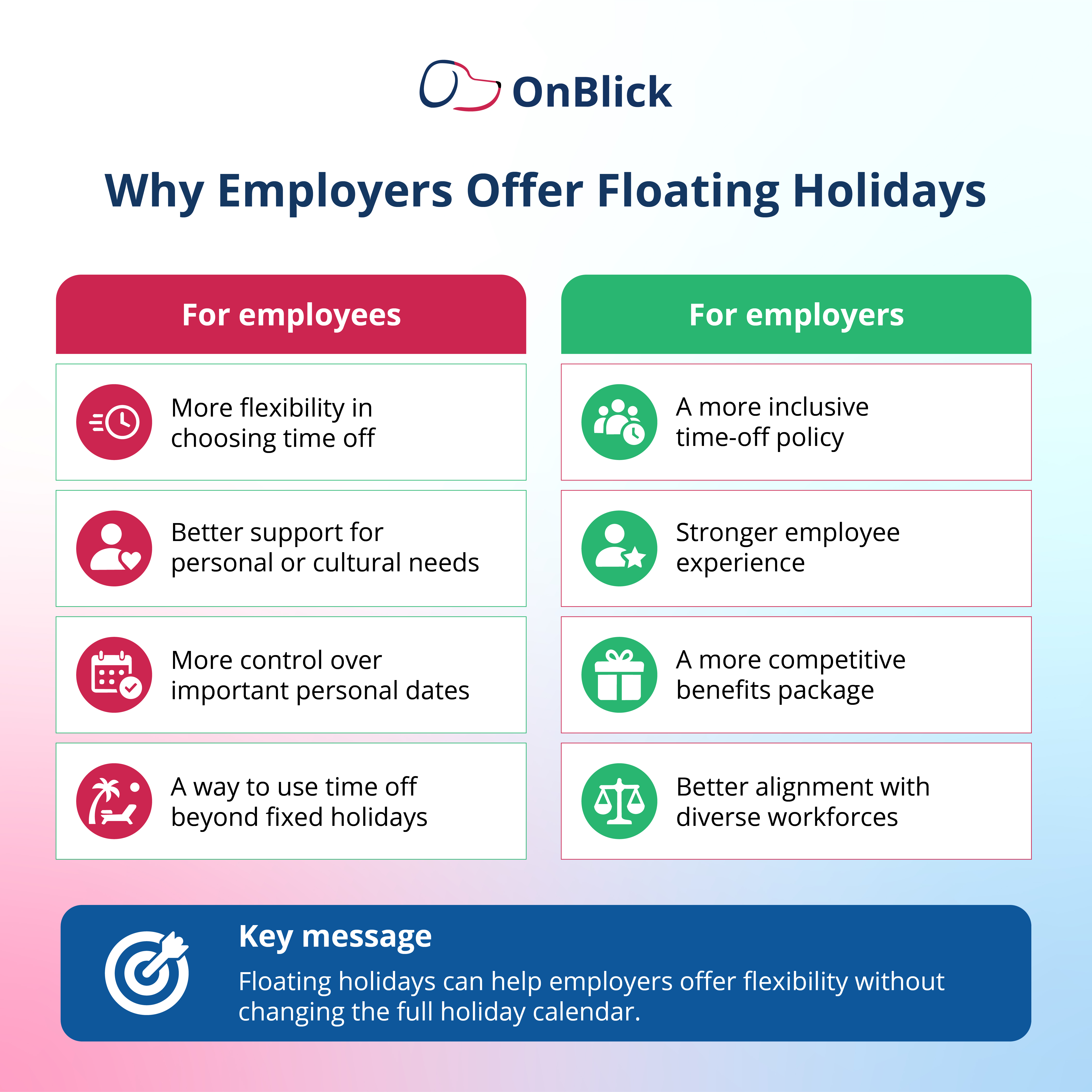
- Employers offer floating holidays to give employees more control over important personal dates while keeping the company holiday calendar manageable. Not every employee observes the same holidays, and a fixed holiday schedule may not reflect every cultural, religious, or personal need in the workforce.
- Floating holidays can also make a benefits package feel more practical. Employees may use them for religious observances, cultural events, school-related needs, family commitments, personal milestones, or dates that matter to them individually. This gives employees more choice without forcing them to use regular PTO for every non-standard holiday.
- For HR teams, floating holidays can support a more flexible leave policy when the rules are clear. Instead of adding many separate holidays to the company calendar, employers can offer a set number of floating holidays and allow employees to request dates that fit their needs.
- They can also help improve employee experience. When employees see that the organization recognizes different time-off needs, the policy can feel more considerate and useful. However, the benefit works best when eligibility, approval, tracking, and pay rules are applied consistently.
Floating holiday vs PTO vs paid holiday
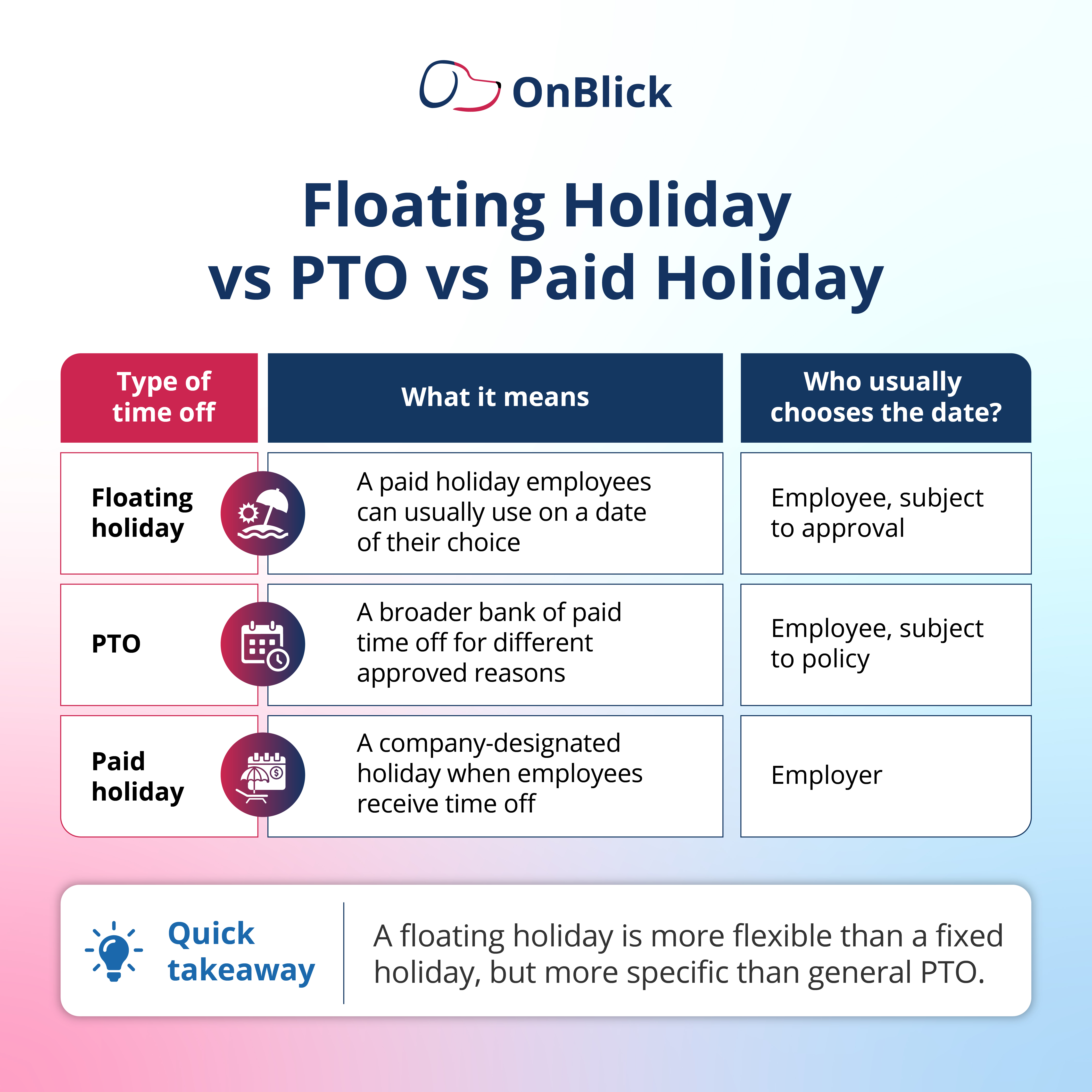
- Floating holidays, PTO, and paid holidays are related forms of paid time away from work, but they serve different purposes.
- A floating holiday is usually a paid day off that employees can choose to use on a date that is meaningful or useful to them, subject to company policy and approval. It gives employees more flexibility than a fixed holiday schedule.
- PTO is broader. Employees may use PTO for vacation, personal time, illness, appointments, family needs, or other approved absences, depending on the employer’s policy. PTO is often tracked as a general balance.
- A paid holiday is different because the employer chooses the date. For example, a company may close for New Year’s Day, Independence Day, Thanksgiving, or Christmas. Employees do not usually choose when to use a fixed paid holiday.
How do floating holidays work?
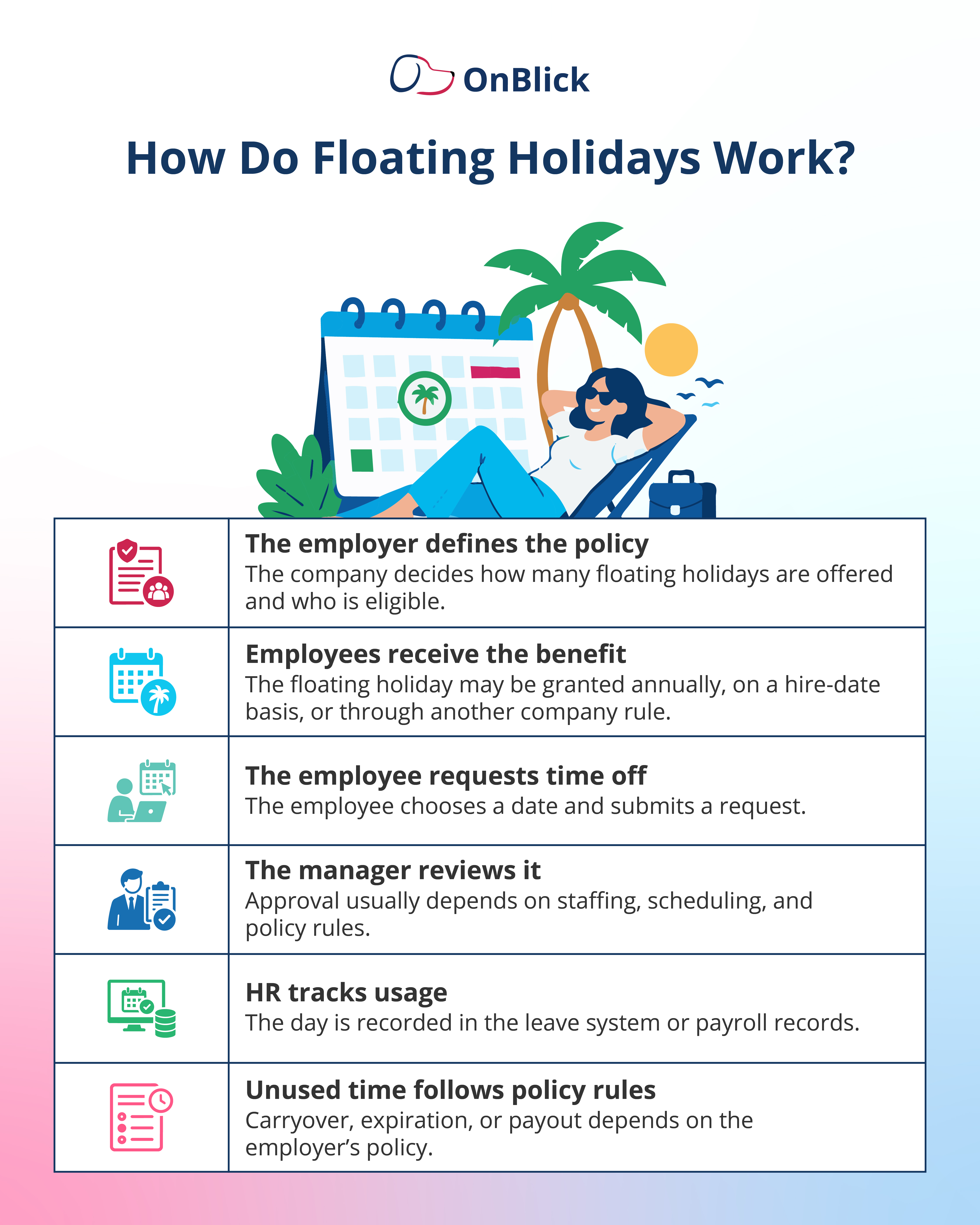
- Floating holidays usually work through a defined policy. The employer decides how many floating holidays employees receive, who is eligible, when the days become available, and how employees should request them.
- In many workplaces, floating holidays are granted at the start of the year, on the employee’s hire date, or after a waiting period. Some employers give the same number of floating holidays to all eligible employees, while others prorate the benefit for new hires, part-time employees, or employees who join later in the year.
- When an employee wants to use a floating holiday, they usually submit a request through the company’s leave process. The manager or HR team reviews the request based on staffing needs, notice requirements, business schedules, and policy rules. Once approved, the day is recorded as paid time off under the floating holiday category.
- Employers should also define what happens if the day is not used. Some floating holiday policies require employees to use the day within the same calendar year. Others may allow carryover, set a cap, or apply separate rules based on state requirements and company policy.
- The process should be easy for employees to understand and simple for HR to track. A floating holiday policy works best when the request process, approval rules, unused balance treatment, and payroll handling are clear from the beginning.
Are floating holidays paid?
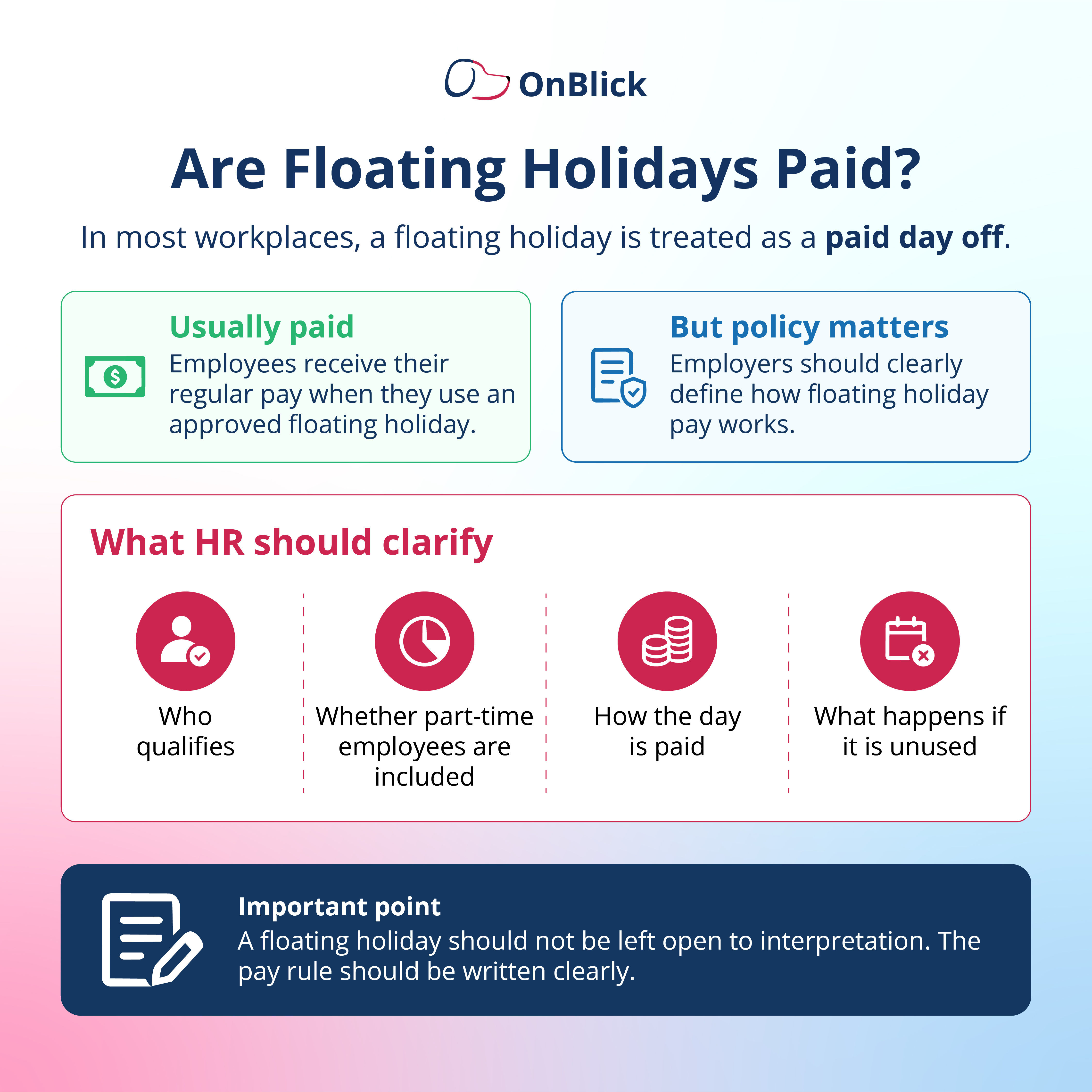
- In most workplaces, floating holidays are treated as paid days off. When an eligible employee uses an approved floating holiday, they typically receive regular pay for that day, similar to how they would be paid for a company holiday.
- However, employers should not leave pay treatment open to interpretation. The policy should clearly explain who qualifies for paid floating holidays, how the day is paid, and whether the rule differs for full-time, part-time, hourly, exempt, or nonexempt employees.
- For hourly or nonexempt employees, HR and payroll teams should also confirm how the floating holiday is recorded in the timekeeping system. The record should show whether the day counts as paid leave, how many hours are paid, and whether the employee worked any hours on that same day.
- Employers should also clarify whether floating holidays are treated differently from PTO, vacation, or sick leave. This is especially important when employees ask about unused balances, final pay, or whether the day can be exchanged for cash instead of time off.
- A simple policy statement can prevent confusion. For example, the policy can state that floating holidays are paid only when requested, approved, and used according to company rules.
Do floating holidays carry over or expire?
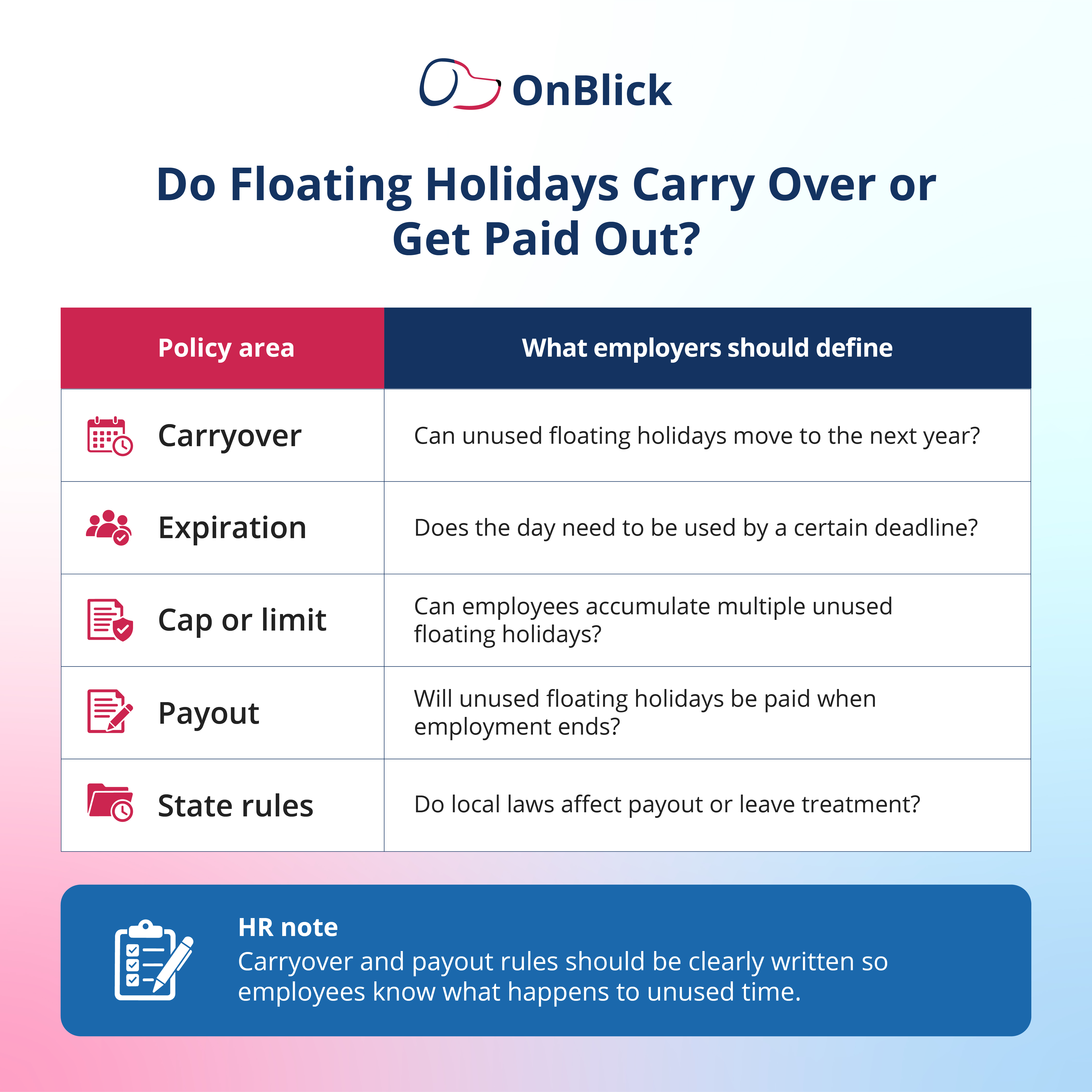
- Floating holiday carryover depends on the employer’s policy and any applicable state or local rules. Some employers require employees to use floating holidays within the same calendar year. Others allow unused days to carry over into the next year, sometimes with a limit.
- A “use by” rule is common. For example, an employer may provide one floating holiday each year and require employees to use it by December 31. If the employee does not use it by the deadline, the day may expire, unless company policy or applicable law says otherwise.
- Other employers may allow carryover but set a cap. This means employees can carry over unused floating holidays only up to a certain limit. Once they reach the cap, they may not receive additional floating holidays until they use an existing one.
- The key is communication. Employees should know when floating holidays become available, when they expire, whether unused days carry over, and whether reminders will be sent before the deadline.
- HR teams should also make sure the leave tracking system reflects the policy correctly. If floating holidays expire at year-end, the system should show the deadline clearly. If they carry over, the balance should be updated accurately.
Are unused floating holidays paid out when employment ends?
- Floating holiday payout can be more complicated than regular usage rules. Whether unused floating holidays must be paid when employment ends may depend on the employer’s policy, how the benefit is classified, employment agreements, and applicable state rules.
- Some employers state that unused floating holidays are not paid out at resignation or termination. Others treat floating holidays more like earned vacation or PTO and pay out unused balances when required or when promised in the policy.
- Because payout rules can vary, vague policy wording can create problems. If the policy simply says employees “receive” floating holidays without explaining what happens at separation, employees and managers may interpret the rule differently.
Employers should clearly define:
- Whether unused floating holidays are paid out
- Whether payout depends on the reason for separation
- Whether payout applies only after the day has been earned
- Whether new hires or departing employees receive a prorated benefit
- Whether state-specific rules apply
HR should also coordinate with payroll so final pay is handled correctly. A floating holiday policy should not be drafted separately from payroll and final wage procedures.
Who is eligible for floating holidays?
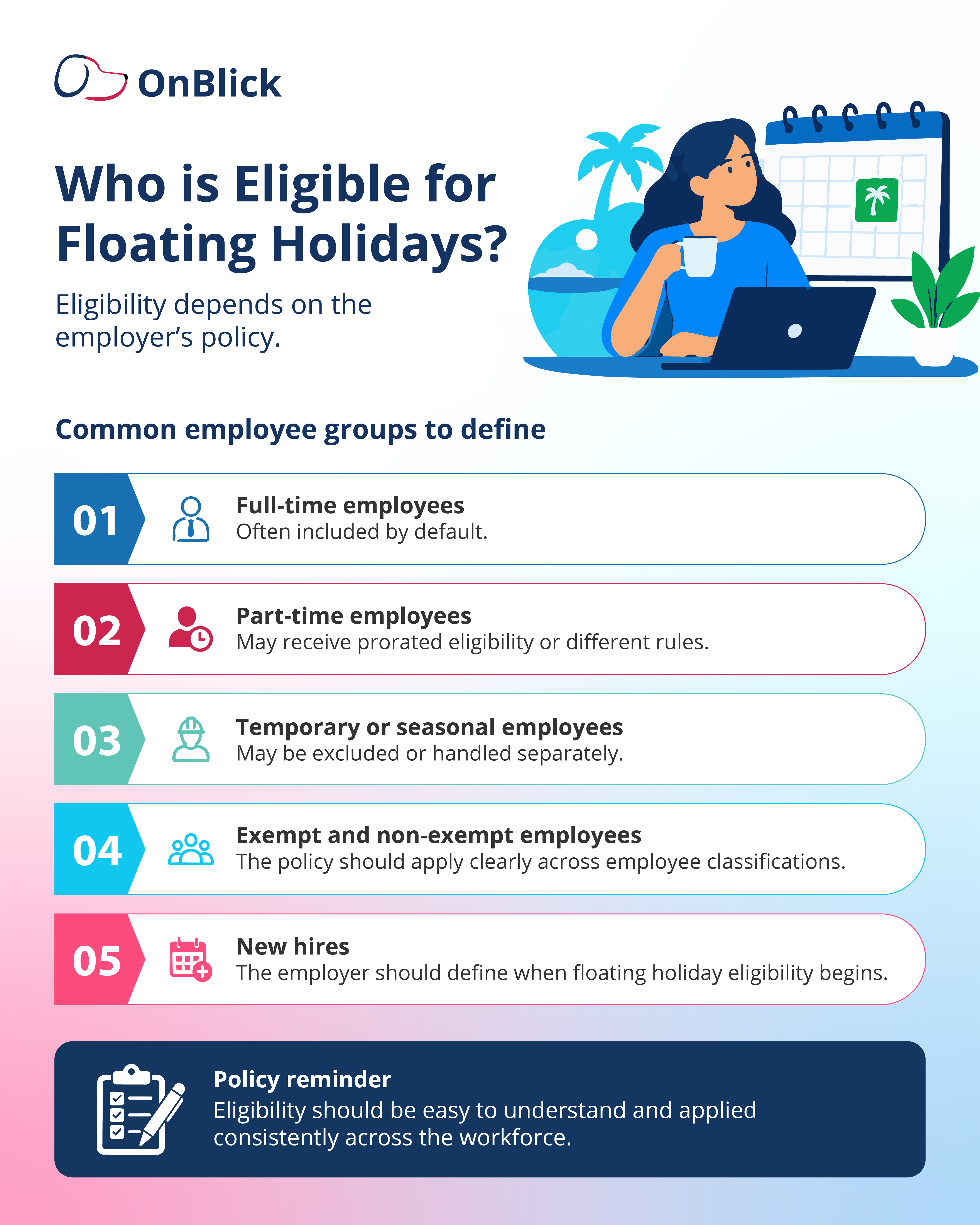
- Eligibility should be clearly defined before floating holidays are introduced. Employers may choose to offer floating holidays to all employees or limit them to specific groups based on employment status, schedule, location, or length of service.
- Full-time employees are often included by default. Part-time employees may receive a prorated floating holiday benefit, a reduced number of hours, or separate eligibility rules. Temporary, seasonal, or contract workers may be excluded or handled under a different policy.
- Employers should also define rules for new hires. For example, an employee who joins in January may receive the full floating holiday benefit, while an employee who joins later in the year may receive a prorated amount or become eligible after a waiting period.
- For multi-state or multi-location employers, eligibility may need additional review. A floating holiday policy should be consistent where possible, but employers should also consider whether state laws, local requirements, collective bargaining agreements, or employment contracts affect how the benefit is offered.
- Clear eligibility rules help reduce fairness concerns. Employees should be able to understand who qualifies, when the benefit starts, and whether any limits apply.
What should a floating holiday policy include?
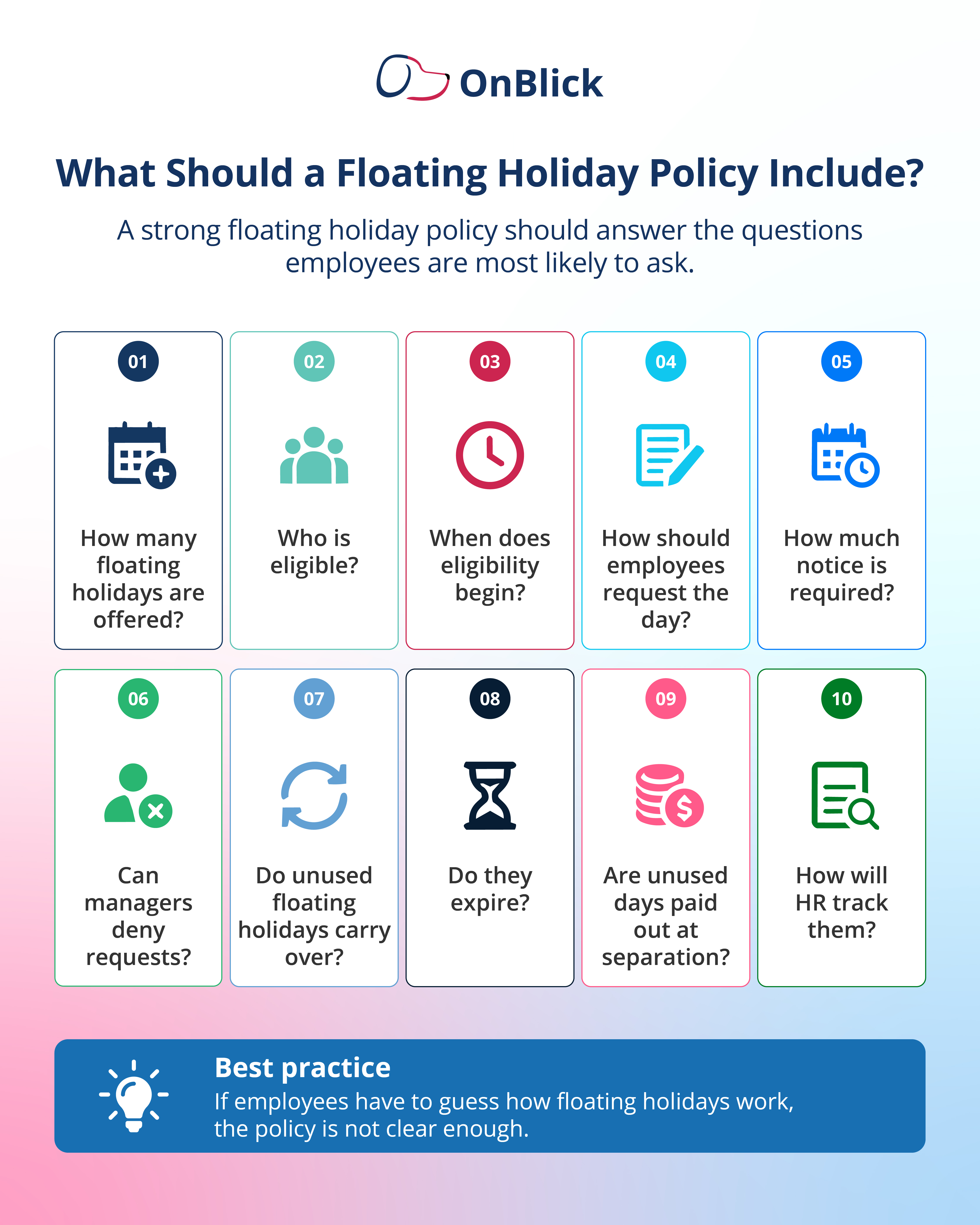
- A floating holiday policy should be specific enough for employees, managers, HR, and payroll to follow without guesswork. The policy should explain both the benefit itself and the process for using it.
- Employers should include the number of floating holidays offered each year and when they become available. The policy should also explain whether the benefit is granted at the start of the year, after a waiting period, on the employee’s anniversary date, or on another schedule.
- The request process should be clearly outlined. Employees should know how to request a floating holiday, how much notice is required, who approves the request, and whether certain business periods may have restrictions.
- The policy should also cover unused floating holidays. This includes whether they expire, carry over, have a balance cap, or are paid out when employment ends. These rules should be written carefully because employees often make plans based on their available time off.
A strong policy should also address:
- Eligibility by employee type
- Proration for new hires or part-time employees
- Use in full-day, half-day, or hourly increments
- Interaction with PTO, sick leave, and fixed holidays
- Payroll coding and timekeeping
- Manager responsibilities
- State-specific exceptions, where applicable
The goal is to make the benefit easy to understand and consistent to administer.
Common floating holiday policy mistakes to avoid
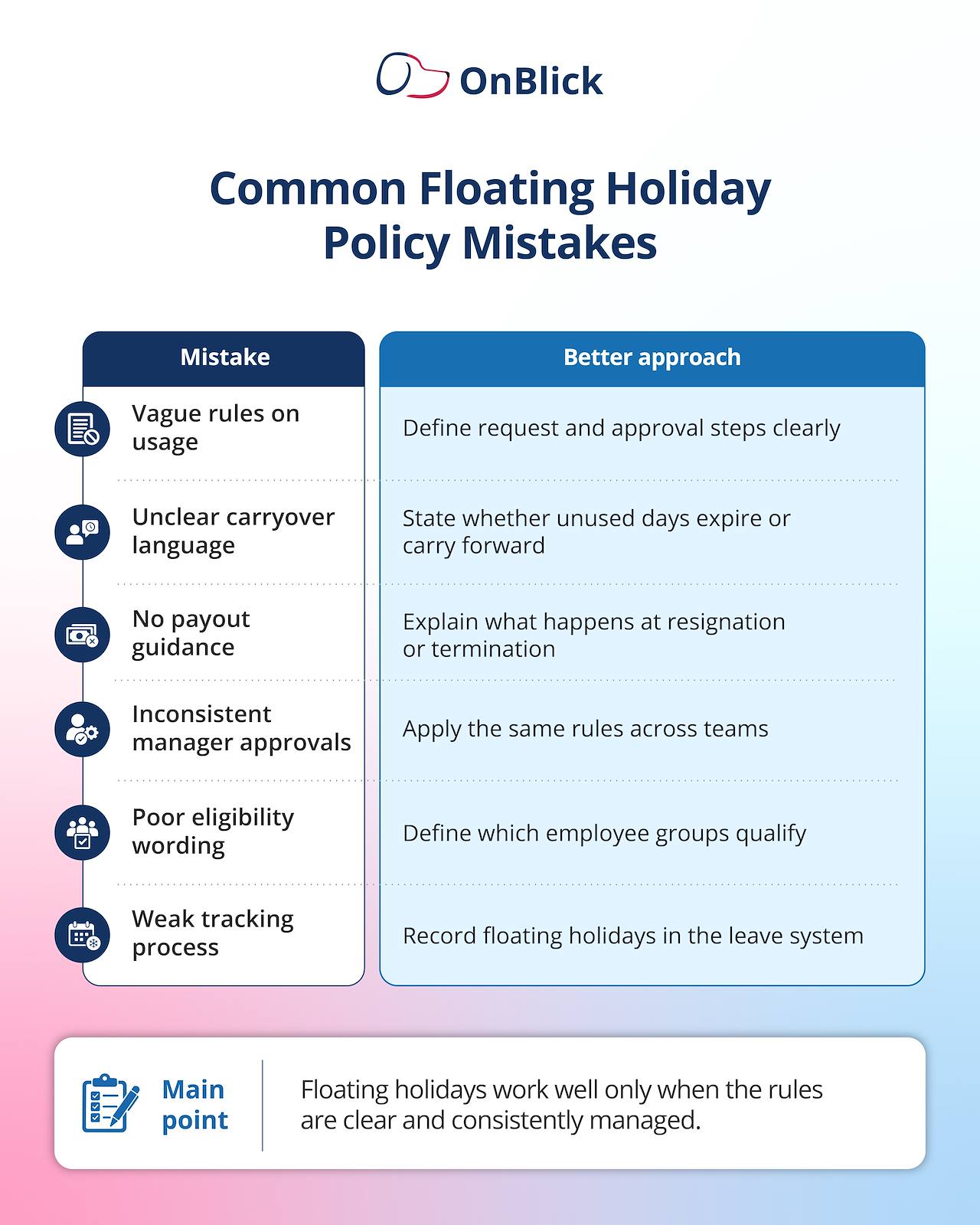
- One common mistake is offering floating holidays without explaining how they are different from PTO or fixed paid holidays. When the terms are unclear, employees may not know when to use each type of time off.
- Another mistake is leaving carryover and payout rules vague. If employees do not know whether unused floating holidays expire, carry over, or get paid out when employment ends, HR may face repeated questions and possible disputes.
- Inconsistent approvals can also create problems. If one manager approves floating holiday requests freely and another denies similar requests without clear criteria, employees may see the process as unfair. HR should set approval rules that managers can apply consistently.
- Poor tracking is another issue. Floating holidays should not be tracked informally through emails or manager notes. HR needs accurate records of available balances, approved dates, used days, and unused time.
- Employers should also avoid ignoring multi-state considerations. Rules around paid leave, final pay, and unused time off can differ by location. A policy that works for one workforce may need adjustments for employees in another state.
- Finally, employers should avoid communicating the policy only once. Floating holiday rules should be included in the handbook, explained during onboarding, and easy for employees to access when they need to request time off.
How HR teams can manage floating holidays better
HR teams can manage floating holidays better by treating them as a formal leave category, not as an informal flexibility perk. The process should be clear from the time the benefit is granted until the day is used, expired, carried over, or paid out.
- The first step is accurate tracking. HR should be able to see how many floating holidays each employee has available, how many have been used, whether any are expiring, and whether any approvals are pending.
- Manager visibility is also important. Managers should be able to review requests with context, including team schedules, workload, staffing needs, and other approved absences. This helps reduce last-minute coverage issues.
- Employee self-service can make the process smoother. When employees can view their floating holiday balance, submit requests, and check approval status in one place, they are less likely to depend on repeated HR follow-ups.
- HR should also coordinate with payroll. Approved floating holidays should be coded correctly so employees are paid accurately and records remain consistent. This is especially important for hourly employees, part-time employees, and employees with alternative schedules.
- Regular review can also help. HR teams should look at usage patterns, unused balances, employee questions, and manager feedback to see whether the policy needs clearer wording or better communication.
How OnBlick helps HR teams manage floating holidays and leave
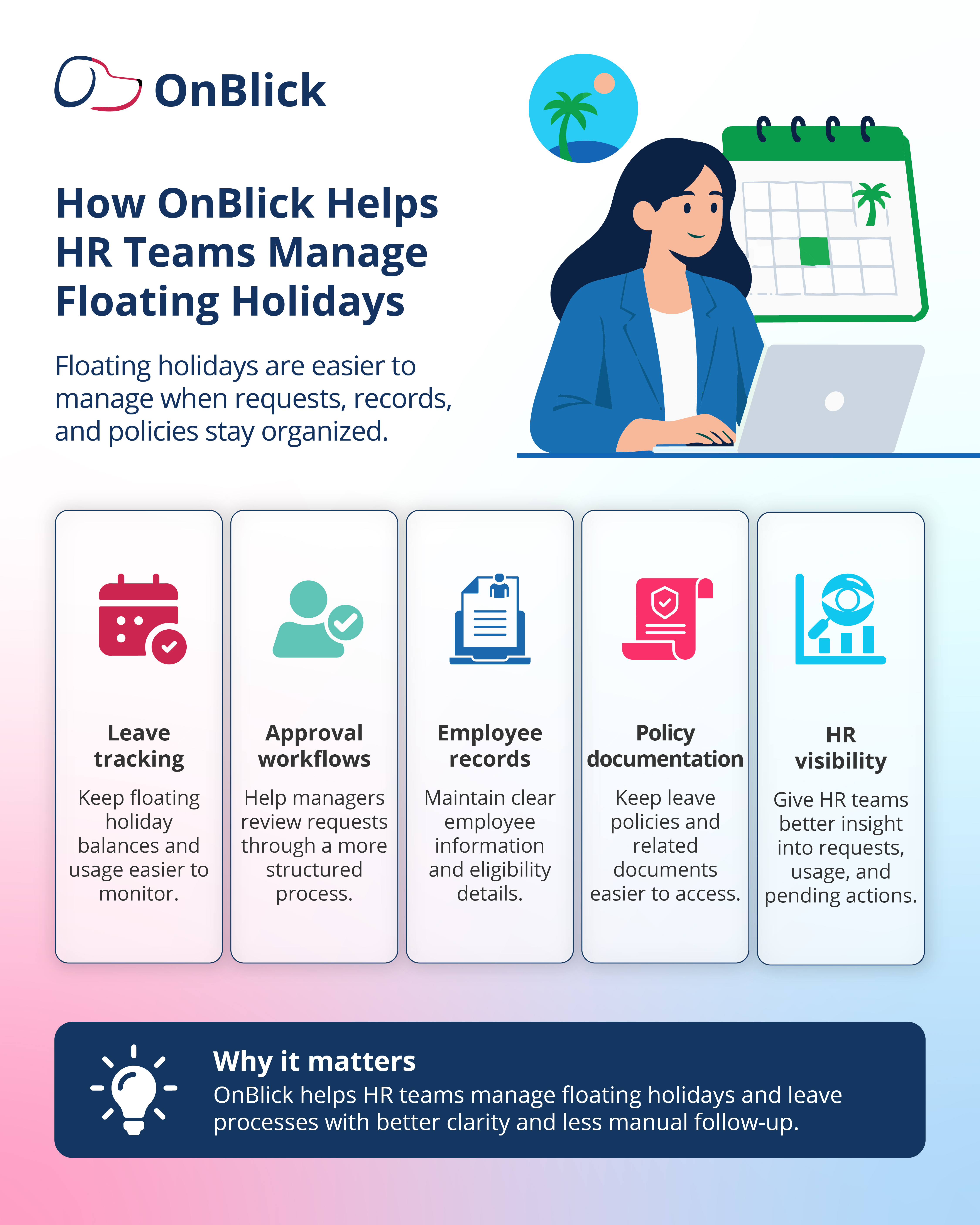
- OnBlick helps HR teams manage floating holidays and leave processes with better structure, visibility, and control. Instead of relying on scattered emails, manual trackers, or disconnected records, HR teams can manage employee information and leave-related workflows from a more organized platform.
- With OnBlick, HR teams can track employee records, leave requests, approvals, time and attendance data, and related documentation more efficiently. This helps employers maintain clearer visibility into who is eligible, what has been requested, what has been approved, and what still needs action.
- OnBlick also supports workflow-based HR processes, alerts, document management, and role-based access. These capabilities can help HR teams apply policies more consistently and reduce missed follow-ups.
- For employers managing different employee groups, locations, or compliance needs, OnBlick helps bring leave management, employee records, and HR workflows together. This makes it easier for HR teams to manage floating holidays along with PTO, holidays, attendance, and other time-off processes.
Conclusion
Floating holidays can be a useful addition to an employer’s time-off policy. They give employees more choice in how they use paid time away from work and can help employers support different personal, cultural, religious, and family-related needs. However, floating holidays work best when the rules are clear. Employers should define eligibility, pay treatment, request steps, approval rules, carryover, expiration, payout, and tracking before the benefit is offered.
For HR teams, the goal is to make the policy easy to understand and easy to manage. When floating holidays are properly documented, tracked, and communicated, employees can use the benefit with confidence and managers can plan coverage more effectively.
OnBlick helps HR teams manage leave requests, employee records, time and attendance, policy documents, and HR workflows in a more organized way. Schedule a free OnBlick demo to see how it can support your HR and leave management processes.
FAQs about floating holidays
1. Can an employer deny a floating holiday request?
Yes. An employer can deny a floating holiday request if the requested date creates staffing issues, conflicts with business needs, does not meet notice requirements, or does not follow the company’s policy. To avoid confusion, the policy should explain how requests are reviewed and when a request may be denied.
2. Can employees use a floating holiday before they earn it?
It depends on the employer’s policy. Some employers grant floating holidays at the start of the year, while others provide them after a waiting period, on an anniversary date, or on a prorated basis for new hires. The policy should clearly state when the benefit becomes available.
3. Can floating holidays be used in half-day or hourly increments?
Employers can allow floating holidays to be used in full-day, half-day, or hourly increments, depending on how the policy is written and how the leave system tracks time. HR should define this clearly so employees and managers do not apply different rules.
4. Can floating holidays be used for religious observances?
Yes. Many employees use floating holidays for religious or cultural observances that are not part of the company’s fixed holiday calendar. Employers should still require employees to follow the normal request and approval process, unless another legal accommodation process applies.
5. Are floating holidays the same for full-time and part-time employees?
Not always. Some employers provide floating holidays only to full-time employees, while others offer prorated floating holidays to part-time employees. The policy should explain eligibility by employee type, work schedule, and location where needed.
6. What happens if a floating holiday falls during an employee’s leave of absence?
The employer’s policy should explain this situation. In some cases, employees may not be able to use a floating holiday while on an unpaid or extended leave of absence. In other cases, the benefit may remain available after the employee returns, depending on company rules and applicable leave requirements.
7. Can employees combine floating holidays with PTO?
Yes, if the employer’s policy allows it. For example, an employee may use a floating holiday with PTO to extend a personal break or observe a longer event. HR should explain whether floating holidays can be combined with PTO, sick leave, unpaid leave, or fixed holidays.
8. Should floating holidays appear on employee pay stubs or leave balances?
Floating holidays should be tracked in a way employees can clearly understand. Some employers show them as a separate leave balance, while others track them internally in the HR or payroll system. Clear visibility helps employees know what is available and helps HR avoid balance disputes.
9. How many floating holidays should employers offer?
There is no single required number for all employers. Many companies offer one or two floating holidays per year, but the right number depends on the employer’s benefits strategy, workforce needs, existing holiday calendar, budget, and administrative capacity.
10. Should floating holiday rules be included in the employee handbook?
Yes. Floating holiday rules should be included in the employee handbook or formal time-off policy. The policy should cover eligibility, request steps, approval rules, pay treatment, carryover, expiration, payout, and how the benefit is tracked.