.gif)



On September 18, 2026, a new Executive Order brought employer layoffs and existing LCA records more directly into federal oversight of the H-1B program. Under the order, Department of Labor (DOL), Department of Homeland Security (DHS), and the Department of State must consider whether an H-1B sponsor engaged in layoffs within the previous year or plans future layoffs that negatively affect similarly situated U.S. workers when handling LCAs, petitions, visas, and entry decisions. This means recent workforce reductions may now become part of the broader H-1B compliance picture rather than being viewed separately from an employer’s immigration activity.
The order also directs DOL’s Wage and Hour Division to begin reviewing data from previously submitted Labor Condition Applications (LCAs) within 30 days and calls for closer coordination among federal agencies using relevant wage, employment, academic, industry, and economic information.
This article discusses what has changed, where employers may face closer scrutiny, and what H-1B sponsors should review as the order moves toward implementation.
What Does the New H-1B Executive Order Change?
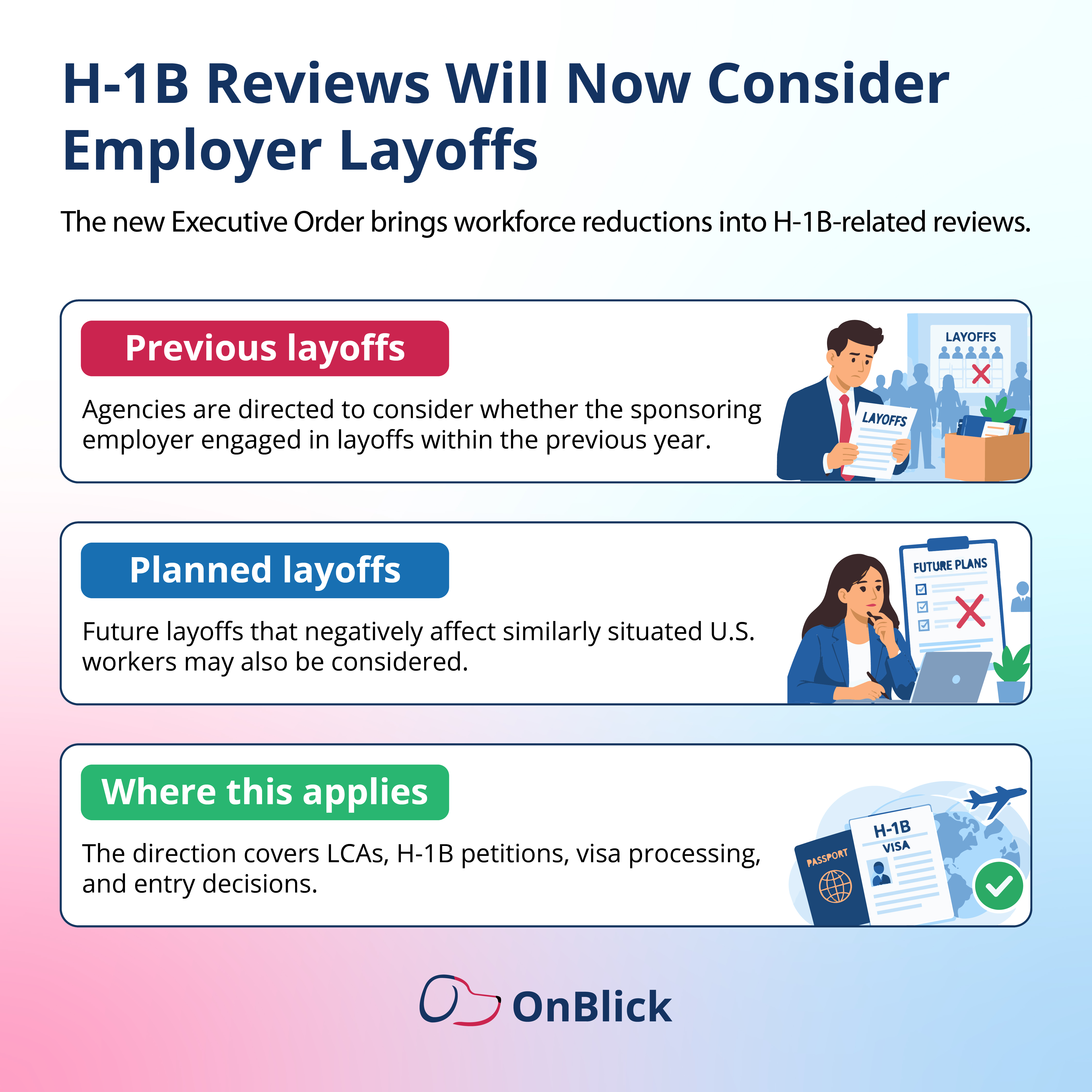
The September 18 order adds a broader layer of review to H-1B administration. DOL, DHS, and the Department of State are directed to consider whether a sponsoring employer directly or indirectly conducted layoffs within the previous year or plans future layoffs that negatively affect similarly situated U.S. workers. That consideration applies across LCAs, H-1B petitions, visa processing, and entry decisions.
The practical significance is that workforce reductions may no longer be viewed separately from an employer’s H-1B activity. A company’s hiring decisions, layoffs, job classifications, wage information, and immigration filings may increasingly need to present a consistent compliance picture.
How Does the One-Year Layoff Lookback Affect Employers?
The order specifically refers to layoffs within the previous year, creating a clear lookback period for agencies to consider. It also reaches forward by directing agencies to consider planned layoffs that may negatively affect similarly situated U.S. workers.
However, the order does not say that every layoff creates an H-1B violation or automatically prevents future sponsorship. The key issue is increased scrutiny of the relationship between workforce reductions and H-1B sponsorship, particularly where affected U.S. workers may be comparable to positions being filled through the H-1B program.
The order does not establish a numerical layoff threshold or provide a detailed operational test for how this factor will be weighed in individual cases. Further agency guidance will therefore be important as implementation develops.
Previously Submitted LCAs Are Part of the Review
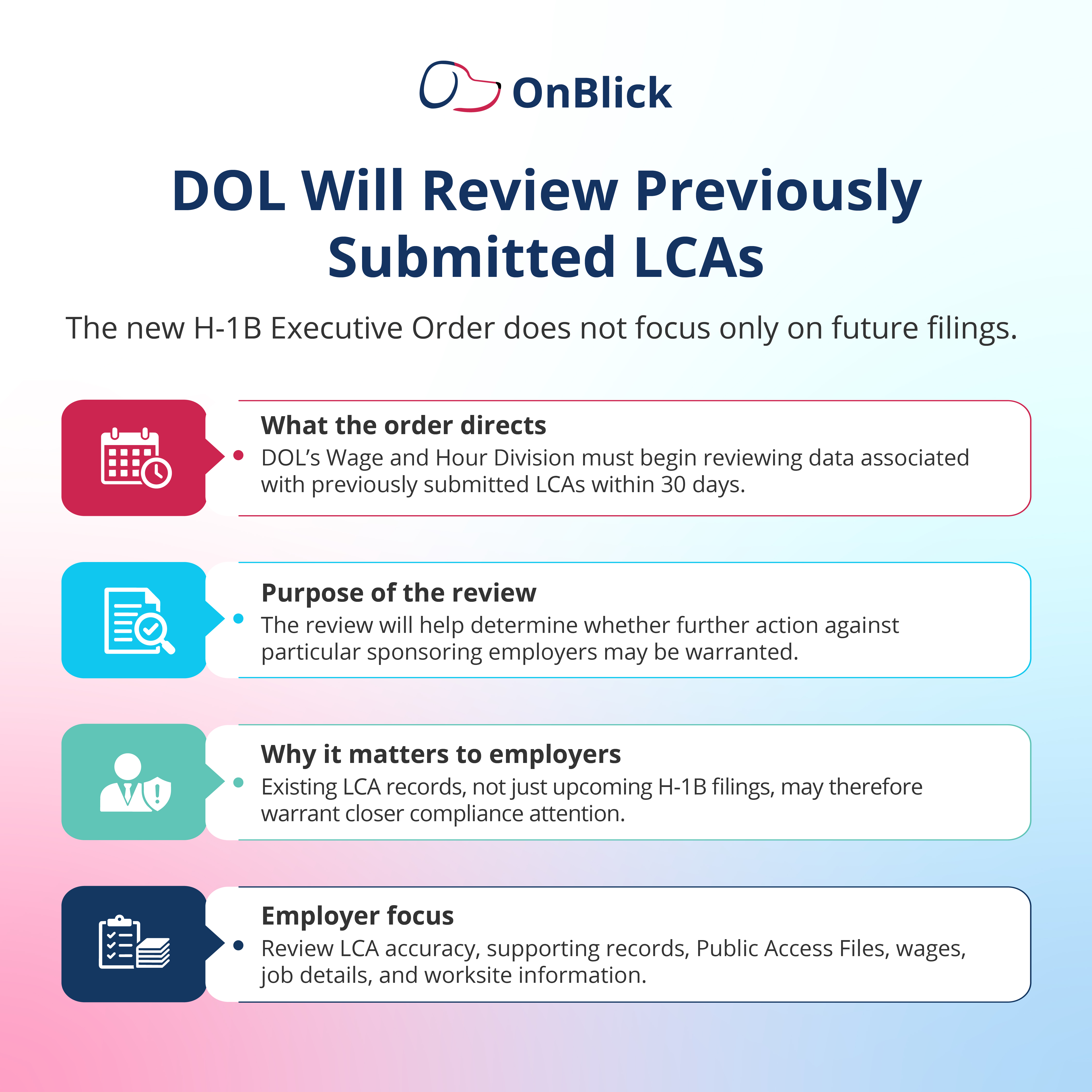
- One of the most consequential provisions is not limited to future filings. The order directs DOL’s Wage and Hour Division to begin, within 30 days, reviewing data associated with previously submitted LCAs to determine whether further action against particular sponsoring employers may be warranted under the Immigration and Nationality Act.
- This gives the order a retrospective compliance dimension. Employers should not assume that only their next LCA or H-1B petition matters. Existing LCA data may also become relevant to enforcement review.
- That makes routine recordkeeping particularly important. DOL already requires H-1B employers to maintain LCA-related documentation and make specified materials available for public examination, including the LCA, wage information, prevailing wage documentation, and evidence that required notice was provided.
Why Interagency Coordination Matters
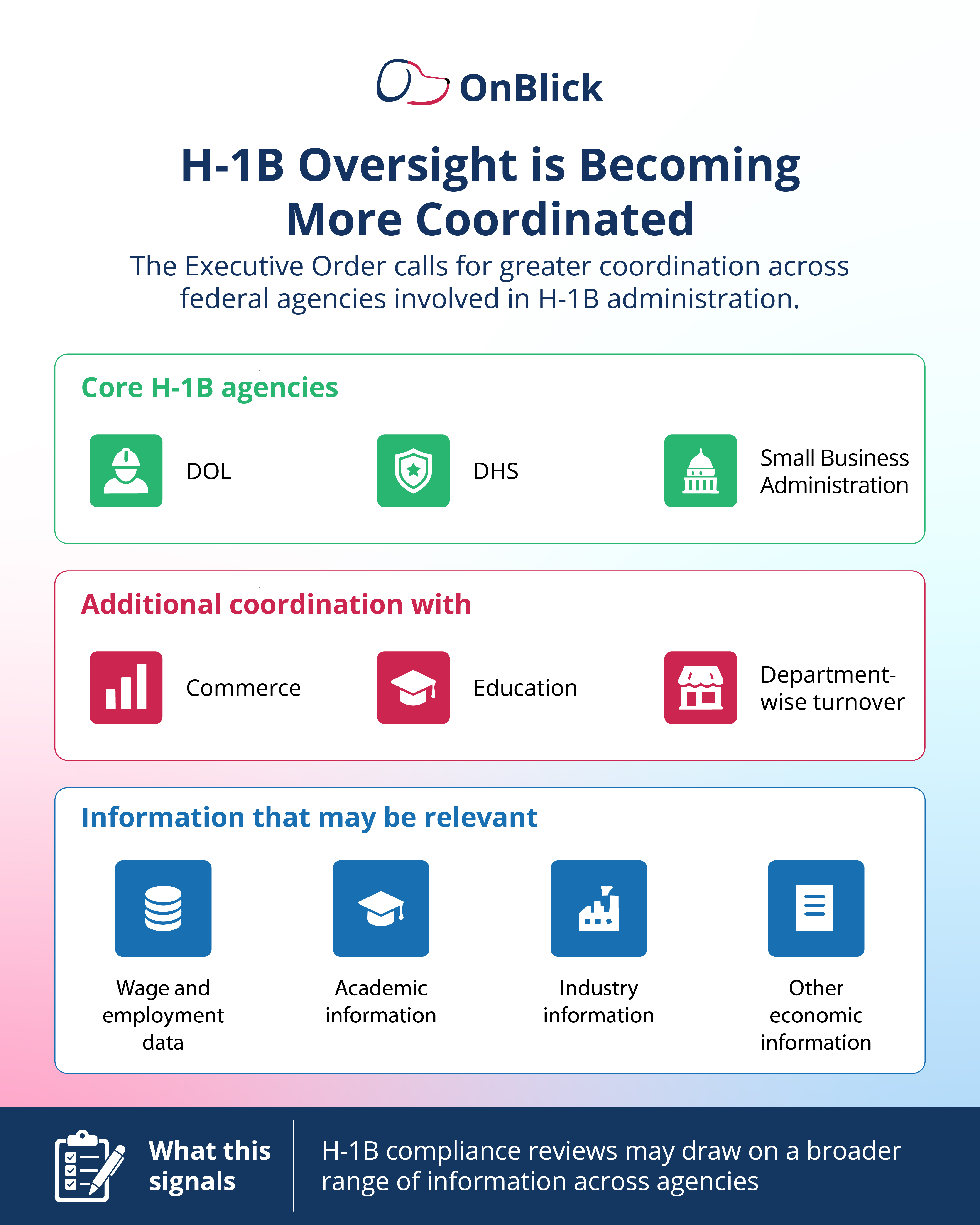
The order also directs DOL, DHS, and the Department of State to coordinate with the Departments of Commerce and Education and the Small Business Administration. These agencies may provide relevant wage, employment, academic, industrial, and other economic information.
This matters because H-1B review may increasingly draw on information beyond a single petition or LCA. Consistency across immigration filings, employment records, wage data, job information, and workforce decisions becomes more important when multiple agencies are expected to coordinate.
The direction also comes within a broader enforcement environment. DOL’s Project Firewall, launched in September 2025, prioritizes H-1B investigations where there are indicators such as displacement of U.S. workers, inadequate recruitment, preference for H-1B workers in certain circumstances, or misrepresentation of job duties and working conditions.
What the Executive Order Does Not Do
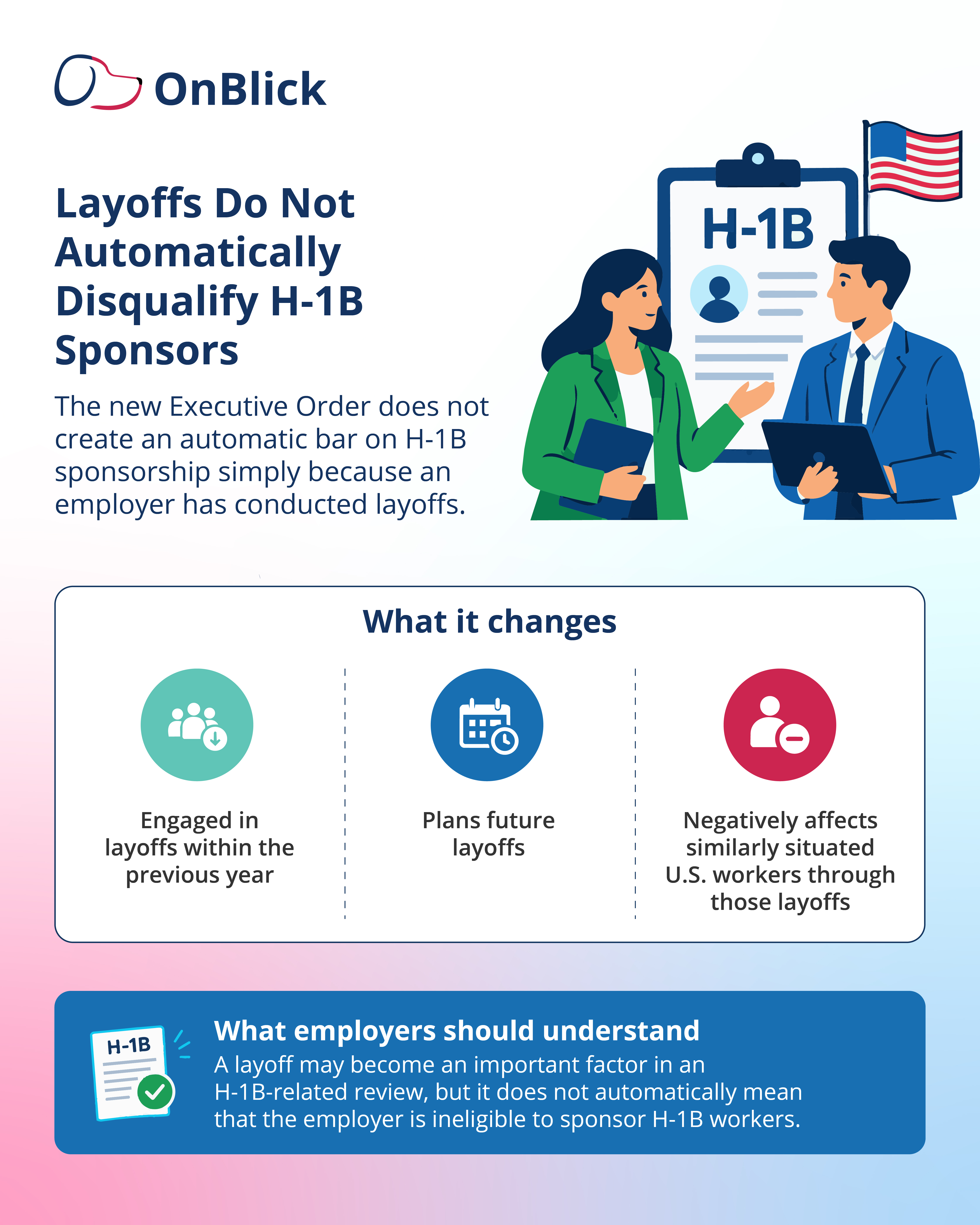
- The Executive Order should not be read as an automatic ban on H-1B sponsorship after layoffs. It does not create a new LCA form, establish a blanket prohibition on sponsoring H-1B workers following a workforce reduction, or state that an H-1B petition must be denied solely because layoffs occurred.
- Instead, it directs agencies to consider those workforce decisions as part of H-1B administration and enforcement. The order also delegates authority for agencies to issue rules, policies, operational guidance, or other guidance needed for implementation.
- For employers, this distinction is important. The immediate concern is not a new standalone filing obligation, but the possibility of closer review and additional implementation measures.
What Should H-1B Employers Review Now?
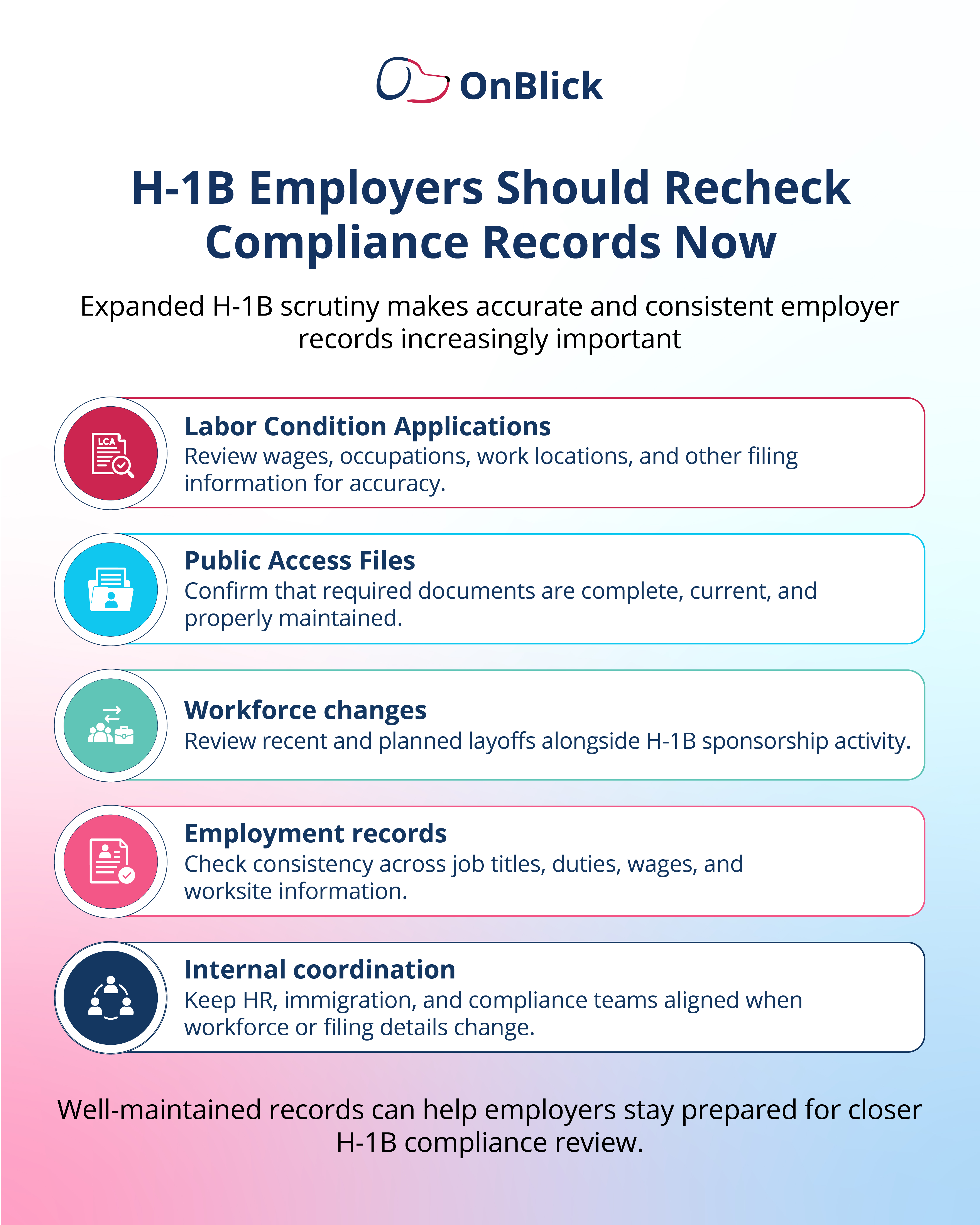
Employers do not need to wait for a formal investigation to assess whether their records are prepared for closer scrutiny. A practical compliance review should include:
- Recent and planned layoffs: Compare affected positions, job duties, locations, and timing with current or planned H-1B sponsorship activity.
- LCA accuracy: Recheck occupation, wage, worksite, period of employment, and other information reflected in active and recent Labor Condition Applications (LCAs).
- Public Access Files (PAFs): Confirm that required LCA-related documentation is complete, current, and properly maintained.
- Employment records: Look for inconsistencies across job titles, duties, compensation, work locations, and immigration documentation.
- Internal coordination: Ensure HR, immigration, legal, and compliance teams are working from the same information when workforce changes occur.
Existing DOL requirements already place obligations on H-1B employers relating to wages, working conditions, notice, recordkeeping, and LCA accuracy. The broader objective now should be to ensure that workforce decisions and H-1B compliance records are internally consistent and supported by documentation.
How OnBlick Supports H-1B and LCA Compliance
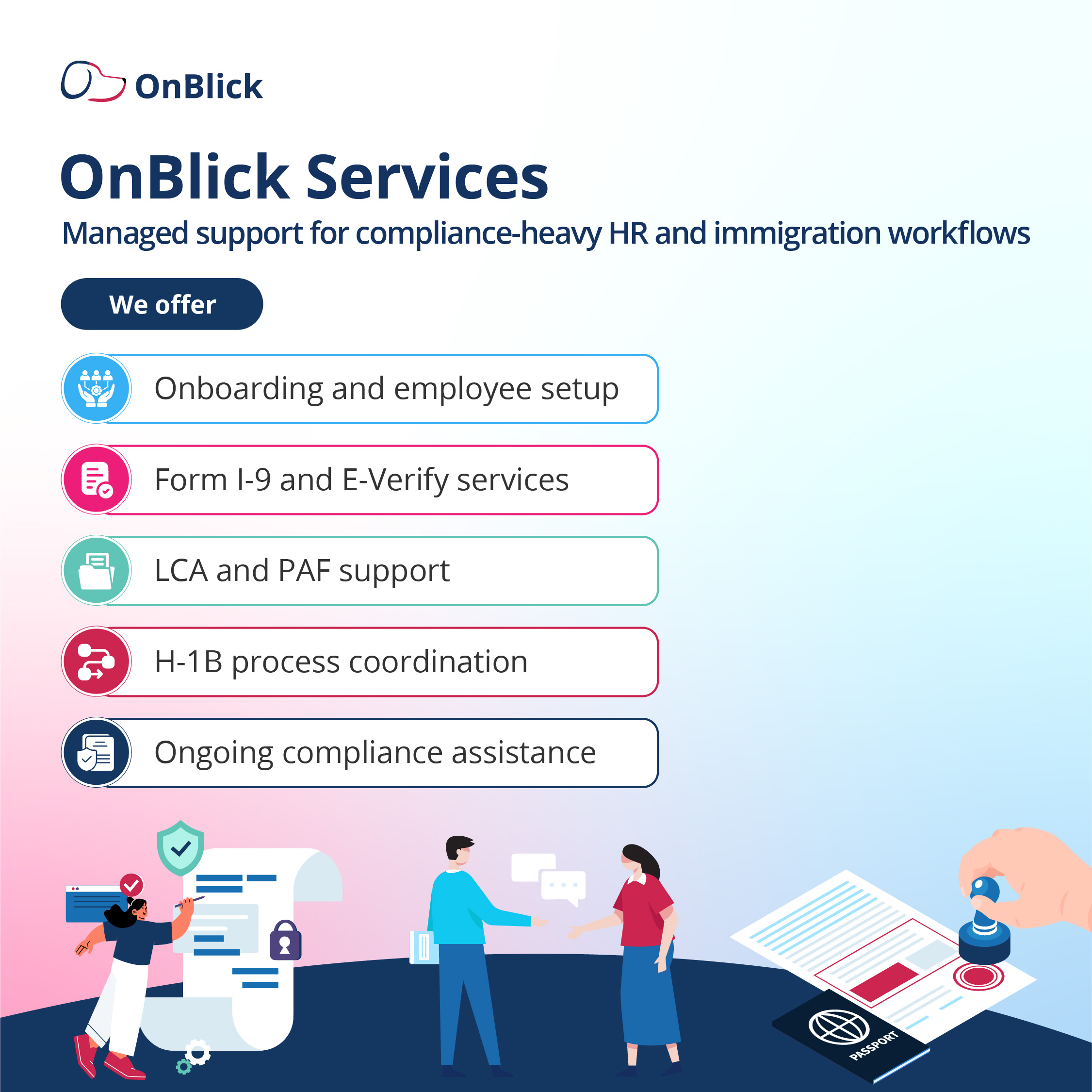
As H-1B oversight becomes more closely connected with workforce decisions and employer records, maintaining accurate documentation and consistent processes becomes increasingly important. OnBlick combines immigration compliance technology with HR Business Process Associate support to help employers manage documentation-heavy HR and immigration workflows with greater structure and visibility.
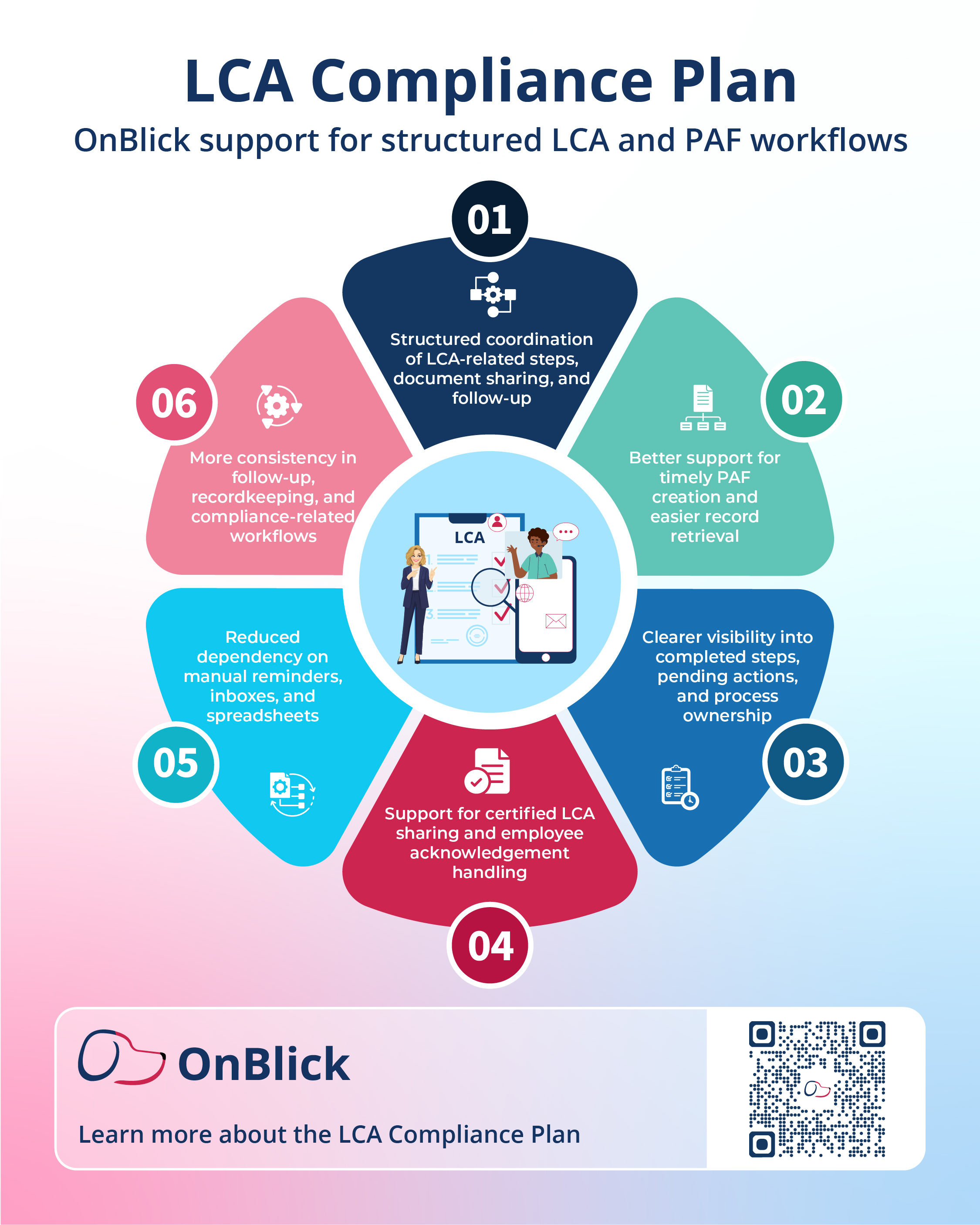
- For employers managing H-1B workers, OnBlick’s LCA Compliance Plan supports LCA coordination, Public Access File (PAF) creation, related documentation follow-up, Form I-9, and onboarding processes. The HRBP Plus Plan extends this support to H-1B coordination and Form I-983/STEM OPT-related processes, helping employers manage connected immigration compliance activities through a more organized workflow.
- Organizations that require broader day-to-day HR and immigration support can consider the HRBP 360 Plan, which adds areas such as offboarding, leave-related coordination, ongoing employee record support, and more comprehensive HR process assistance. This can be particularly useful when workforce changes need to be reflected consistently across employment records, immigration documentation, and ongoing compliance processes.
- By combining technology with structured HRBP support, OnBlick helps employers improve documentation control, reduce process gaps, and stay better prepared for evolving H-1B and LCA compliance expectations.
Want to strengthen your H-1B and LCA compliance processes? Schedule a free OnBlick demo.
Frequently Asked Questions
1. When is DOL expected to begin reviewing previously submitted LCAs?
The order directs the Wage and Hour Division to begin the review within 30 days of September 18, 2026. It does not specify how long the broader review will continue or when action involving individual employers may follow.
2. Does the order define “similarly situated U.S. workers”?
The Executive Order uses the term but does not establish a new definition or detailed test for applying it in this context. Employers should watch for agency guidance that may clarify how such comparisons will be made during H-1B reviews.
3. Does an employer need to make a new filing because of the Executive Order?
The order itself does not introduce a new employer form or standalone filing requirement. Existing H-1B and LCA obligations continue to apply, while relevant agencies have been given authority to issue additional rules, policies, or guidance for implementation.
4. Are only large-scale layoffs relevant?
The order does not establish a numerical threshold for the number of employees who must be affected before layoffs are considered. Future implementation guidance may provide more detail on how agencies will assess the scale, timing, and circumstances of workforce reductions.
5. What should H-1B employers monitor next?
Employers should monitor implementation guidance from DOL, DHS, the Department of State, and other agencies involved in the order. New rules, policies, or operational guidance could provide important details on how layoff history, planned workforce reductions, and interagency information will factor into H-1B decisions.
Conclusion
The September 18 Executive Order places workforce decisions and H-1B compliance on a more connected enforcement track. Recent or planned layoffs, previously submitted LCA data, and information shared across agencies may all receive closer attention.
For H-1B sponsors, the practical response is to review the accuracy and consistency of existing records, understand how workforce changes intersect with immigration activity, and follow subsequent agency guidance as implementation develops.

.png)