.gif)


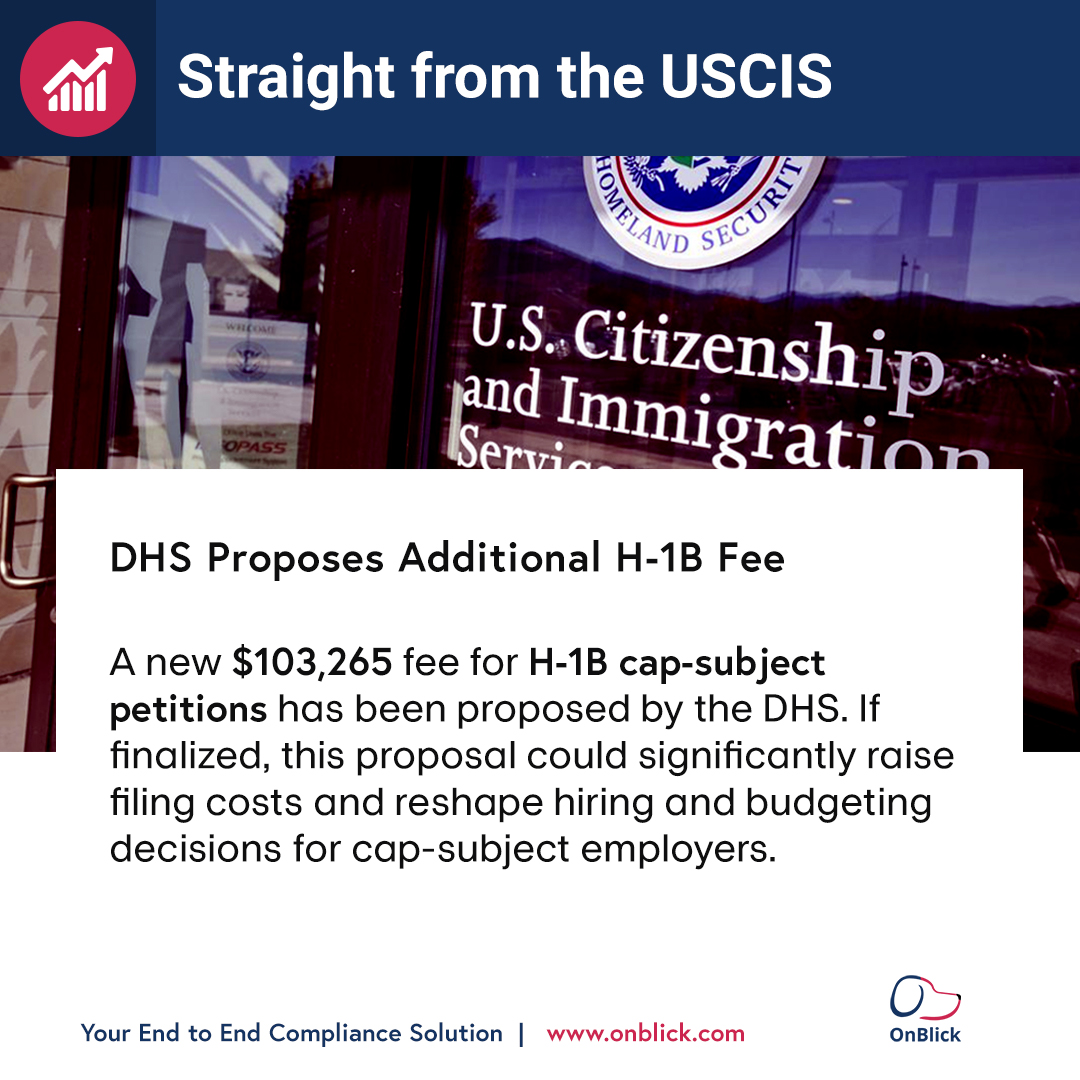
The Department of Homeland Security (DHS) has proposed a significant new cost for employers filing H-1B cap-subject petitions: an additional $103,265 fee per petition.
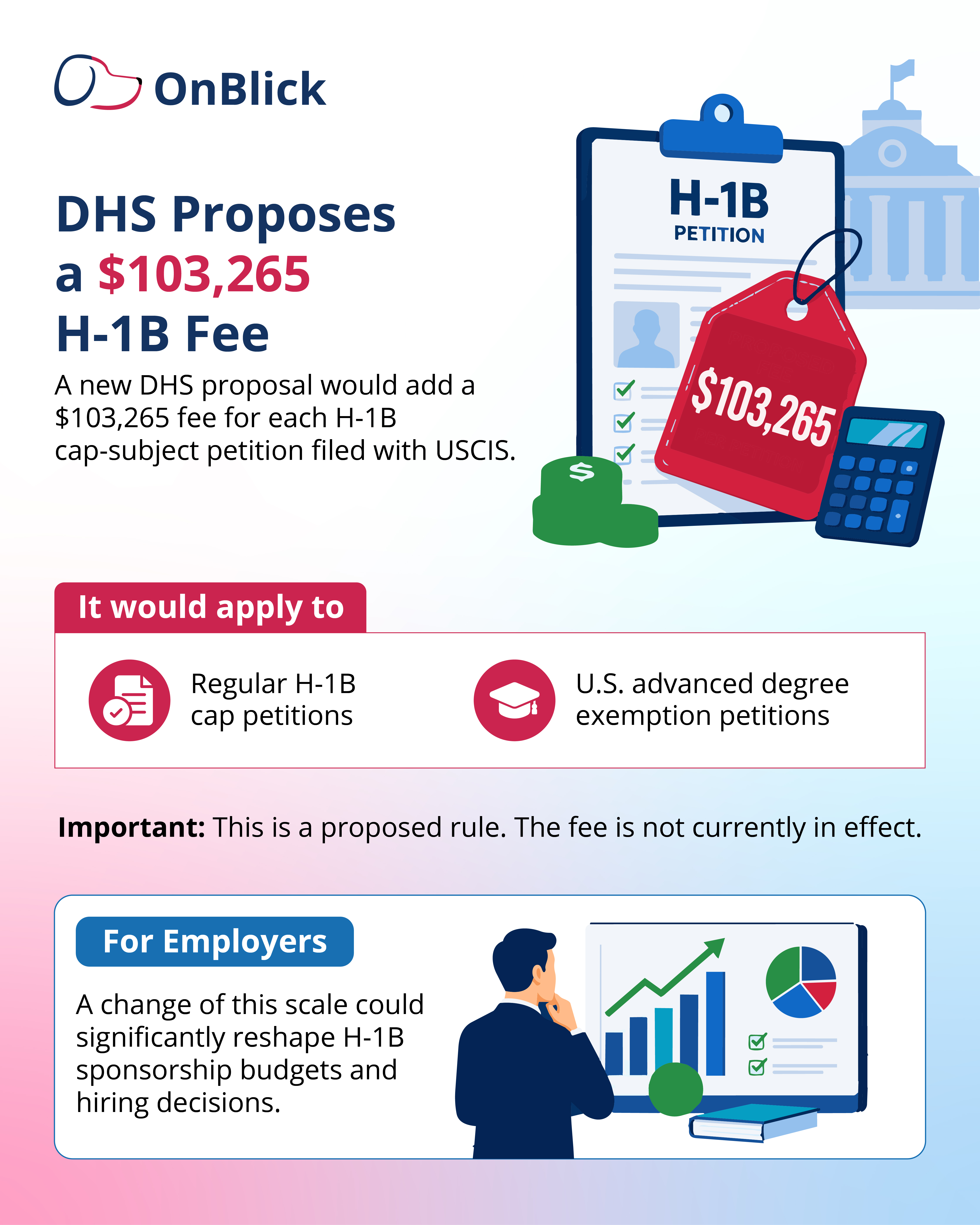
The proposed fee would be payable when an H-1B cap-subject petition is filed and would apply to both regular cap cases and petitions for beneficiaries eligible for the U.S. advanced degree exemption. Importantly, it would be charged in addition to other applicable H-1B filing fees and payments.
This blog discusses the proposed $103,265 H-1B fee, who it could affect, and what employers should know. If finalized, the fee could significantly influence H-1B sponsorship budgets and hiring decisions, particularly for smaller employers.
What is the DHS H-1B Fee Proposal
Under the proposed rule, DHS would establish a separate $103,265 fee for each H-1B cap-subject petition filed with USCIS.
The fee would be due at the petition-filing stage. It is therefore different from the H-1B electronic registration fee paid before the selection process.
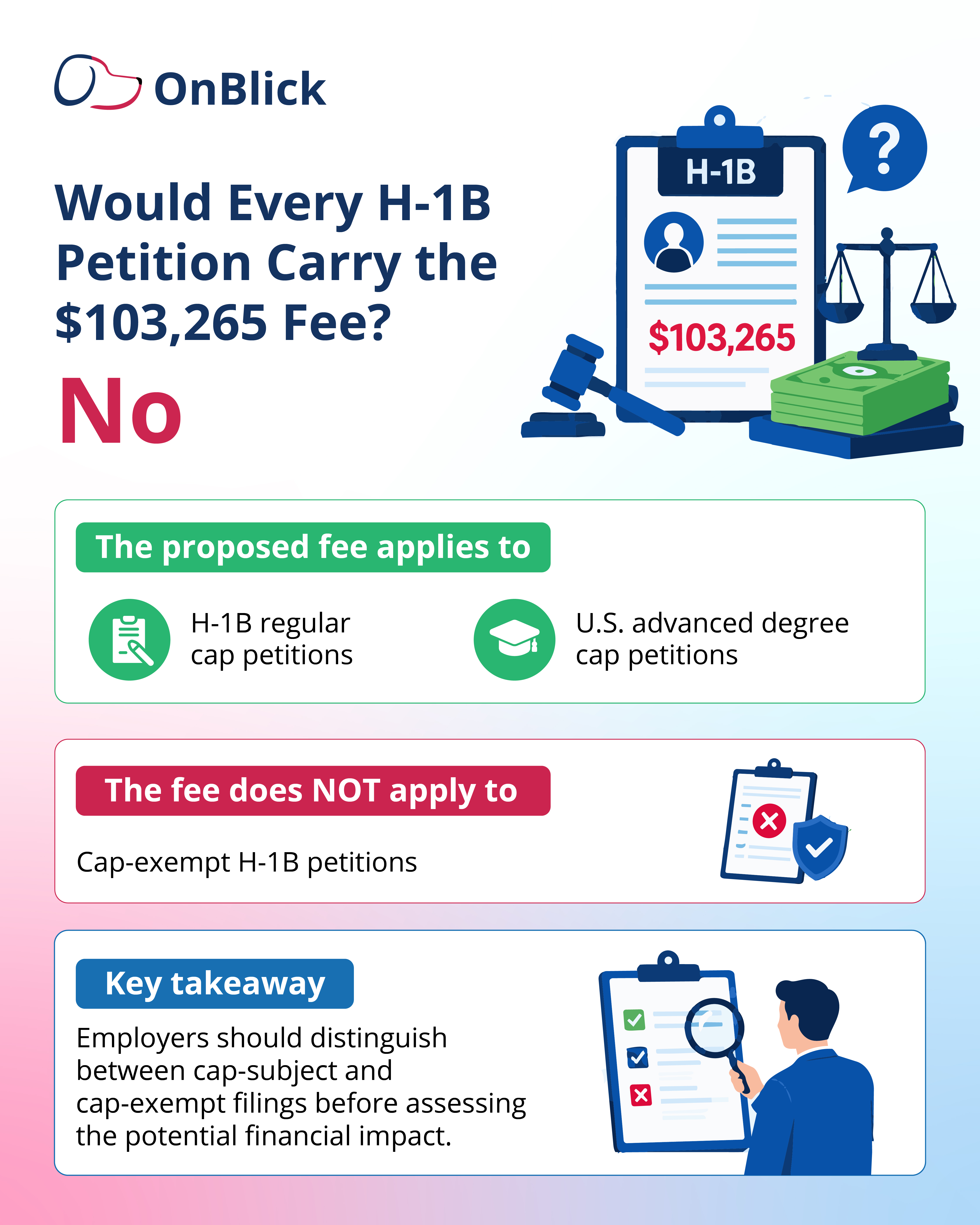
Regular H-1B cap petitions and petitions filed under the U.S. advanced degree exemption would be subject to the proposed $103,265 fee. Cap-exempt H-1B petitions would not be subject to the proposed fee.
This distinction matters because the proposal does not impose a $103,265 charge on every H-1B petition filed by an employer.
Why is the Proposed H-1B Fee $103,265?
DHS says the proposal is intended to recover a portion of the government's broader costs of administering the lawful immigration system.
- Unlike a fee designed only to cover USCIS processing of an individual H-1B petition, DHS's calculation incorporates costs attributed to multiple federal agencies involved in immigration administration, including USCIS, U.S. Immigration and Customs Enforcement (ICE), U.S. Customs and Border Protection (CBP), the Executive Office for Immigration Review (EOIR), the Department of State (DOS), and the Department of Labor (DOL).
- DHS calculated approximately $8.78 billion in costs to be recovered and divided that figure by a projected annual volume of 85,000 fee-paying H-1B cap-subject petitions. That produces a calculated fee of $103,264.57, which DHS rounded to $103,265. The agency estimates that the fee could generate approximately $8.8 billion annually.
- This makes the proposal notable not only because of the amount involved, but also because of the way DHS is approaching cost recovery. The proposed H-1B fee would help fund immigration-related activities extending beyond the adjudication of the individual petition being filed.
Is This Fee Different From the $100,000 H-1B Payment?
Employers may understandably confuse the proposed $103,265 fee with the separate $100,000 H-1B payment associated with Presidential Proclamation 10973.
They are not the same.
- DHS states that the proposed $103,265 fee is based on separate legal authority and would be an additional fee independent of the proclamation-related payment.
- The proposed rule also acknowledges the current legal and timing issues surrounding that $100,000 payment. It notes that federal district court action vacated the agency guidance implementing the proclamation payment in June 2026 and that the government appealed. The proposal further states that, unless extended, Presidential Proclamation 10973 would expire before the newly proposed fee could take effect.
- If both requirements were legally operative at the same time, however, DHS states that an employer subject to both would have to pay both amounts.
- For employers, the practical takeaway is to treat the two developments separately rather than assuming the new proposal is simply a replacement for the $100,000 payment.
What Could the Proposed Fee Mean for H-1B Hiring?
- A $103,265 additional cost per cap-subject petition could materially change the economics of H-1B sponsorship for some employers.
- For an organization planning to file one cap-subject petition, the proposed fee alone would exceed $100,000 before considering other applicable government fees, attorney costs, recruitment expenses, or internal administrative costs.
- The impact becomes more significant for organizations filing multiple cap-subject petitions.
- DHS itself recognizes that the proposed fee could affect employer behavior. In explaining what it considers an indirect benefit of the rule, DHS states that a fee of this size could make an employer less likely to select an H-1B worker over a qualified U.S. worker unless the employer has a legitimate need for the worker's specialized skills.
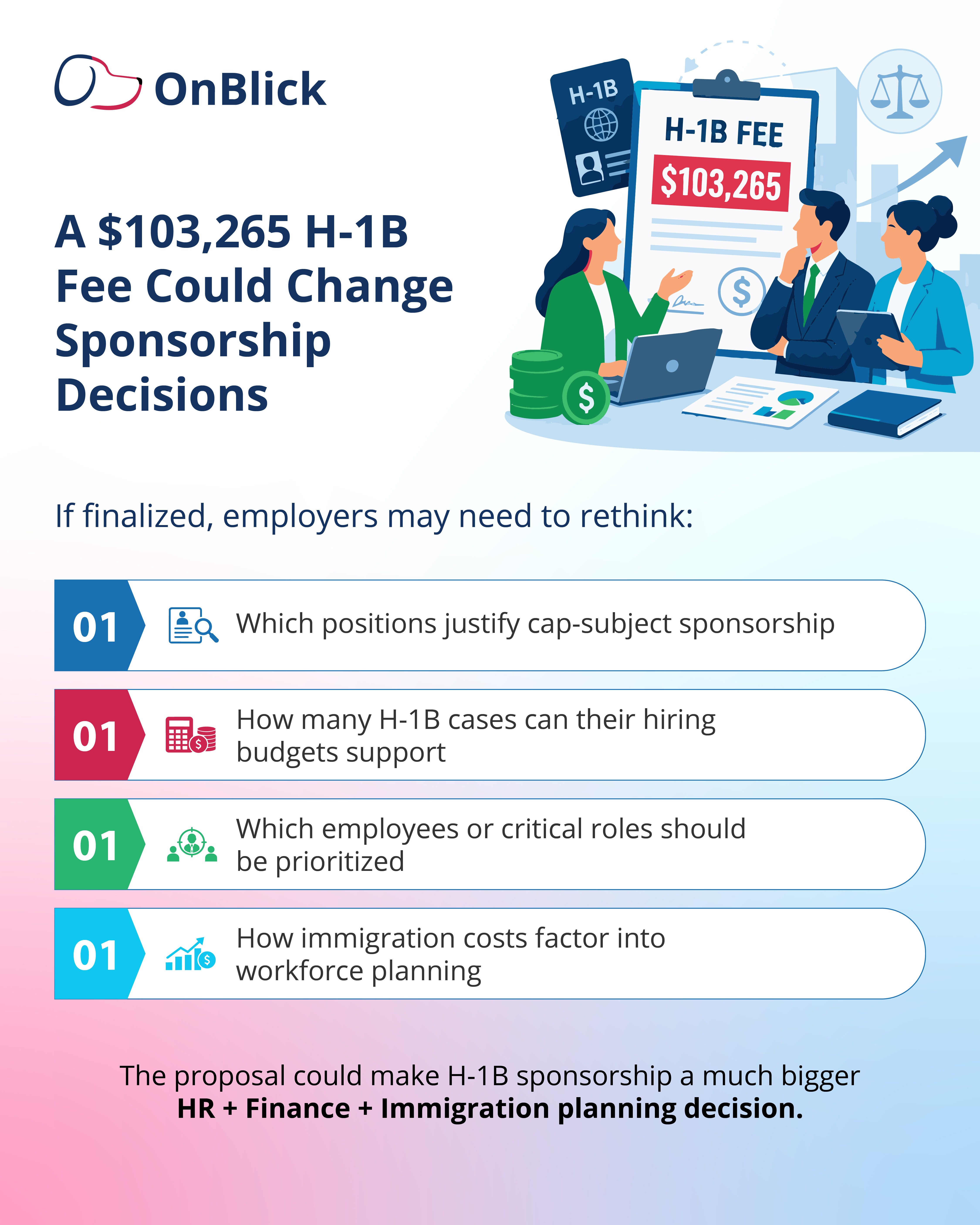
From an employer-planning perspective, this could mean greater scrutiny around questions such as:
- whether a position is important enough to justify cap-subject sponsorship;
- which employees should be prioritized when sponsorship budgets are limited;
- how immigration costs should be incorporated into workforce and project planning;
- whether certain hiring needs can be met through workers who are already cap-counted or through other lawful immigration pathways; and
- how early HR, finance, immigration, and business teams should coordinate before the H-1B cap season.
The proposed fee therefore has the potential to become a workforce-planning issue as much as an immigration filing issue.
H-1B Fee Hike: Impact on Small Employers
One of the most important parts of the proposed rule appears in DHS's Regulatory Flexibility Act analysis.
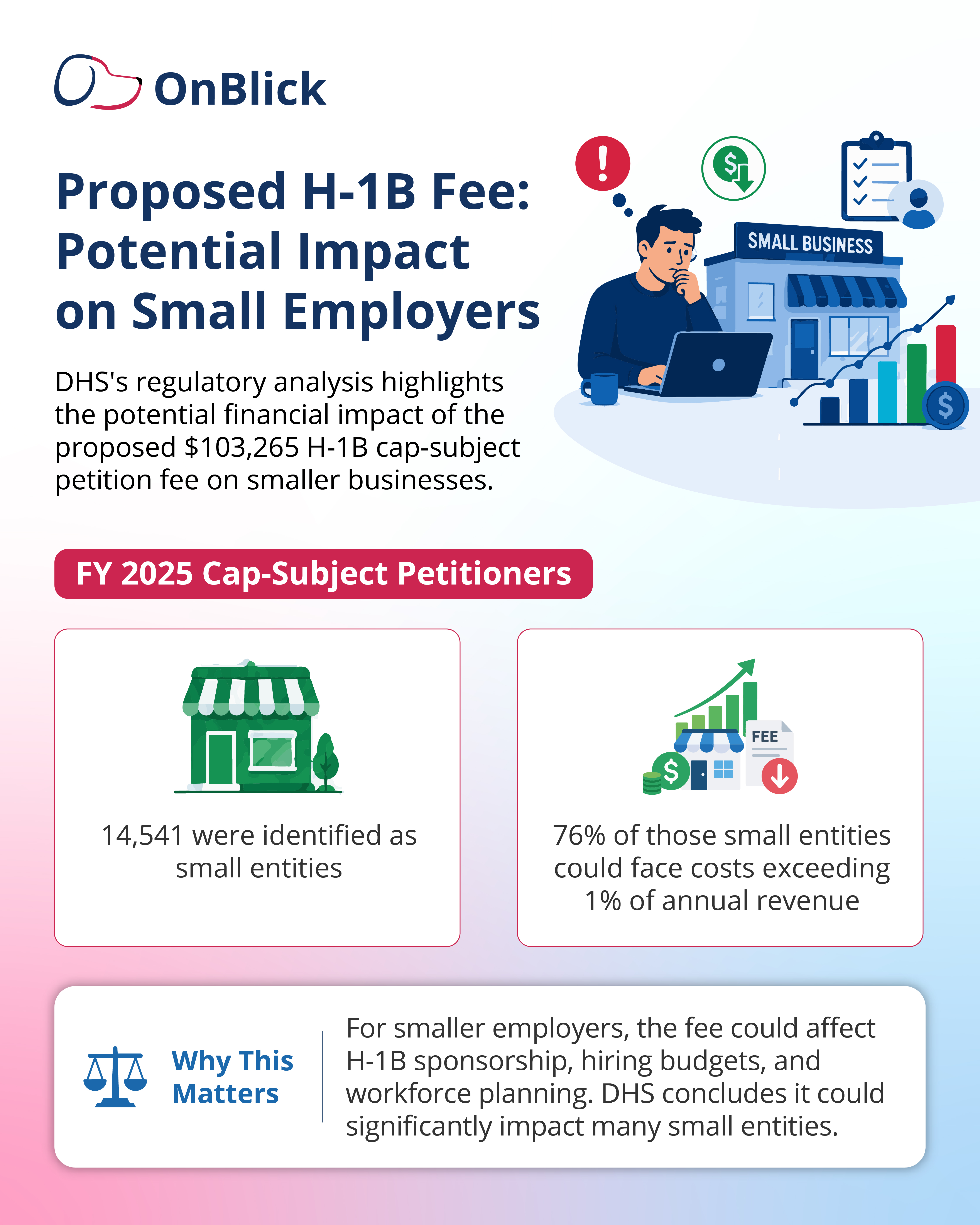
- USCIS identified 28,649 unique entities that filed cap-subject H-1B petitions in FY 2025. Of these, 14,541 were classified as small entities, representing 51% of the total analyzed population.
- DHS then assessed the proposed $103,265 cost against the revenues of those small entities.
- Its conclusion was significant: 11,051 small entities, or 76% of the small entities identified, could experience costs exceeding 1% of their annual revenue. DHS considers an impact above that threshold significant for purposes of its regulatory analysis.
- DHS therefore concludes that the proposal could have a significant economic impact on a substantial number of small entities that file H-1B cap-subject petitions.
- This may be where the proposal has its greatest practical impact. Large organizations may have more flexibility to absorb or redistribute sponsorship costs. For smaller technology companies, staffing businesses, consulting firms, and other employers that rely on specialized talent, a six-figure fee attached to each cap-subject petition could require much more selective sponsorship decisions.
What Should H-1B Employers Do Now?
Employers do not need to begin paying or budgeting the proposed fee as though it were already final.
- The current stage is a notice of proposed rulemaking. DHS is providing a 30-day public-comment period following Federal Register publication, after which the agency would need to consider comments before deciding whether and how to proceed with a final rule. The final provisions or fee amount could therefore differ from the current proposal.
- Employers should, however, start evaluating possible exposure. Organizations expecting to participate in future H-1B cap seasons can identify the number of positions that typically require cap-subject sponsorship and model what a $103,265 per-petition fee would mean for immigration and hiring budgets.
- It will also be important to distinguish cap-subject filings from cap-exempt petitions and other H-1B filings that would fall outside the proposal, rather than applying the proposed cost broadly to the entire H-1B workforce.
- Most importantly, employers should continue monitoring the rulemaking process before making long-term decisions based on a proposal that has not been finalized.
How OnBlick Helps Employers Manage H-1B Compliance
Changes to H-1B rules and filing requirements make organized immigration data and documentation increasingly important.
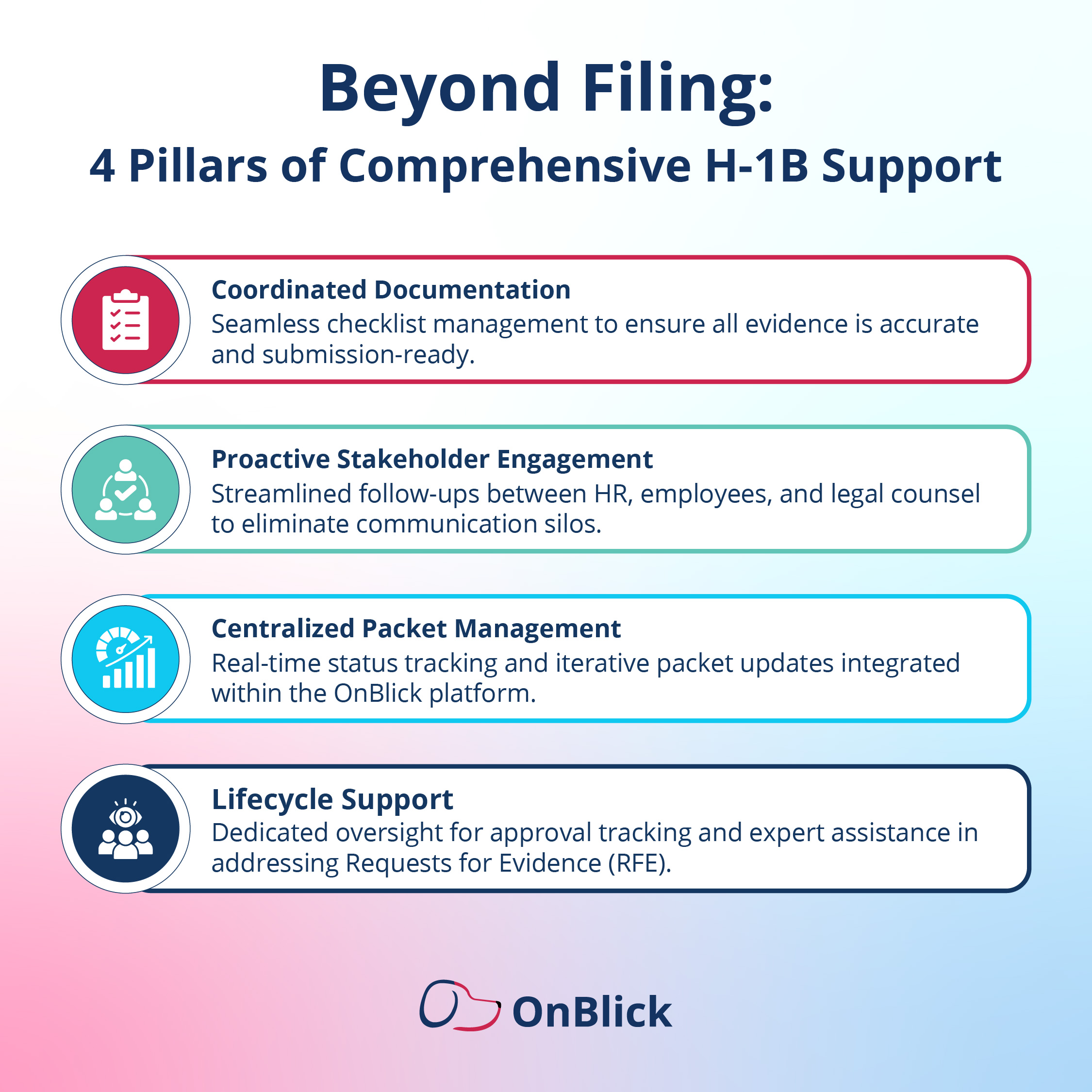
OnBlick helps HR and immigration compliance teams manage H-1B petition data, employee documentation, and related compliance workflows in one system. Employers can manage I-129 petition data, LCA lifecycle activities, Public Access Files, worksite information, employee documents, and USCIS case tracking while maintaining centralized compliance records.
Schedule a free OnBlick demo to see how your organization can simplify H-1B and immigration compliance management.

H-1B Visa Fee: Frequently Asked Questions
Is the $103,265 H-1B fee already in effect?
No. DHS published the proposed rule in the Federal Register on August 25, 2026. Employers are not currently required to pay the $103,265 fee. A final rule would need to be issued before the proposed requirement could take effect.
Which H-1B petitions would have to pay the proposed fee?
The proposal applies to H-1B cap-subject petitions, including petitions for beneficiaries eligible for the U.S. advanced degree exemption. It would be payable when the petition is filed.
Would cap-exempt H-1B petitions be subject to the $103,265 fee?
No. DHS specifically proposes excluding H-1B petitions that are not subject to the annual cap.
Is the $103,265 fee the same as the $100,000 H-1B proclamation payment?
No. DHS describes them as separate requirements based on different legal authorities. The proposal also notes that the proclamation payment is subject to ongoing litigation and that the proclamation, unless extended, is scheduled to expire before this proposed fee could take effect.
When will employers know whether the proposed fee will be final?
DHS is accepting public comments for 30 days after publication of the proposed rule in the Federal Register. The agency would then review the comments before determining whether to issue a final rule. Employers should continue following USCIS and Federal Register updates.
Conclusion
The proposed $103,265 H-1B cap-subject petition fee represents a potentially significant change in the cost of employment-based immigration sponsorship.
The proposal would not affect every H-1B filing, but for employers participating in the annual cap process, particularly smaller organizations, the financial impact could be considerable. Employers should focus on understanding which filings could be affected, evaluating potential future costs, and monitoring the public-comment and rulemaking process closely.
As H-1B policies continue to evolve, early coordination between HR, immigration, finance, and business teams will be important for making informed sponsorship decisions while maintaining strong immigration compliance.
OnBlick will continue to monitor DHS, USCIS, and Federal Register updates on the proposed H-1B fee and share relevant developments as the rulemaking process progresses. If you would like to learn how OnBlick can support your organization’s H-1B compliance and immigration workflows, book a free OnBlick demo today.