.gif)


The U.S. Department of Labor’s Office of Inspector General announced a major investigation in July 2026 focused on alleged fraud, worker exploitation, and abuse within the H-1B and PERM systems. For employers that sponsor foreign workers or manage employment-based immigration programs, the announcement is a reminder that compliance cannot be treated as a one-time filing activity.
The investigation may increase attention on how employers manage immigration-related records, wage obligations, recruitment documentation, and internal compliance processes. It also makes audit readiness more important for HR, immigration, payroll, legal, and compliance teams.
This blog explains what the 2026 DOL H-1B and PERM investigation means for employers, what may trigger a DOL investigation, which compliance areas should be reviewed, and how organizations can prepare before an inquiry or audit occurs.
What is the DOL H-1B and PERM Investigation About?
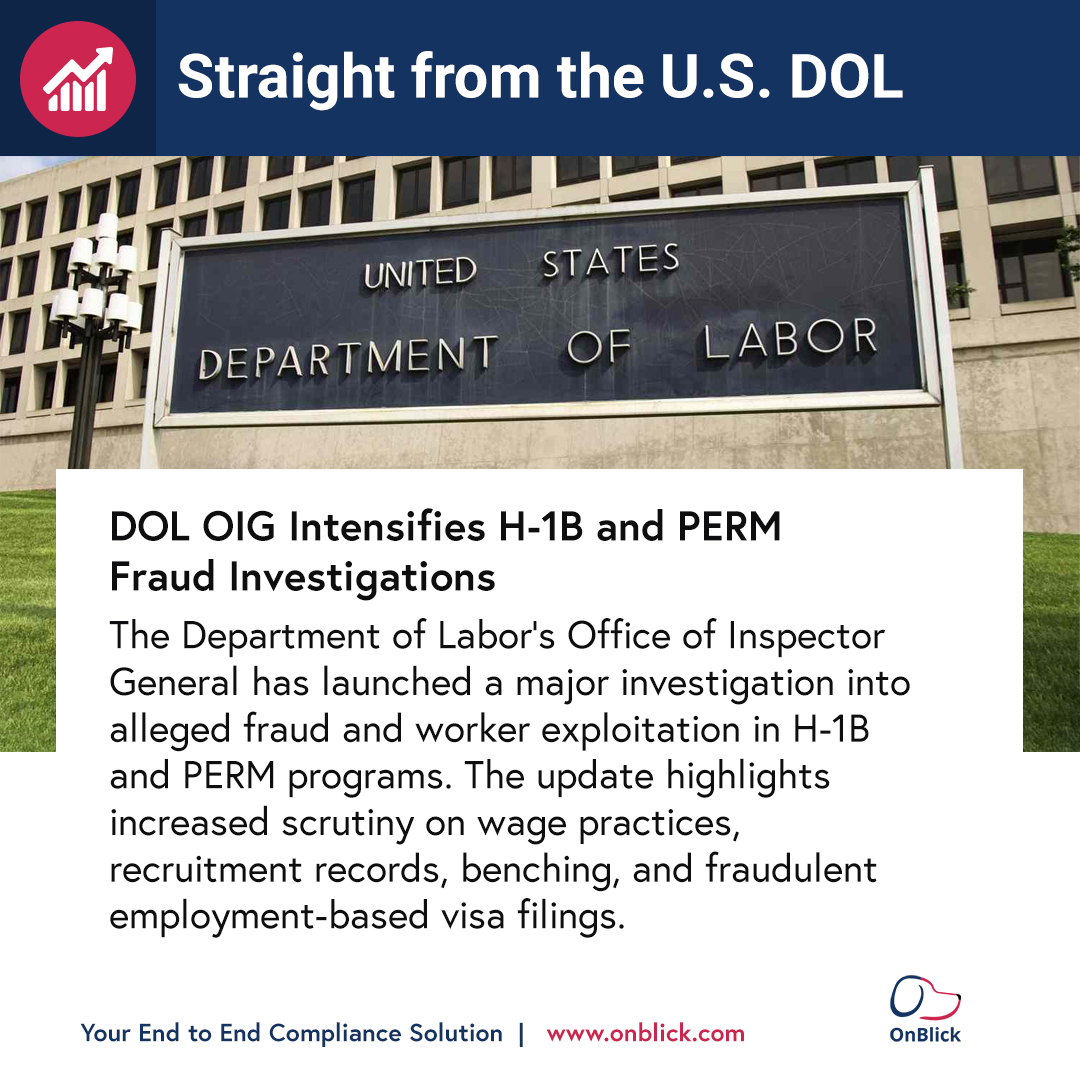
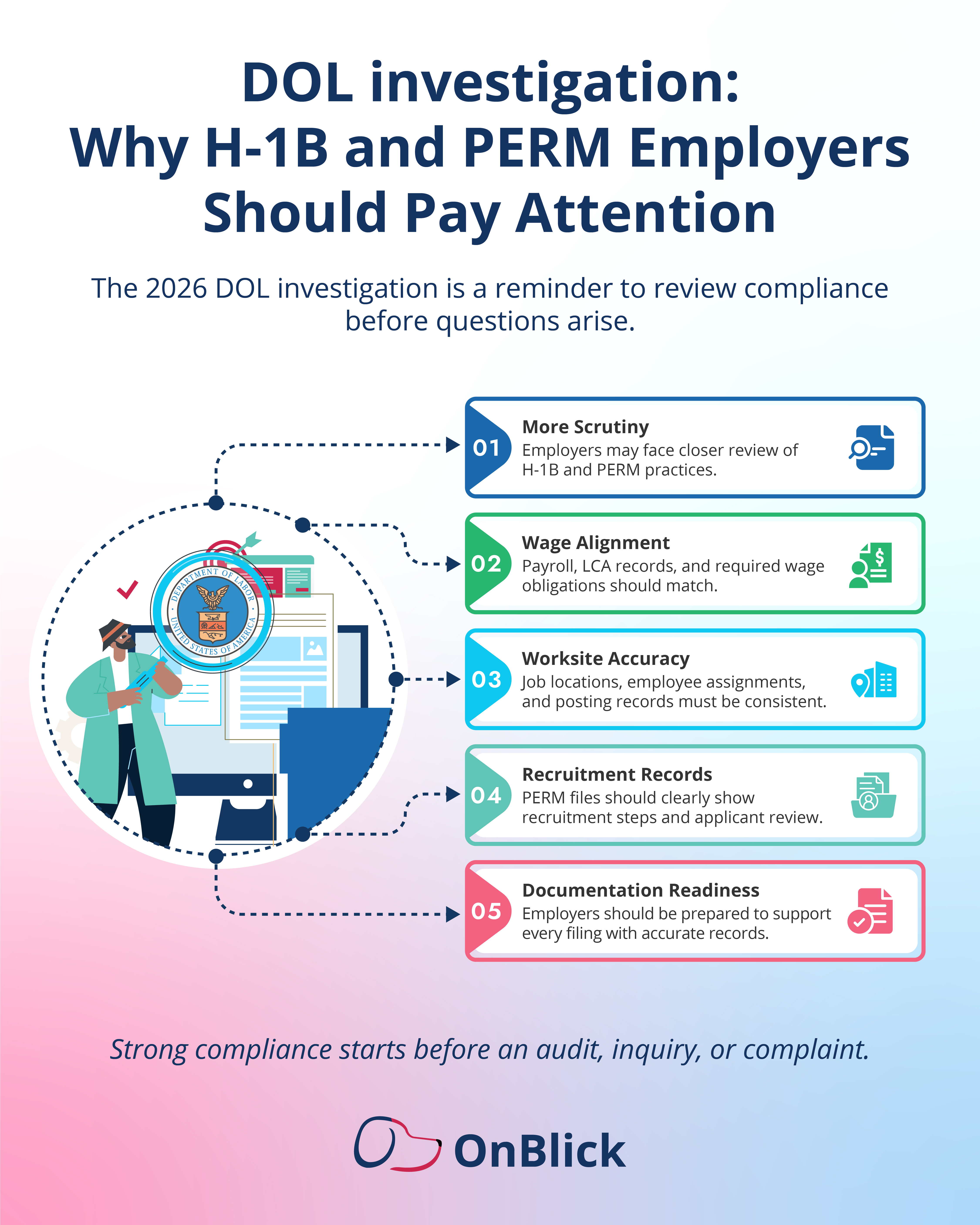
The U.S. Department of Labor Office of Inspector General launched a major investigation in July 2026 targeting alleged fraud, worker exploitation, and abuse. The announcement specifically points to enforcement concerns involving both H-1B and PERM programs, making it important for employers to understand what the investigation is focused on and where compliance risks may appear.
As per the announcement, issues such as fraudulent applications, coercive wage-kickback arrangements, below-wage labor, benching, fraudulent recruitment practices, and potential visa program abuse are the investigation’s focus. These are serious concerns because H-1B and PERM programs depend on accurate employer filings, lawful wage practices, proper recruitment steps, and fair treatment of workers.
For employers, the announcement does not mean every H-1B or PERM sponsor is under investigation. However, it does signal that immigration-related employment practices may receive closer attention from regulators, workers, and other reporting sources. Employers with H-1B employees, PERM cases, staffing arrangements, or third-party worksites should use this moment to review whether their records, wage data, recruitment files, and internal processes are complete and consistent.
Note: H-1B and PERM employers need to be ready to show that their immigration practices are supported by accurate records and ongoing compliance controls.
A Quick Note on PERM
PERM stands for Program Electronic Review Management. It is the DOL-managed permanent labor certification process used by employers that want to sponsor certain foreign workers for permanent employment-based roles in the United States. In simple terms, PERM is meant to help show that the employer tested the U.S. labor market and followed required recruitment steps before moving forward with the sponsorship process.
Why The DOL Investigation Matters for H-1B and PERM Employers
- The 2026 DOL OIG investigation is important because it follows a broader shift toward more active H-1B enforcement. In September 2025, the Department of Labor launched Project Firewall, an H-1B enforcement initiative focused on protecting U.S. workers’ rights, wages, and job opportunities while holding employers accountable for misuse of the H-1B program.
- For employers, this means H-1B compliance may receive closer attention not only at the petition stage, but also after the worker is placed. Wage practices, job duties, worksite locations, LCA obligations, Notice of Posting records, and Public Access Files should all remain accurate and consistent throughout the employment period.
- The recent DOL OIG investigation adds another layer of concern because it references alleged fraudulent applications, wage kickbacks, benching, fraudulent recruitment practices, and visa program abuse. These are areas closely tied to employer documentation, payroll practices, worker treatment, and recruitment integrity.
- For PERM employers, the concern is not exactly the same, but the compliance lesson is similar. PERM cases depend on a well-documented recruitment process. Employers should be able to show that recruitment steps were completed properly, applicants were reviewed consistently, and job requirements were accurate, lawful, and business-related.
- This does not mean every H-1B or PERM employer is at risk of enforcement. However, it does mean employers should be more careful about internal consistency. Immigration, HR, payroll, legal, and staffing teams should all work from the same set of accurate records.
The main concern for employers is not only whether forms were filed. It is whether the company can prove that its wage practices, recruitment records, employee treatment, and compliance documentation match what was represented in those filings.
What Triggers a DOL Investigation?
A DOL investigation may begin for different reasons, including a complaint, a referral, or information that suggests possible violations. In the H-1B context, this is especially relevant because the DOL has already expanded its enforcement focus through Project Firewall, which supports targeted, data-driven H-1B enforcement and coordination with other federal agencies.
The 2026 DOL OIG announcement also encourages U.S. workers, foreign workers, and others to report concerns involving possible fraud, coercion, benching, fraudulent recruitment, wage kickbacks, or visa program abuse. For employers, this means complaints or tips may come from multiple sources, including current workers, former workers, job applicants, competitors, or others who believe the program is being misused.
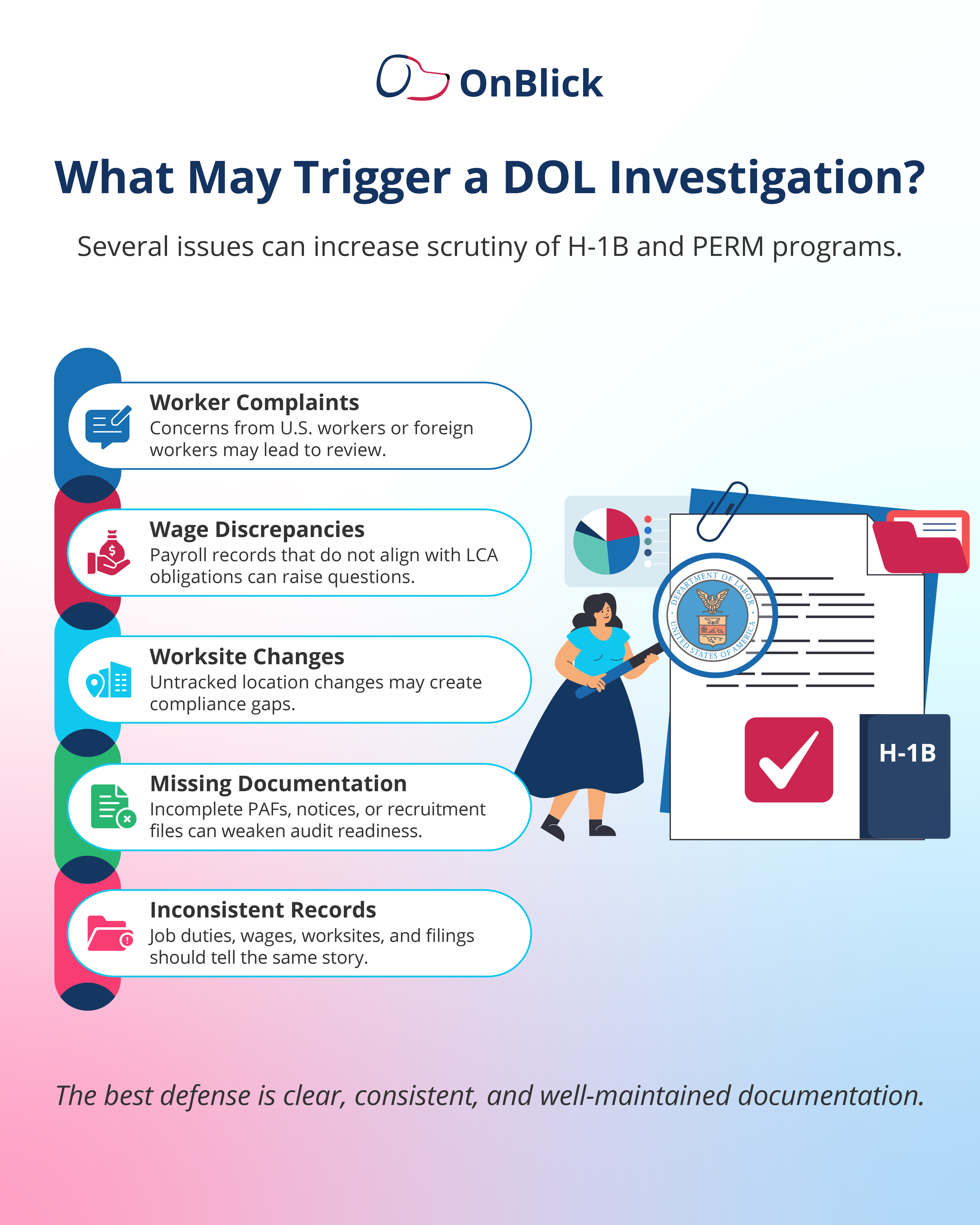
Several issues may increase the chance of scrutiny:
- Worker complaints or public tips
Concerns raised by U.S. workers, foreign workers, applicants, or third parties may lead to agency review, especially if the complaint points to wage issues, displacement concerns, coercion, or unfair employment practices.
- Wage or payroll discrepancies
If payroll records do not align with LCA wage obligations, offer letters, job terms, or actual work performed, this can create H-1B compliance concerns.
- Benching or nonproductive time issues
The OIG announcement specifically refers to benching concerns. Employers should review whether H-1B workers are being paid properly during nonproductive periods and whether internal practices match wage obligations.
- Inconsistent worksite records
A mismatch between the LCA worksite, actual employee location, Notice of Posting records, remote work arrangements, or third-party placement details may raise questions during a DOL audit or inquiry.
- Incomplete Public Access Files
DOL guidance says H-1B employers must make certain LCA-related materials available to the public within one working day of filing the LCA. Missing or incomplete Public Access File records can weaken an employer’s ability to respond confidently.
- PERM recruitment concerns
Inconsistent job ads, unclear applicant review notes, weak recruitment reports, or unexplained rejection reasons may create PERM audit risk, especially when the employer cannot clearly show how the recruitment process was handled.
- Patterns suggesting program abuse
A single documentation gap may be fixable, but repeated inconsistencies across wages, worksites, job duties, recruitment records, or employee treatment can look more serious. Under Project Firewall, DOL has emphasized targeted and data-driven enforcement efforts, so patterns across records may matter.
Not every issue automatically triggers a DOL investigation. However, these areas can increase risk when records are incomplete, inconsistent, or difficult to explain. Employers should treat them as warning signs and review their H-1B and PERM files before a DOL inquiry, department of labor audit, or investigation occurs.
Key H-1B Compliance Areas Employers Should Review
H-1B compliance depends on more than filing the petition correctly. Employers should be able to show that the job, wage, worksite, and employment conditions continue to match the Labor Condition Application and related records.
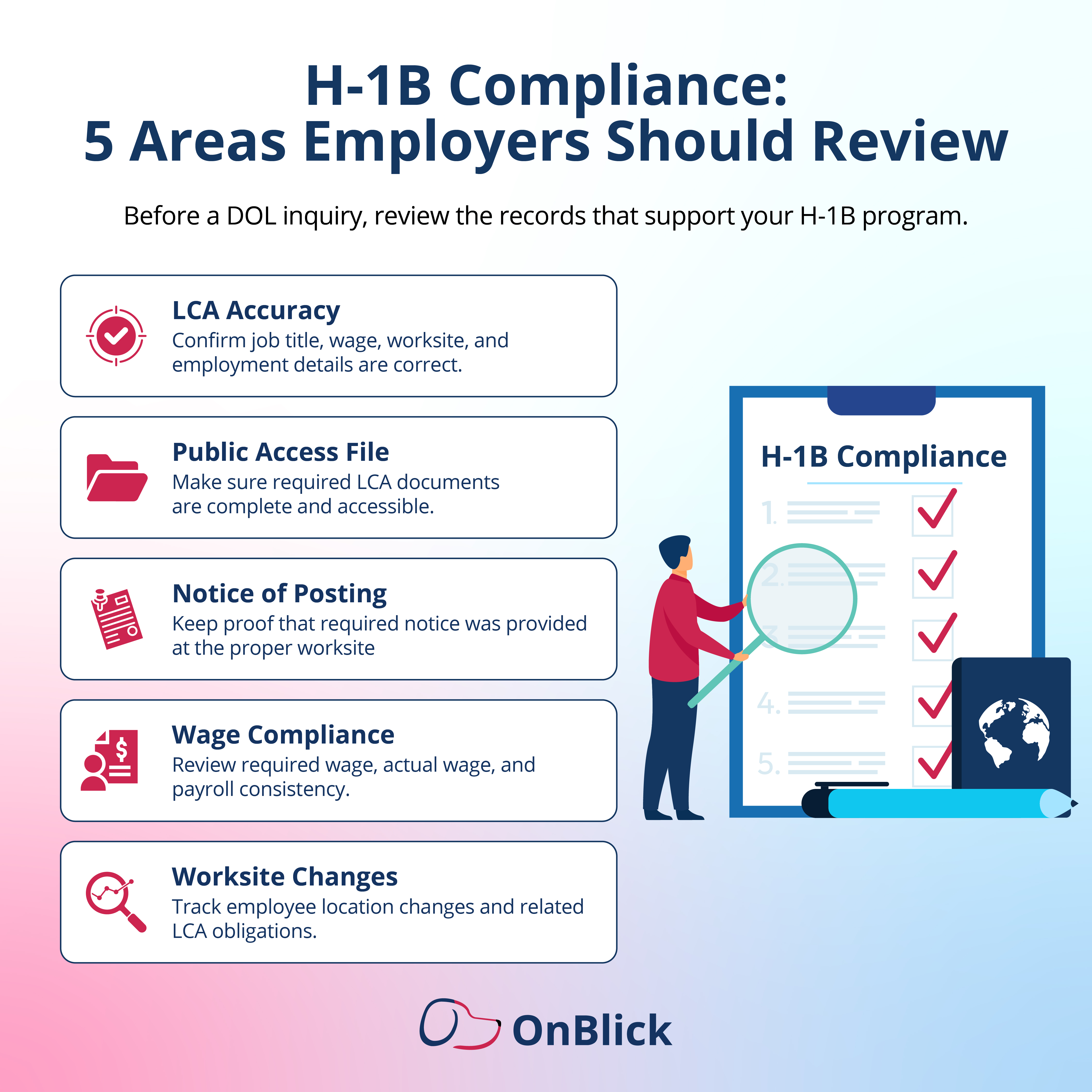
- LCA accuracy
Review whether the Labor Condition Application accurately reflects the H-1B worker’s job classification, wage level, employment terms, and place of employment. DOL guidance states that the LCA must be filed for the geographic area where the H-1B worker will be employed.
- Wage and payroll consistency
Employers should compare required wage obligations with actual payroll records. The DOL explains that H-1B workers must be paid the higher of the actual wage paid to similarly employed workers or the local prevailing wage for the occupation.
- Public Access File readiness
The Public Access File should be complete and available within the required timeframe. DOL guidance says H-1B employers must make certain LCA-related materials available to the public within one working day of filing the LCA.
- Notice of Posting records
Employers should keep proof that the required LCA notice was provided properly. This includes confirming the location, timing, method, and content of the notice.
- Worksite and location changes
If the employee’s work location changes, employers should review whether the existing LCA still covers the worksite or whether a new LCA and amended petition may be required.
- Benching and nonproductive time
Employers should review how they handle nonproductive periods. DOL guidance states that nonproductive time must generally be paid at the required wage rate for the occupation listed on the H-1B worker’s LCA.
- Employee LCA delivery
Employers should confirm that the H-1B employee received a copy of the certified LCA, as required under H-1B program rules.
For audit readiness, these records should not be scattered across HR, payroll, immigration, and manager files. They should tell one consistent story about the role, wage, worksite, and employment conditions.
Key PERM Compliance Areas Employers Should Review
PERM compliance is centered on whether the employer followed the required recruitment process and maintained records that support the labor certification filing. Since PERM is tied to permanent labor certification, employers should be able to show that recruitment was conducted properly and that applicant review decisions were documented consistently.
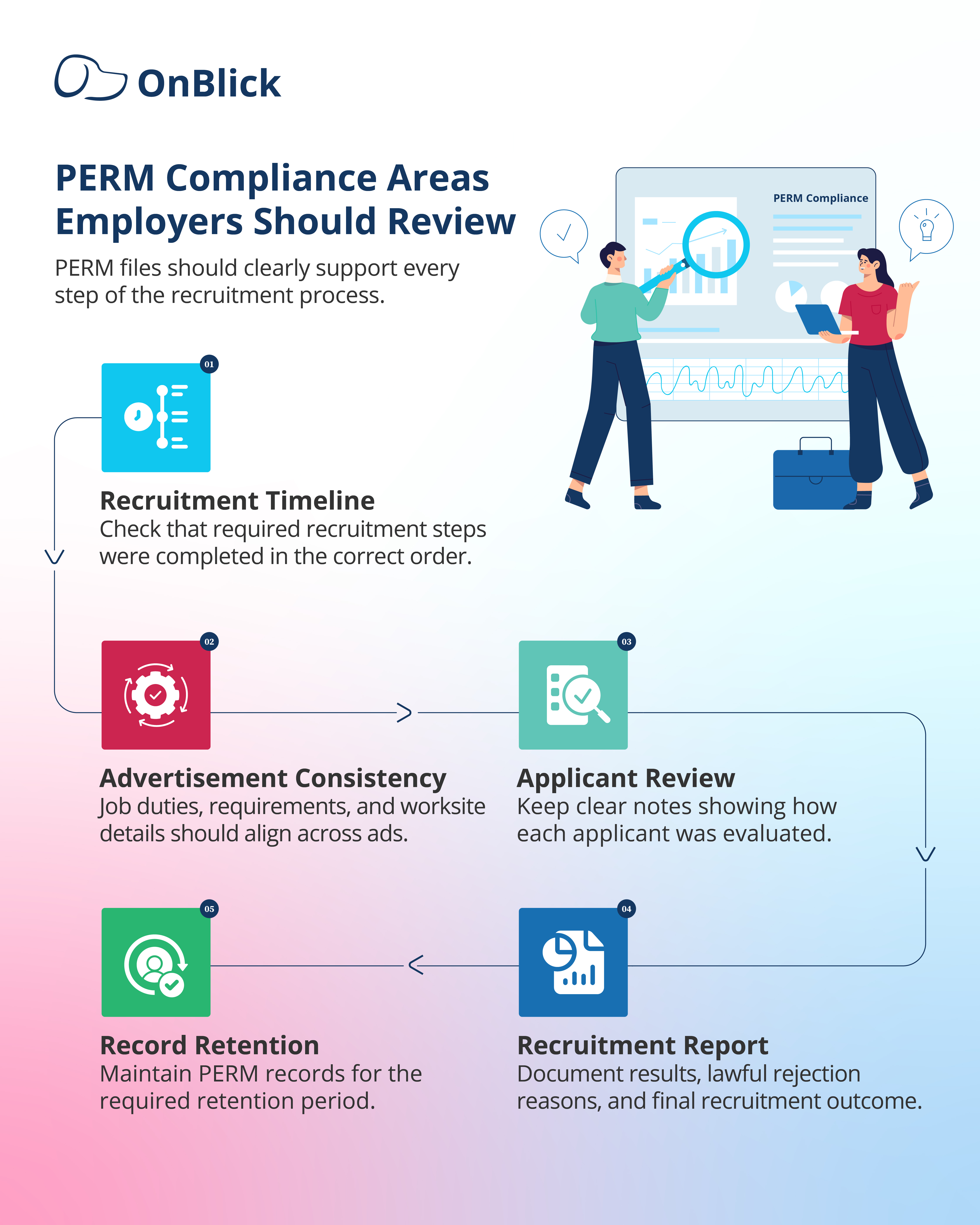
- Recruitment timeline
Employers should review whether the required recruitment steps were completed in the proper sequence and within the correct timeframes. Any missing or poorly documented step can make the PERM file harder to defend.
- Advertisement consistency
Job titles, duties, requirements, work locations, and employer information should remain consistent across advertisements, recruitment materials, internal documents, and the PERM filing.
- Applicant review documentation
Employers should maintain clear notes showing how applicants were evaluated. Rejection reasons should be lawful, job-related, and supported by the minimum requirements listed for the position.
- Recruitment report
The recruitment report should summarize the recruitment steps, results, number of applicants, and lawful reasons for rejection. It should be detailed enough to explain how the employer reached its conclusion.
- Prevailing wage and job requirements
Employers should confirm that the job description, minimum requirements, and prevailing wage determination align with the role being sponsored. Requirements should be accurate and defensible.
- Business necessity support
If the role includes requirements that may need additional justification, employers should keep documentation showing why those requirements are necessary for the position.
- Record retention
PERM records should remain organized and accessible after filing. Employers should be prepared to produce recruitment and supporting documents if selected for a PERM audit or asked to respond to a labor department inquiry.
For PERM employers, the goal is not only to complete recruitment steps. The goal is to maintain a clear, consistent file that shows how the recruitment process was conducted and why the employer moved forward with the sponsored candidate.
DOL Audit Checklist for H-1B and PERM Employers
A DOL audit or inquiry can move quickly, so employers should not wait until records are requested to start organizing them. A practical checklist can help HR, payroll, legal, immigration, and staffing teams identify gaps before they become harder to explain.
- LCA and Public Access File records
Review certified LCAs, wage rate details, prevailing wage documentation, actual wage explanation, benefits summary, and Public Access File completeness.
- Payroll and wage documentation
Confirm that payroll records support the required wage obligations listed in the LCA. Wage payments, pay frequency, deductions, and nonproductive time records should be clear and consistent.
- Notice of Posting proof
Maintain evidence that the required notice was provided at the correct worksite or through the correct electronic method. Keep details such as posting dates, location, method, and content.
- Worksite and location records
Check whether employee worksites, remote work locations, client sites, and third-party placements align with the LCA and related immigration records.
- Employee communication records
Keep proof that the certified LCA was provided to the H-1B worker. Employers should also maintain relevant communications about role, worksite, wage, and employment changes.
- PERM recruitment files
Review job advertisements, recruitment dates, resumes received, applicant review notes, interview records, rejection reasons, and the final recruitment report.
- Internal approval and tracking records
Maintain documentation showing who reviewed filings, approved job details, monitored deadlines, and handled compliance-related updates.
- Inquiry response protocol
Define who will receive, review, and respond to any DOL inquiry. HR, payroll, immigration, legal, and management teams should understand their roles before a request arrives.
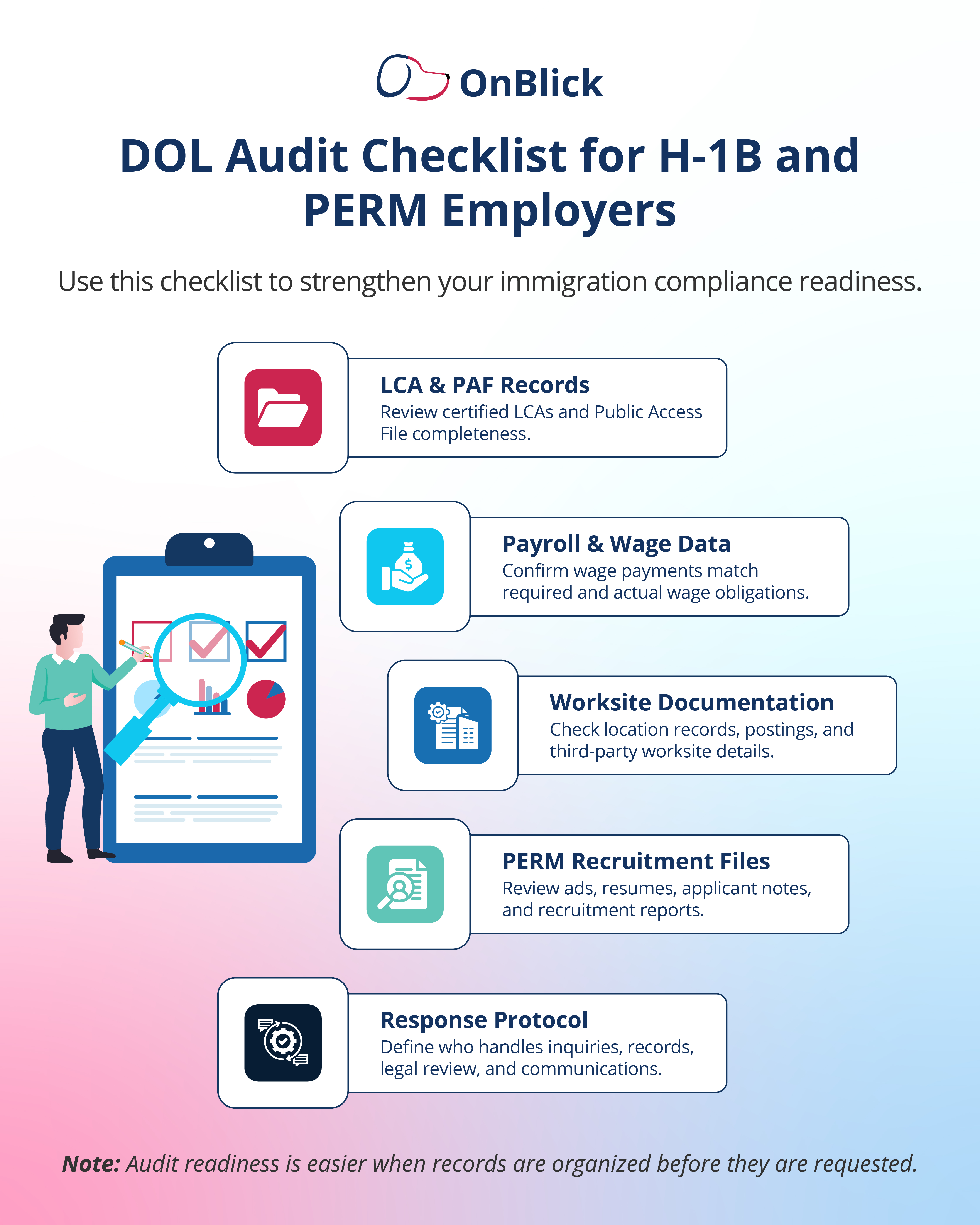
A DOL audit checklist is not just about storing documents. It is about making sure the records are complete, consistent, and easy to retrieve when the employer needs to explain its compliance practices.
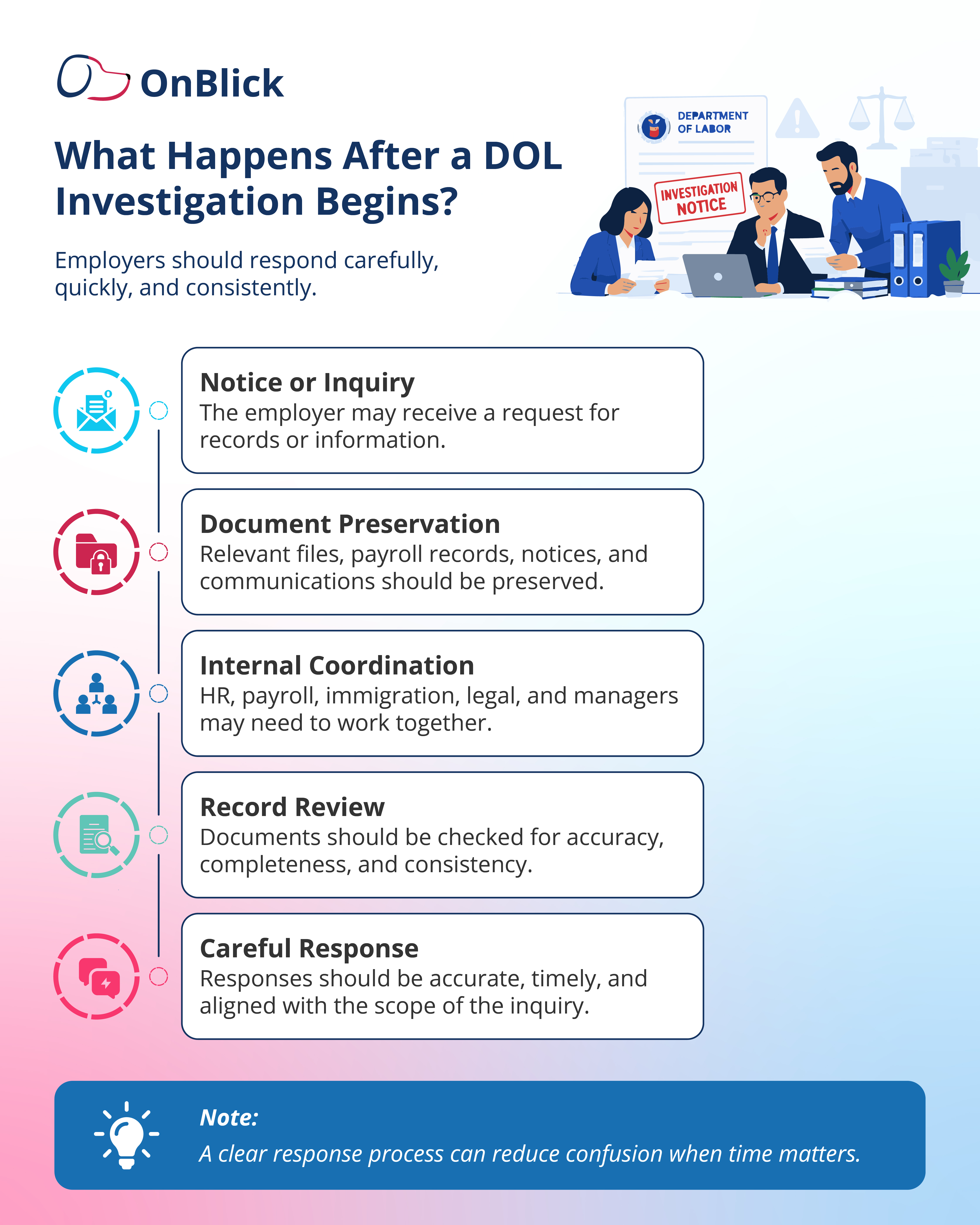
What Happens After a DOL Investigation Begins?
When a DOL investigation or inquiry begins, employers may receive a notice, request for records, or communication asking for specific information. The scope can vary depending on the issue being reviewed, the program involved, and the records the agency wants to examine.
The first step is to route the inquiry to the right internal team. HR, immigration, payroll, legal, compliance, and relevant managers may all need to coordinate. Employers should avoid informal or inconsistent responses and make sure all communication is reviewed carefully.
- Preserve relevant records
Employers should preserve H-1B, PERM, payroll, recruitment, employee communication, and worksite records. Documents should not be changed or recreated after an inquiry begins.
- Identify the scope of the request
The employer should understand what the DOL is asking for, which workers or filings are involved, and what time period is under review.
- Review records for consistency
Before responding, employers should check whether filings, payroll data, worksites, job duties, notices, and recruitment records align.
- Coordinate internally
Payroll may need to confirm wage records, HR may need employee files, immigration teams may need LCAs or PERM records, and legal counsel may need to review the response strategy.
- Respond accurately and on time
Responses should be complete, truthful, and consistent with the records. If something is unclear, employers should work with qualified counsel before submitting information.
A DOL investigation does not automatically mean a violation has occurred. However, how an employer responds can matter. A clear response process helps reduce confusion and supports a more organized review.
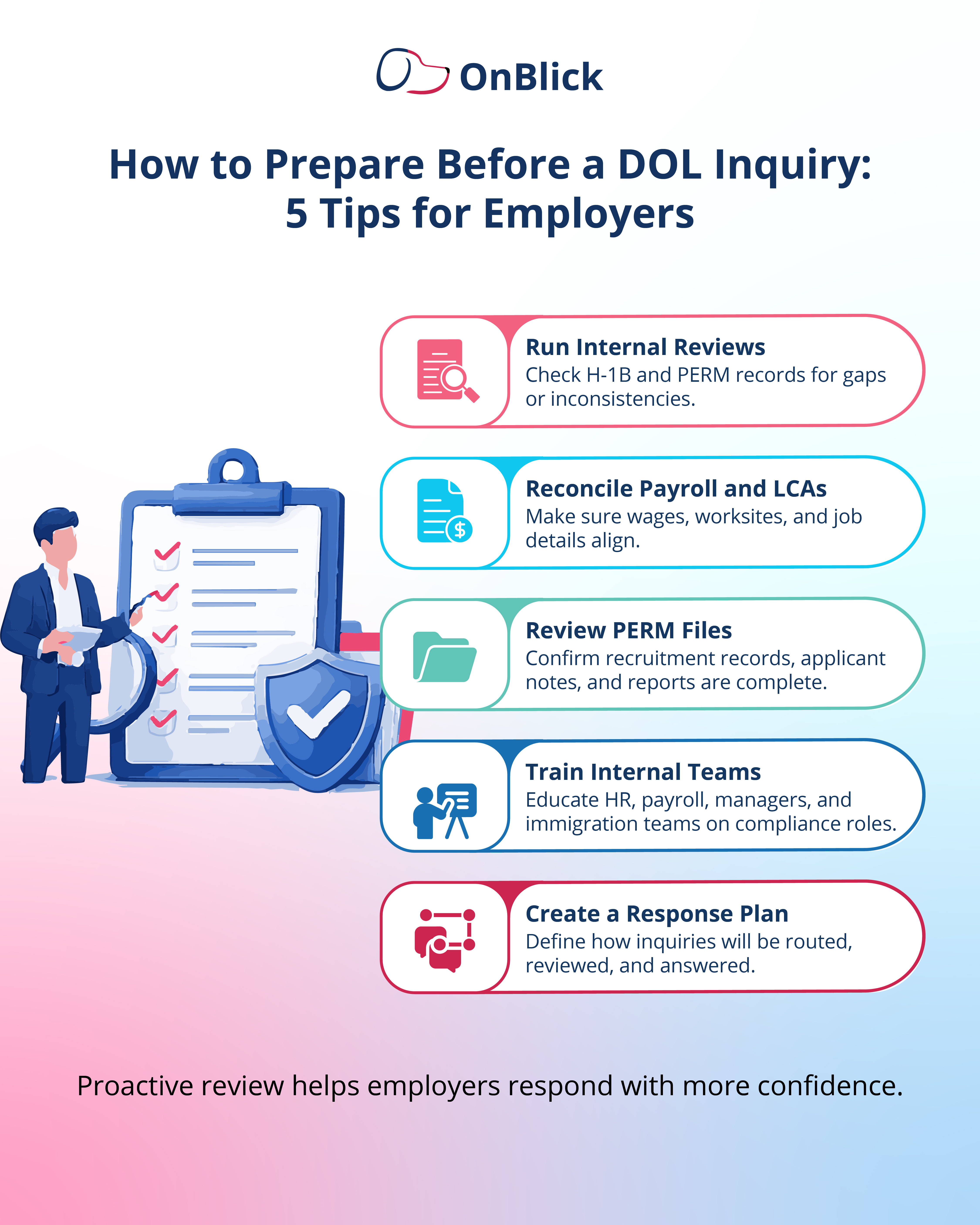
How Employers Can Prepare Before a DOL Inquiry
Employers should not wait for a DOL inquiry to begin before reviewing their H-1B and PERM records. Preparation is most effective when compliance checks are done regularly and before records are requested.
- Conduct an internal compliance review
Review active H-1B files, PERM cases, payroll records, worksite documentation, and Public Access Files to identify gaps or inconsistencies.
- Reconcile LCAs with payroll and worksites
Check whether the wage paid, work location, job role, and employment conditions match the certified LCA and internal records.
- Review Public Access Files
Make sure required LCA-related documents are complete, organized, and available within the required timeframe.
- Check PERM recruitment files
Review recruitment timelines, advertisements, resumes, applicant review notes, rejection reasons, and recruitment reports.
- Train internal teams
HR, payroll, immigration, managers, and staffing teams should understand their role in maintaining compliance records and reporting changes.
- Create a response protocol
Define who receives government notices, who gathers records, who communicates with counsel, and who approves responses.
- Monitor changes continuously
Worksite changes, role changes, wage updates, remote work arrangements, and employee status changes should be reviewed as they happen.
Preparation helps employers respond with more confidence if a DOL audit, inquiry, or investigation occurs. It also helps teams catch compliance gaps before they become larger risks.
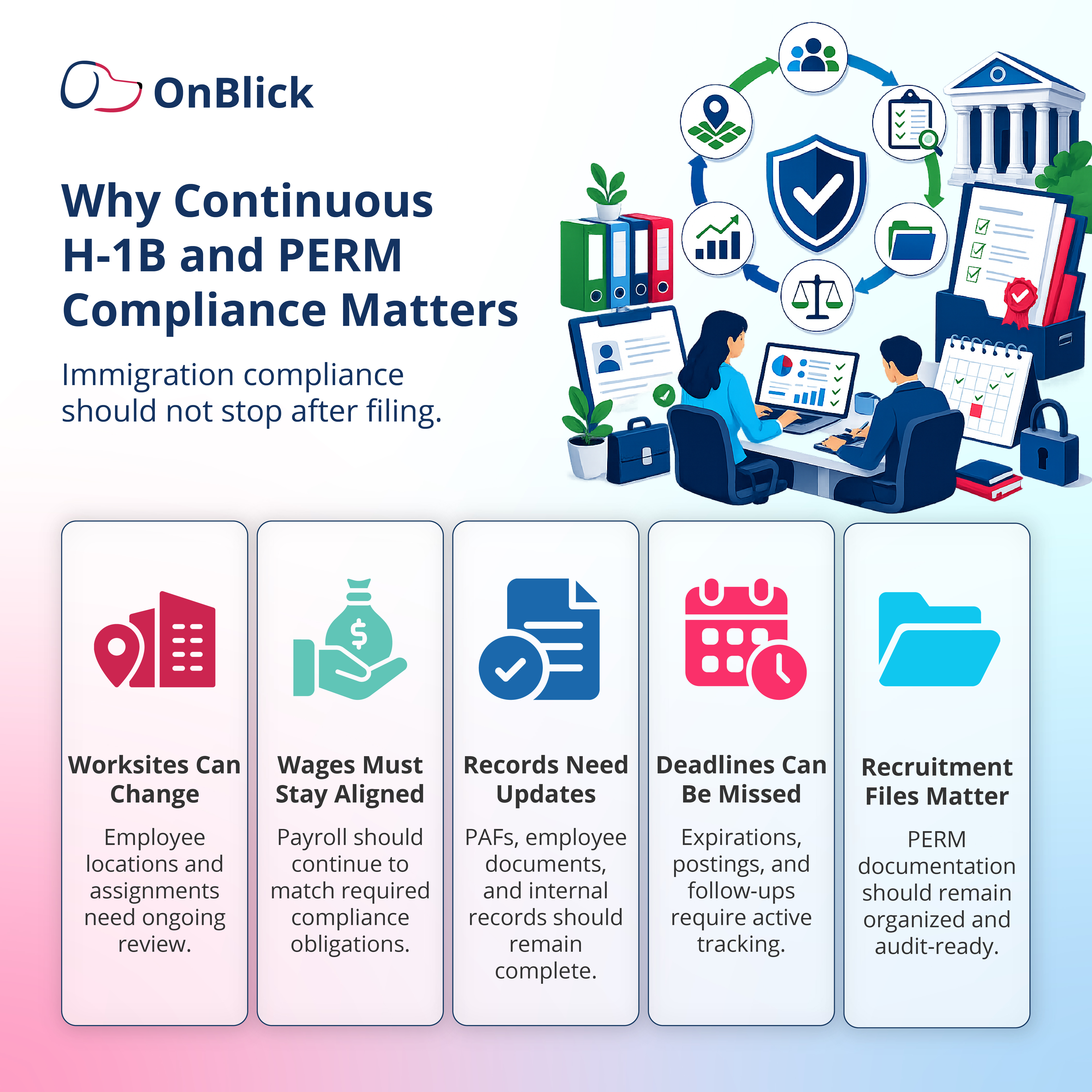
Why Continuous H-1B and PERM Compliance Matters
- H-1B and PERM compliance should not be treated as a one-time filing task. Many compliance issues arise after a petition or application is filed, especially when there are changes in job duties, wages, worksites, reporting structures, employee status, or recruitment documentation.
- For H-1B employers, ongoing compliance is important because the certified LCA must continue to align with the employee’s actual work conditions. If an employee moves to a new location, works at a third-party site, changes role responsibilities, or experiences a payroll change, the employer should review whether the existing records still support the placement.
- PERM compliance also depends on strong recordkeeping. Employers should maintain recruitment documentation, applicant review notes, job advertisements, prevailing wage records, and the recruitment report in an organized way. If a PERM audit occurs, the employer should be able to explain how the recruitment process was conducted and why the sponsored candidate was selected.
- Continuous compliance also helps teams identify gaps earlier. Instead of discovering missing documents during a DOL audit or inquiry, employers can regularly review files, reconcile records, and correct internal process issues before they become larger risks.
- For HR, payroll, immigration, legal, and staffing teams, the goal should be to maintain a system where records are current, responsibilities are clear, and changes are reviewed on time. This makes audit readiness part of daily operations rather than a rushed response during an investigation.
How OnBlick Supports H-1B and PERM Compliance Readiness
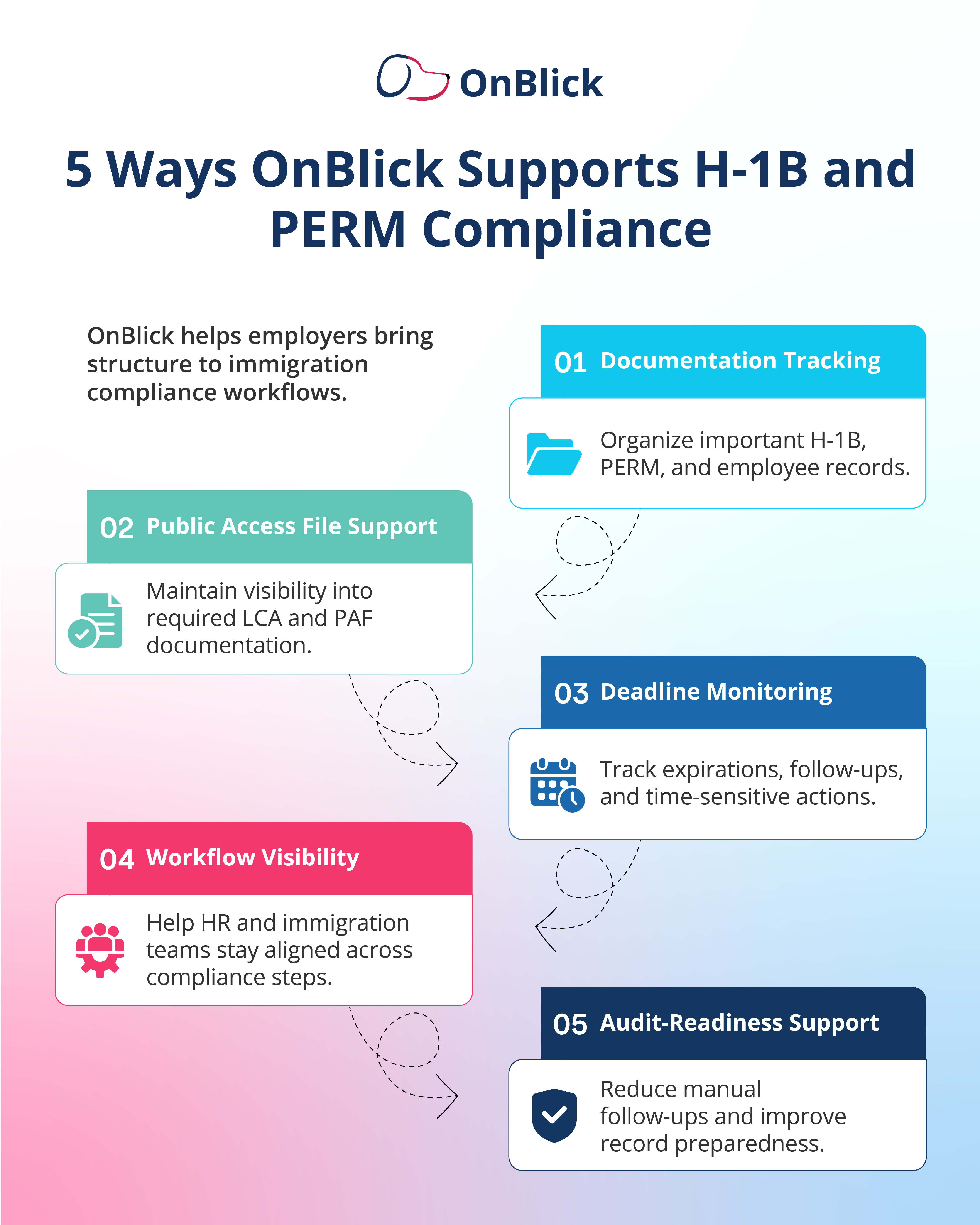
OnBlick helps employers bring more structure, visibility, and control to immigration compliance workflows. For organizations managing H-1B employees, PERM cases, staffing arrangements, and compliance-heavy HR processes, this can reduce the risk of scattered records and missed follow-ups.
With OnBlick, employers can manage important documentation, track deadlines, organize employee records, and support compliance workflows across HR and immigration teams. This helps teams stay aligned when they need to review LCAs, Public Access Files, worksite details, employee records, and related compliance actions.
OnBlick also supports audit-readiness by helping employers maintain better visibility into pending tasks, missing documents, expirations, and follow-up actions. Instead of relying only on spreadsheets, email trails, or manual reminders, teams can use structured workflows to keep compliance processes moving.
For employers preparing for greater DOL scrutiny, the key is not only having documents stored somewhere. It is having the right records organized, accessible, and connected to the workflow they support.
Book a free OnBlick demo to learn how your team can strengthen H-1B and PERM compliance with more organized workflows, documentation, and follow-through.
Frequently Asked Questions About the 2026 DOL H-1B and PERM Investigation
- Does the 2026 DOL investigation affect all H-1B employers?
The investigation does not mean every H-1B employer is under review. However, it signals stronger attention on H-1B and PERM program integrity. Employers that sponsor foreign workers should use this moment to review wage records, LCAs, worksites, Public Access Files, and internal compliance processes.
- Should employers review old H-1B and PERM files?
Yes. Employers should review both active and recent historical files, especially if they may still be within record retention periods. Older files can reveal missing documentation, inconsistent wage records, incomplete postings, or recruitment gaps that should be addressed before an inquiry occurs.
- What H-1B wage records should employers keep ready?
Employers should keep payroll records, wage rate details, actual wage explanations, prevailing wage documentation, offer letters, and records showing how wages were determined and paid. These records should support the wage obligations listed in the certified LCA.
- How can employers check if their Public Access Files are complete?
Employers should confirm that each Public Access File includes the required LCA-related documents, wage information, actual wage explanation, benefits summary, posting details, and other required supporting records. The file should be organized and available within the required timeframe.
- What PERM recruitment records are most important during an audit?
Important PERM records include job advertisements, recruitment dates, resumes received, applicant review notes, interview records, rejection reasons, prevailing wage records, job descriptions, and the final recruitment report. These records should clearly show how recruitment was conducted.
- Can third-party worksites increase H-1B compliance risk?
Third-party worksites can create additional compliance challenges because employers must track where the H-1B worker is actually working and whether the LCA covers that location. Posting records, client-site details, role information, and payroll records should remain consistent.
- How often should employers conduct H-1B and PERM compliance reviews?
Employers should conduct periodic reviews instead of waiting for an audit. Many companies review files quarterly, semiannually, or whenever there is a major change in worksite, role, wage, employee status, or recruitment activity.
- Who should be involved in immigration compliance reviews?
H-1B and PERM compliance reviews should involve HR, immigration, payroll, legal, compliance, and relevant managers. Each team holds different records, so coordination is important for maintaining accurate and consistent documentation.
- What is the role of payroll in H-1B compliance?
Payroll plays a key role because wage records must support the employer’s LCA obligations. Payroll teams should understand required wage rules, pay frequency, deductions, nonproductive time concerns, and how wage changes should be communicated internally.
- How can technology help with H-1B and PERM audit readiness?
Technology can help employers organize documents, track deadlines, monitor missing records, maintain workflow visibility, and reduce manual follow-ups. For H-1B and PERM programs, structured systems can make it easier to keep compliance records accessible and audit-ready.
Conclusion
The 2026 DOL H-1B and PERM investigation is a reminder that immigration compliance cannot be managed only at the time of filing. Employers should be ready to show that their records, wage practices, recruitment steps, and employee treatment align with program requirements.
For H-1B employers, this means reviewing LCAs, Public Access Files, wage records, worksites, Notice of Posting proof, and payroll consistency. For PERM employers, it means maintaining clear recruitment documentation, applicant review notes, job requirement support, and audit-ready files.
Not every employer will face a DOL investigation or audit, but every employer can benefit from stronger internal controls. By reviewing records early, training the right teams, and maintaining continuous compliance workflows, organizations can respond with more confidence if questions arise.
A proactive approach helps employers reduce risk, improve documentation readiness, and keep H-1B and PERM compliance aligned with day-to-day HR and immigration operations.