
.gif)

.jpg)

Think about the last performance expectation that caught someone off guard. The manager frustrated. The employee blindsided. HR in the middle of a conversation that should never have happened.
In most cases, the breakdown didn't start at the review. It started months earlier, when expectations were assumed instead of stated. When "you'll figure it out" replaced a real conversation about what good actually looks like.
That gap, between what managers expect and what employees understand, is where performance quietly falls apart. Clear performance expectations fix this. They are the foundation of every productive team, every fair review, and every employee who actually grows in their role.
This article breaks down why expectations fail, what they should include, and how to make them work across your organization.
What Are Performance Expectations?
Performance expectations are the agreed-upon standards that define what success looks like in a role. They go beyond a job description to cover:
- Output quality and quantity
- How work should be approached (behaviors, not just results)
- Timelines and priorities
- How progress will be measured and discussed
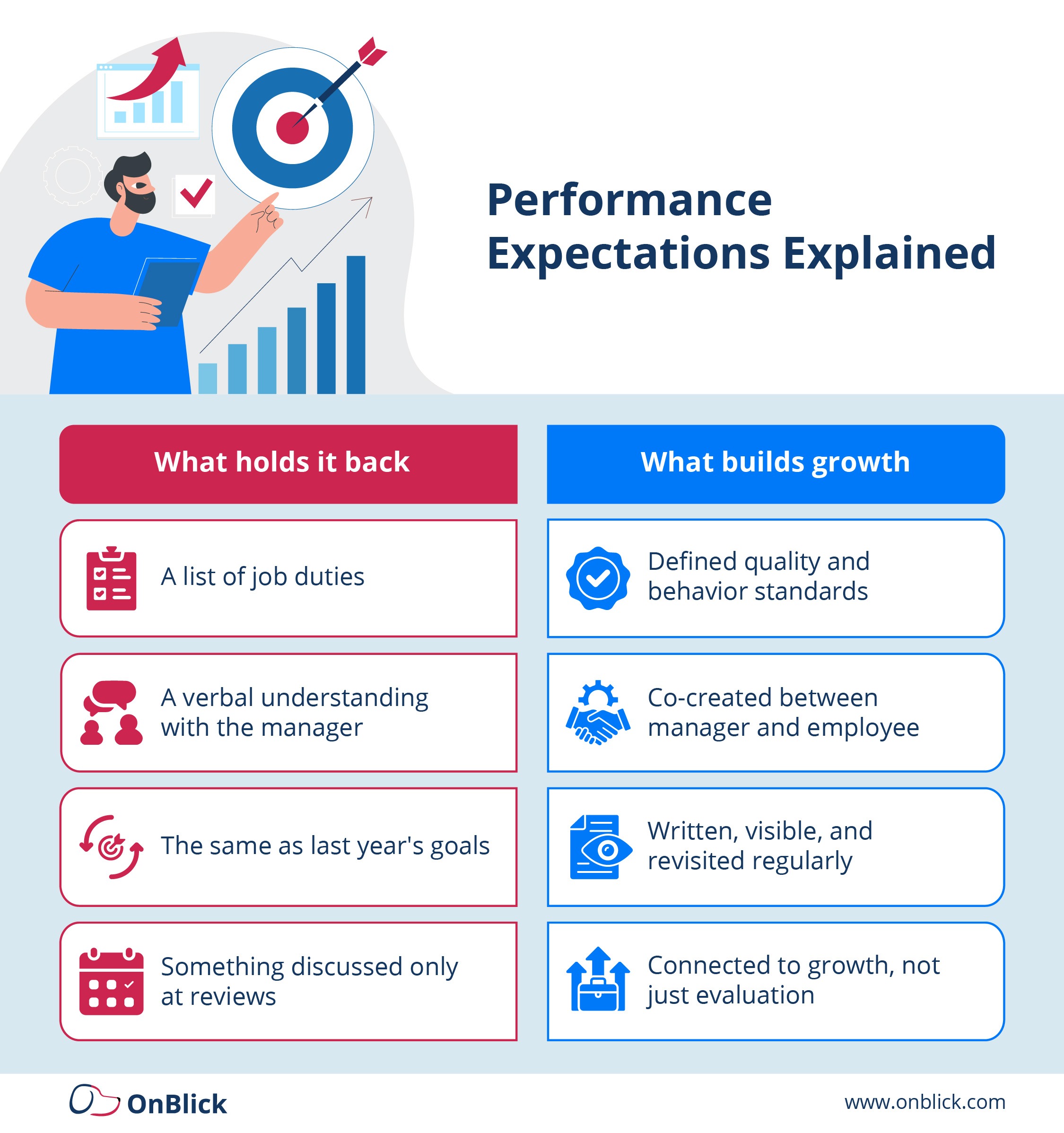
The important distinction: expectations are not the same as goals. Goals shift. Expectations set the baseline for how someone shows up every day.
Why Performance Expectations Matters for Managers and HR
Managers are often asked to evaluate performance without ever clearly defining it. HR is left mediating disputes that could have been avoided with one honest conversation at the start.
When expectations are clear, teams see:
- Fewer performance surprises at review time
- Less conflict between managers and direct reports
- Faster onboarding into full productivity
- More meaningful development conversations
When expectations are unclear, the patterns are predictable:
Employees optimize for visibility instead of impact. Managers give vague feedback because the standard was never written down. High performers disengage when effort goes unrecognized. Underperformers stay too long because no one documented the gap.
The Numbers Behind the Problem
The research here is consistent and worth knowing:
- Employees who strongly agree that they know what is expected of them at work are significantly more engaged and productive (Gallup).
- Only 50% of employees say they clearly understand what is expected of them (Harvard Business Review).
- Gallup also reports that manager-employee conversations about expectations are one of the single strongest predictors of engagement.
What these numbers tell us: most organizations assume expectations are understood. Most of the time, they are not.
The Psychology of Clarity: Why Ambiguity Costs More Than You Think
Unclear expectations create a hidden tax on performance. Employees spend energy managing uncertainty instead of doing their best work:
Am I on track? Is this the right priority? Will this be used against me in my review? What does my manager actually value?
When employees have to guess the answer to these questions daily, performance suffers, confidence erodes, and trust breaks down quietly over time.
What clear expectations actually provide:
A shared language for feedback. A way for employees to self-assess before being assessed. The psychological safety to ask for help without fear. A foundation for growth conversations that feel fair, not punitive.
Performance Expectations: Spotting the Signs
If performance expectations are not working, the signals appear before any formal review.
Operational warning signs:
- Managers give different answers to the same employee question
- Review cycles produce surprises on both sides
- High performers leave citing "unclear growth paths"
- Improvement plans feel punitive rather than supportive
Employee experience warning signs:
- Employees do not know how their work connects to team goals
- They cannot articulate what success looks like in their role
- Feedback feels inconsistent or tied to personal preference
- Recognition feels arbitrary
Compliance and documentation risk:
Poorly documented expectations also create legal exposure:
- Without written standards, terminations become harder to defend
- Inconsistent expectations across demographic groups create discrimination risk
- Undocumented performance conversations leave HR with no paper trail
When expectations are written, shared, and consistently applied, both the employee and the organization are protected.

A Practical Framework: 6 Elements of a Strong Performance Expectation
Based on what works across teams and industries, a well-constructed expectation includes six components.
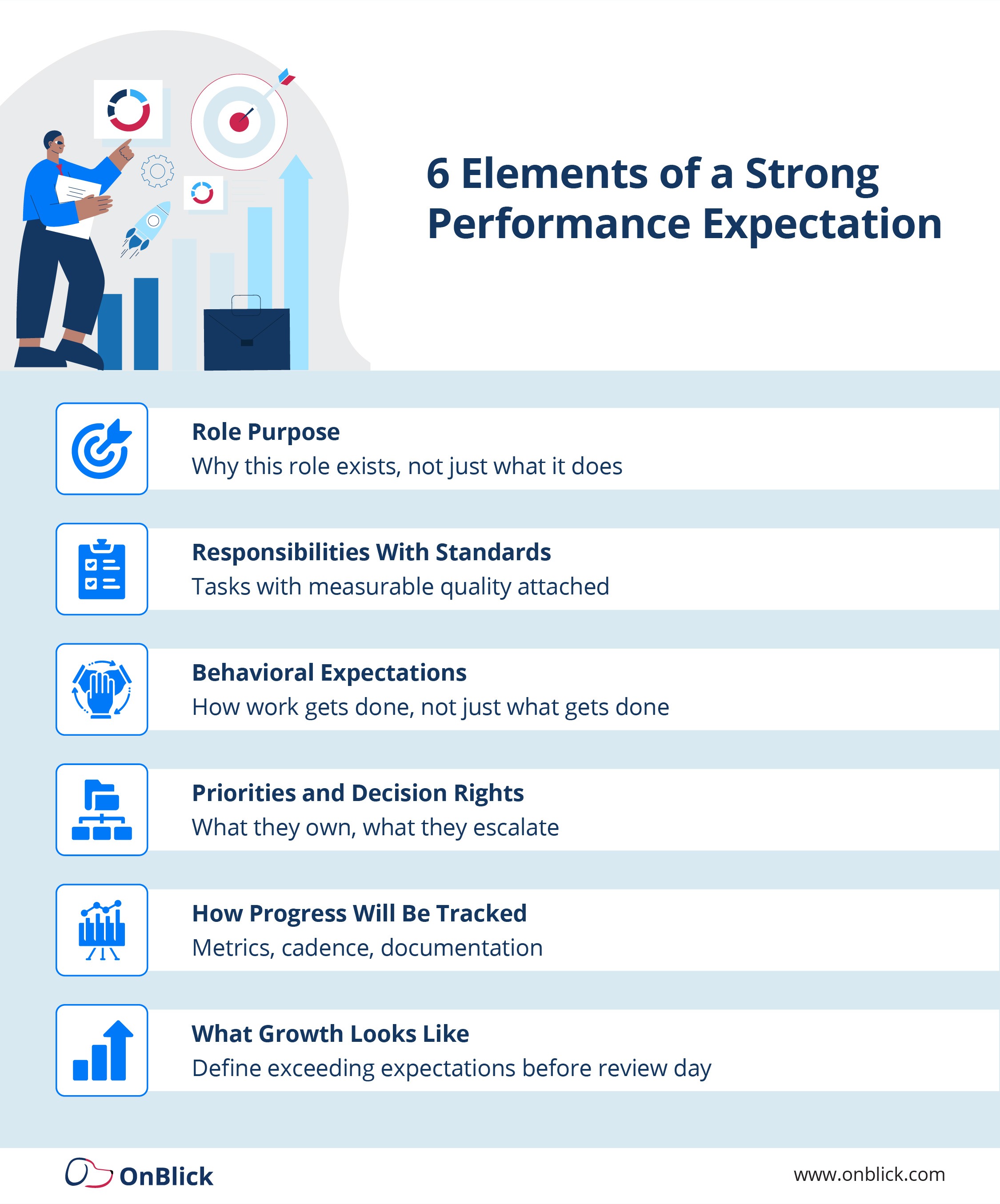
Element 1: Role purpose
What does this role exist to do? Not the task list. The reason the role matters to the team.
Element 2: Core responsibilities with standards attached
Not just "manages customer inquiries" but "resolves tier-one customer inquiries within 24 hours with a satisfaction target of 90% or above."
Element 3: Behavioral expectations
How work gets done matters as much as output. Communication style, collaboration, reliability, and initiative are all fair to name explicitly.
Element 4: Priorities and decision rights
What does this person own? What requires escalation? Unclear boundaries here cause the most day-to-day friction.
Element 5: How progress will be tracked
Metrics, check-in cadence, and what documentation will be kept. Monthly one-on-ones with written notes are a minimum.
Element 6: What growth looks like
What would "exceeding expectations" mean here? Naming it in advance removes the appearance of favoritism later.
Making Expectations Fair, Consistent, and Growth-Focused
The biggest mistake organizations make is treating performance expectations as a compliance document rather than a development tool.
To make expectations fair:
Apply the same framework across roles at the same level. Let employees co-create them where possible. Review them when responsibilities change, not only at annual review time.
To make them consistent:
Train managers on how to write and communicate expectations before the process begins. Audit across teams regularly to catch unintentional gaps. Use templates HR provides, with space for managers to add role-specific context.
To make them growth-focused:
Separate "meeting expectations" from "growing into the next level." Name both clearly. Give employees a ladder, not just a floor.
Executive View: Expectations as Organizational Infrastructure
Leaders talk about culture, retention, and performance. Performance expectations are one of the most practical systems that supports all three.
The leadership case for standardizing expectations:
- Reduces manager-to-manager inconsistency in how performance is evaluated
- Protects against legal risk when employment decisions are challenged
- Speeds up time-to-full-productivity for new and transitioning employees
- Creates a fairer basis for promotion and compensation decisions
What can be standardized without losing flexibility:
Expectation templates by role type and level. A shared definition of what "meets," "exceeds," and "does not meet" means organizationally. A consistent check-in schedule that managers own but HR tracks. Onboarding expectations for the first 30, 60, and 90 days.
Where OnBlick fits
OnBlick supports performance documentation workflows by enabling employers to store role documentation, track employee records, and maintain audit-ready files across teams and locations.
Final Takeaway
A performance expectation is not a threat. It is a promise: here is what we need, here is how we will measure it, and here is how we will support you in getting there.
When employees know what is expected, they can actually meet it. When managers document expectations clearly, feedback becomes a conversation instead of a verdict. And when organizations build consistency into how expectations are set, performance reviews stop feeling like surprises and start feeling like progress.
If your team is still working from unwritten assumptions, your next best move is simple: write them down.


.png)
.jpeg)


