.gif)


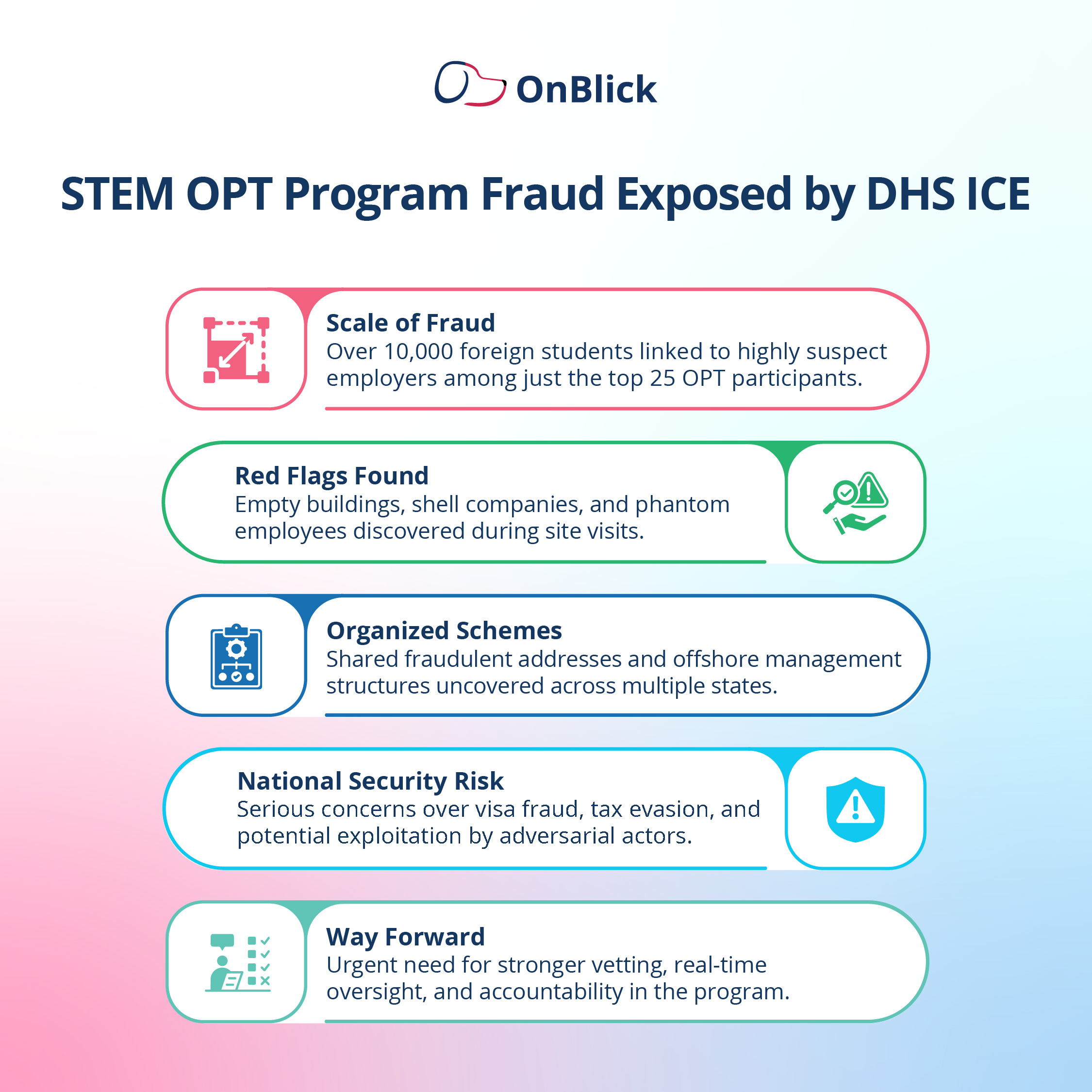
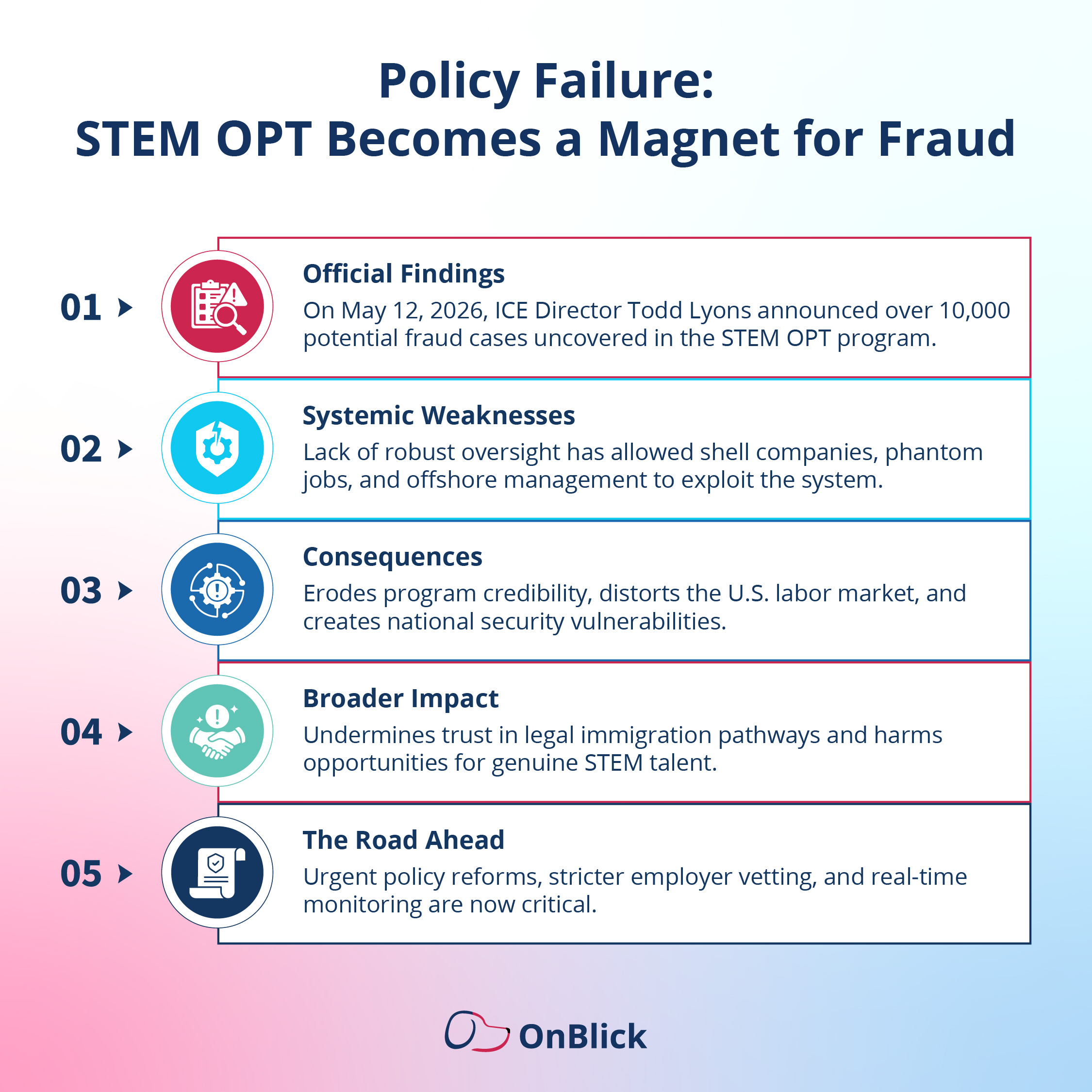
Optional Practical Training, commonly known as OPT, is facing heightened federal scrutiny after U.S. Immigration and Customs Enforcement raised concerns about fraud involving foreign students, suspect employers, false worksites, shell companies, and incomplete employment records. On May 12, 2026, ICE officials stated that more than 10,000 foreign students were identified as claiming employment with “highly suspect employers,” based on a review of the top 25 OPT employers.
The issue has important implications for employers that hire F-1 students under OPT and STEM OPT. While the announcement focused on OPT broadly, STEM OPT carries added employer responsibilities, including a formal training plan, supervision, reporting, and documentation obligations.
This article discusses what ICE flagged in the recent OPT fraud review, why the update matters for STEM OPT employers, what compliance gaps businesses should review, and how employers can strengthen documentation before an agency inquiry, ICE/HSI worksite visit, or SEVP site visit.
OPT and STEM OPT: Why the Program is Under Scrutiny
OPT allows eligible F-1 students to receive temporary work authorization related to their field of study. USCIS states that eligible students may apply for up to 12 months of OPT employment authorization before or after completing their academic studies. Students with qualifying STEM degrees may also apply for a 24-month STEM OPT extension if they meet the program requirements.
ICE’s recent comments indicate that federal agencies are now looking closely at whether OPT employment is real, whether listed employers are legitimate, whether worksites exist, and whether students are actually receiving practical training.
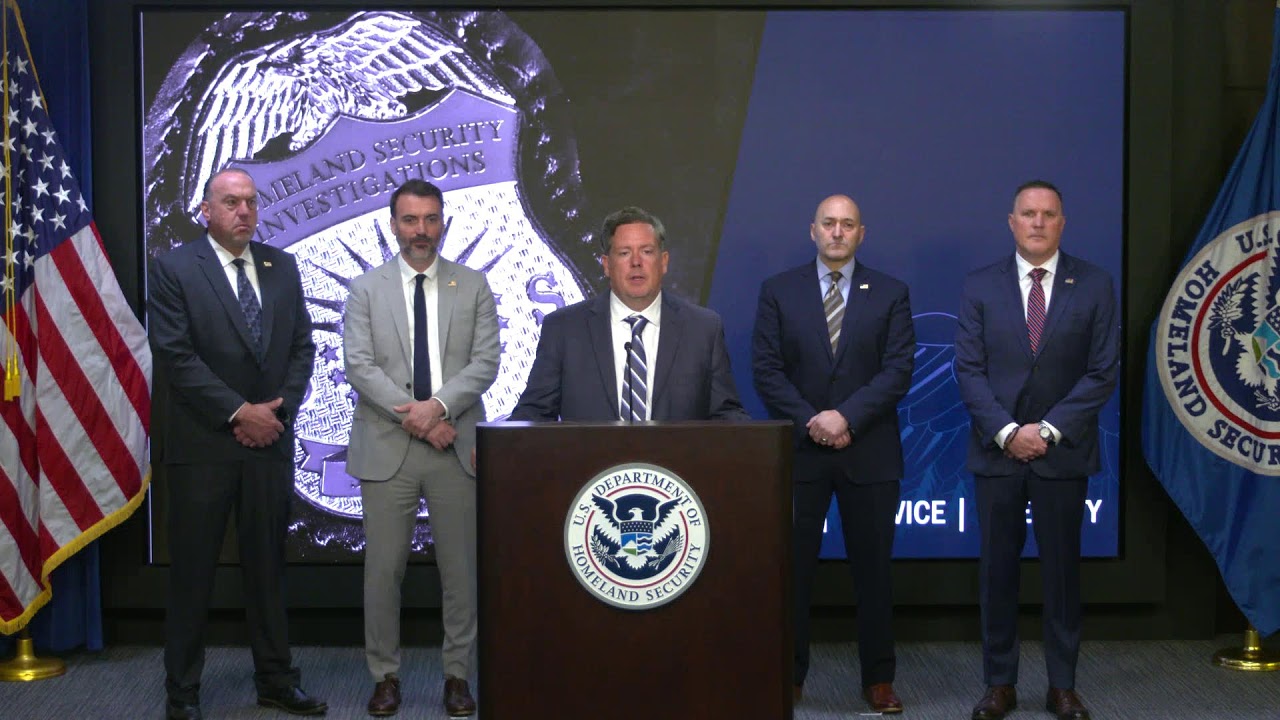
ICE Director Todd Lyons described the concern in direct terms, stating, “Today, our focus is on the optional practical training program, which has become a magnet for fraud”.
For employers, this means OPT and STEM OPT records may receive greater attention, especially where there are inconsistencies in worksite addresses, employer information, payroll records, supervision, or training documentation.
What ICE Flagged in the Recent OPT Fraud Review
ICE officials described several fraud indicators identified through investigations and site visits. These included empty buildings, locked doors, residential addresses listed as worksites for large numbers of students, multiple employers operating from the same address without evidence of leasing the facility, and employers that could not explain basic details about the students allegedly working for them.
The agency also raised concerns about financial and operational red flags. These included tax liens, civil lawsuits, collections, breach of contract issues, suspicious international financial transactions, and businesses that allegedly failed to maintain basic employment records for foreign students.
One of the most serious points involved “phantom employees”. ICE officials said they had identified foreign students who obtained work authorization through OPT but never appeared at the worksites they claimed.
Lyons also emphasized the broader enforcement concern, stating, “This is not accidental. It is deliberate, coordinated, and criminal”.
Site Visits Revealed Employer Clusters and Shell Company Concerns
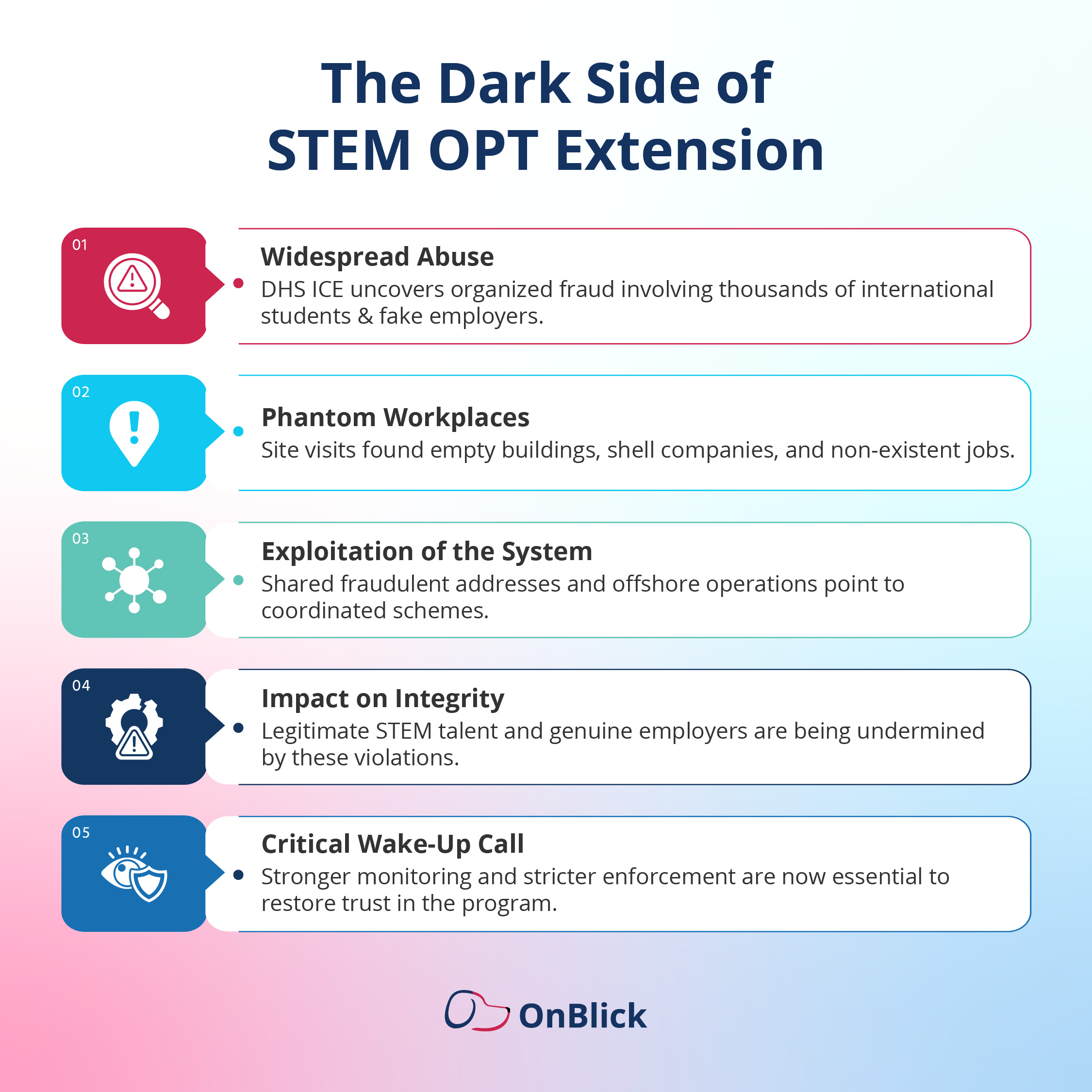
HSI officials also discussed site visits conducted at 18 OPT worksites in North Texas. The findings included coordinated employer clusters, nearly identical websites, shared job postings, shared management personnel, and employers claiming no relationship with one another despite overlapping business patterns.
The agency also described shell company schemes where multiple OPT employers appeared to be established by the same owner or operator. In one example, an employer reportedly claimed to have only three OPT employees, while government records showed more than 500 foreign students claiming to work there.
For legitimate employers, this is a reminder that agencies may look beyond forms and approvals. They may examine whether the business is operating as represented, whether the employee count makes sense, whether management and training are real, and whether records can support the employment relationship.
Why STEM OPT Employers Face Added Compliance Responsibility
Although the recent announcement focused on OPT broadly, STEM OPT employers face additional obligations. The STEM OPT extension is not just a work authorization benefit. It is tied to a structured training relationship between the student and employer.
DHS guidance states that STEM OPT students and employers must work together to complete Form I-983, Training Plan for STEM OPT Students. The form must explain the training opportunity, the student’s role, the employer’s supervision plan, and how the position relates to the student’s STEM degree.
USCIS also states that employers must attest through Form I-983 to establish that there is a bona fide employer-employee relationship. The employer signing Form I-983 must be the same entity that employs the student and provides practical training experience. Employers and students are also required to report material changes to the Designated School Official.
This is why STEM OPT employers should treat the recent ICE update as a compliance reminder. The question is not only whether the employee has an Employment Authorization Document. The employer must also be able to show that the training plan is accurate, the role is real, supervision is active, and records are complete.
For a detailed step-by-step reference, employers can review our guide to complete Form I-983 for STEM OPT students.
Form I-983 and Training Plan Accuracy
Form I-983 is central to STEM OPT compliance. It documents the training arrangement and requires employer involvement. Any mismatch between the form and the actual employment arrangement can create risk.
Employers should review whether each Form I-983 includes accurate information on:
- Employer name and address
- Worksite location
- Student role and responsibilities
- Training goals and objectives
- Supervisor details
- Compensation information
- Evaluation process
- Reporting obligations
- Material changes or deviations
If job duties, work locations, supervisors, compensation, or training structure have changed, the employer and student may need to update the training plan and report changes through the proper process. DHS guidance states that both STEM OPT students and employers are obligated to report material changes or deviations from the formal training plan to the DSO.
Employers should also remember that Form I-983 is not only a filing document. It is the document SEVP officers may use to verify whether the student’s actual job duties, training, supervision, and worksite match the approved STEM OPT training plan.
For more on compliance gaps and risk areas, employers can refer to OnBlick’s article - STEM OPT and Form I-983 Rules: Risks of Non-Compliance
Worksite Accuracy is a Major Risk Area
One of the strongest themes in ICE’s comments was worksite accuracy. Officials described empty offices, locked buildings, residential addresses, PO boxes, and locations where no employees were present despite large numbers of students being listed as working there.
Employers should verify whether the address listed in records reflects the actual work arrangement. This is especially important when employees are remote, hybrid, assigned to a client location, or working through a consulting model.
If the student’s actual worksite does not match the information in the training plan or related records, the employer should review whether an update is required. In the current enforcement environment, inaccurate worksite information may raise concerns even when the employment relationship itself is legitimate.
Supervision and Offshore Management Concerns
ICE officials also raised concerns about employers claiming that HR, payroll, or management functions were handled overseas. In one example, officials said company representatives could not answer basic questions about the business and deferred to HR managers in India.
This point is especially important for STEM OPT employers because the program requires a real training relationship. The employer should be able to identify who supervises the student, how training is provided, how progress is evaluated, and how the student’s work relates to the qualifying STEM degree.
Where supervision is unclear, fragmented, or handled outside the documented employer structure, the company may face questions about whether it is meeting STEM OPT requirements.
Third-Party Placement and Unreported Employer Risks
ICE officials also described networks of alleged employers claiming to train thousands of OPT students and then placing them with unreported third-party employers. The agency said such arrangements make oversight difficult and may raise national security concerns.
This does not mean every third-party or client-site arrangement is automatically improper. However, employers using staffing, consulting, vendor, or client-site models should ensure the training relationship is clearly documented.
Employers should be able to answer:
- Who is the actual employer?
- Who provides day-to-day supervision?
- Where does the student perform work?
- Who controls the training plan?
- Are job duties consistent with Form I-983?
- Are changes reported when required?
- Are payroll and employment records complete?
If the company cannot answer these questions clearly, it may need to review the arrangement before an external inquiry arises.
Employment Records Must Support the Reported Relationship
ICE officials stated that some businesses failed to maintain basic employment records for foreign students. This is a serious warning for employers.
STEM OPT records should not exist only as isolated forms. They should connect with broader employee records, including offer letters, payroll records, job descriptions, onboarding documents, Form I-9 records, E-Verify records where applicable, supervisor information, training evaluations, and worksite details.
Employers should also make sure records are easy to retrieve. During a site visit, audit, or agency inquiry, delays and gaps can create unnecessary risk even when the underlying employment is legitimate.
SEVP Site Visits and STEM OPT Readiness
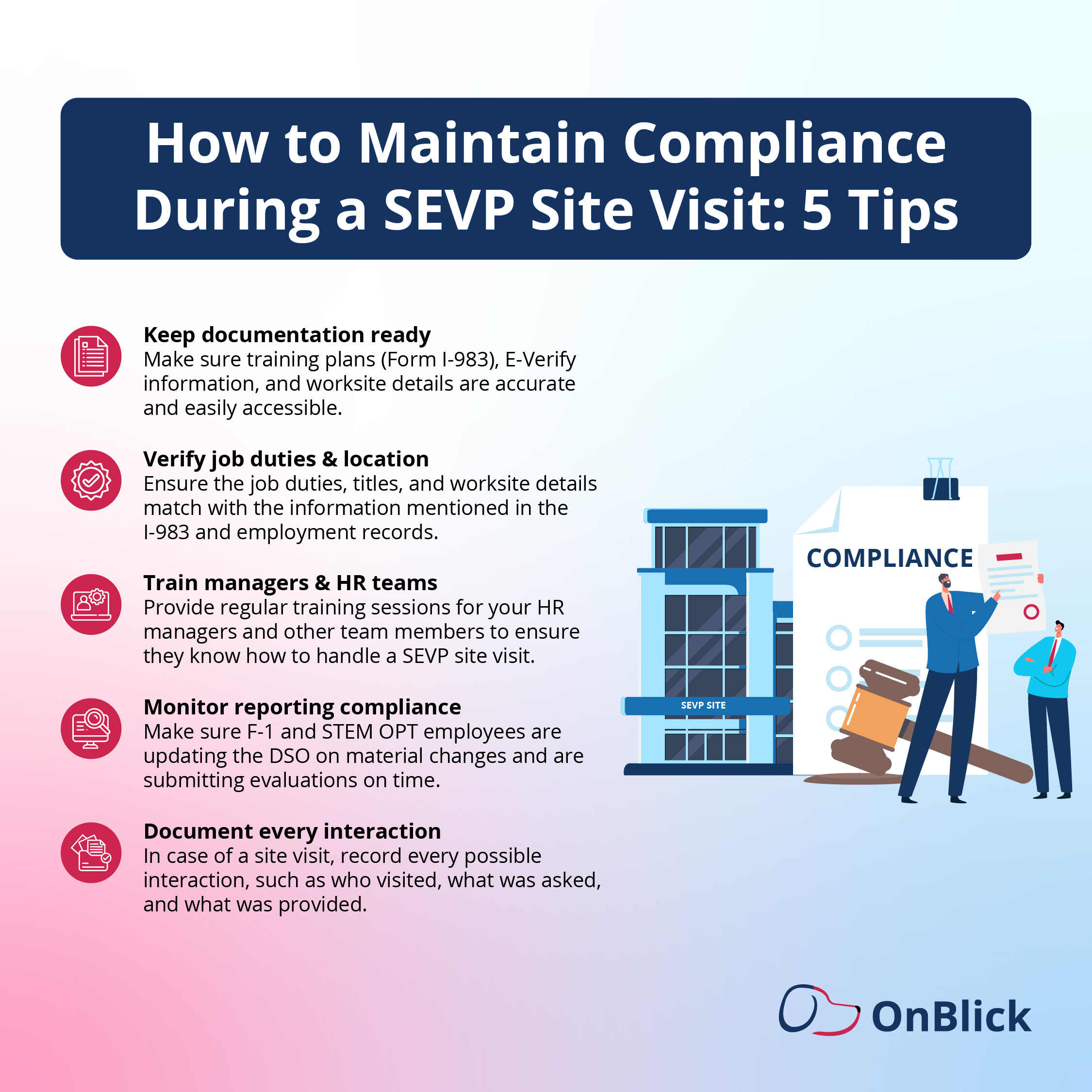
For STEM OPT employers, the most relevant compliance inspection is often the SEVP site visit. SEVP site visits are part of ICE’s compliance oversight for the STEM OPT program and are used to confirm whether the employer and student are following the requirements outlined in Form I-983. Officers may review the student’s job duties, training, supervision, documentation, compensation records, Form I-9 records, and evidence of changes in employment or training.
DHS also states in Form I-983 that it may conduct an employer site visit to ensure program requirements are being met, including whether the employer has the ability and resources to provide structured and guided work-based learning consistent with the training plan.
Here’s a guide on SEVP Site Visits for STEM OPT employers
During an SEVP site visit, employers should be prepared to explain the student’s role, work location, training structure, supervision model, and documentation trail. Supervisors and HR teams should also understand the Form I-983 commitments and be ready to explain how the company supports the student’s practical training.
.jpg)
What OPT Employers Should Review Now
Employers that currently hire OPT or STEM OPT workers should consider a focused internal review. This review should confirm whether the company’s records accurately reflect real employment practices.
Key areas to review include:
- Active OPT and STEM OPT employee lists
- Form I-983 records for STEM OPT workers
- Worksite and remote work details
- Supervisor names and reporting lines
- Job duties and degree relevance
- Payroll and compensation records
- Training evaluations and progress documentation
- Material changes reported to the DSO
- Third-party or client-site arrangements
- Employee termination or departure reporting
- Form I-9 and E-Verify records, where applicable
The goal is not to create unnecessary alarm. The goal is to ensure that legitimate employment can be proven through accurate, complete, and accessible documentation.
How Employers Can Prepare for an SEVP Site Visit or Agency Inquiry
Employers should be prepared to explain the student’s role, work location, training structure, and supervision model. They should also make sure the appropriate HR, immigration, payroll, and business managers understand their responsibilities.
A practical readiness checklist should include:
- Maintain updated Form I-983 records
- Keep supervisor information current
- Document training goals and evaluations
- Store payroll and employment records securely
- Confirm physical, remote, and client-site work locations
- Track material changes and reporting steps
- Keep records organized for quick retrieval
- Train managers who supervise STEM OPT employees
- Review high-risk arrangements before issues arise
Lyons made clear that ICE views the issue as an enforcement priority, stating, “DHS will relentlessly investigate, disrupt, and refer for prosecution anyone who exploits our programs”.
For compliant employers, the practical response is to strengthen documentation and reduce avoidable inconsistencies.
How OnBlick Helps Employers with STEM OPT Compliance
STEM OPT compliance requires more than completing a form. Employers must manage Form I-983 accurately, maintain documentation, track material changes, support student evaluations, and stay prepared for SEVP site visits or other compliance reviews. OnBlick helps employers bring these activities into a more structured and reliable workflow. With OnBlick, employers can simplify Form I-983 management by guiding teams through electronic completion, helping reduce documentation errors, and keeping training plan information more organized.
OnBlick’s support also extends to broader employment compliance workflows, including Form I-9, E-Verify, employee records, onboarding documents, LCA, PAF, H-1B coordination, and audit readiness. For employers managing international talent, this creates a more connected compliance record rather than relying on separate spreadsheets, email threads, and manual reminders.
To learn more about how we simplify STEM OPT compliance, book a free OnBlick demo
Final Thoughts
ICE’s recent STEM OPT fraud press conference signals closer attention to foreign student employment records, employer legitimacy, worksite accuracy, and training arrangements. While the agency’s comments focused on suspected fraud, the message for legitimate employers is clear.
STEM OPT compliance depends on accurate training plans, real supervision, proper worksite reporting, complete employment records, timely updates, and readiness for SEVP site visits. Employers that rely on scattered files, outdated records, or informal tracking may face unnecessary risk.
A proactive review now can help employers confirm that their OPT and STEM OPT records match actual employment practices and are ready for an agency inquiry, ICE/HSI worksite visit, SEVP site visit, or internal compliance check.
Frequently Asked Questions
1. What is the recent ICE press conference about OPT fraud?
ICE officials on May 12, 2026, said they identified more than 10,000 foreign students claiming employment with highly suspect employers among the top 25 OPT employers reviewed. The agency also described concerns involving false worksites, shell companies, phantom employees, offshore management, and missing employment records.
2. Is this update about OPT or STEM OPT?
The announcement focused on OPT broadly. However, it is highly relevant to STEM OPT employers because STEM OPT includes additional employer responsibilities, including Form I-983, formal training, supervision, reporting, and documentation obligations.
3. What is Form I-983?
Form I-983 is the Training Plan for STEM OPT Students. DHS guidance states that STEM OPT students and employers must work together to complete the form, which documents the training opportunity, supervision plan, and relationship between the job and the student’s STEM degree.
4. What are the biggest STEM OPT risks for employers?
Major risks include inaccurate worksite information, incomplete Form I-983 records, unclear supervision, unreported material changes, missing payroll or employment records, and third-party placement arrangements that do not clearly support the required training relationship.
5. Should employers review their STEM OPT records now?
Yes. Employers should review STEM OPT records to confirm that Form I-983 details, worksite information, supervisor details, job duties, payroll records, and reporting practices are accurate and current.
6. Are STEM OPT site visits the same as SEVP site visits?
In employer compliance discussions, STEM OPT site visits are generally referred to as SEVP site visits because they are connected to SEVP’s oversight of STEM OPT employer compliance. These visits help verify whether the employer and student are following the Form I-983 training plan and STEM OPT requirements.
7. What happens during an SEVP site visit?
During an SEVP site visit, officers may review the student’s Form I-983, job duties, supervision, worksite, compensation records, Form I-9, training progress, and documentation of changes in employment or training. Employers may also be asked to explain how the role relates to the student’s STEM degree.
8. Can SEVP site visits be unannounced?
Many SEVP site visits may involve advance notice, but ICE may conduct unannounced visits if there are compliance concerns. Employers should keep STEM OPT documentation organized and current so they are prepared for either situation.
9. What material changes should STEM OPT employers track?
Employers should track changes in job duties, supervisor information, worksite location, compensation, hours, employer information, training structure, and termination or departure. Material changes or deviations from the training plan may need to be reported to the DSO.
10. How can employers reduce STEM OPT compliance risk?
Employers can reduce risk by keeping Form I-983 accurate, maintaining complete employment and payroll records, documenting supervision and training progress, tracking material changes, preparing for SEVP site visits, and using a structured compliance system to manage deadlines, documentation, and follow-ups.